


Lay-delivered behavioral activation for depressed senior center clients: Pilot RCT
- PMID: 31368583
- PMCID: PMC6803033
- DOI: 10.1002/gps.5186
Lay-delivered behavioral activation for depressed senior center clients: Pilot RCT
Abstract
Objective: We describe the development of a lay-delivered behavioral intervention ("Do More, Feel Better") for depressed senior center clients, and we present preliminary data from a pilot randomized controlled trial (RCT) on (a) the feasibility of training lay volunteers to fidelity and (b) the acceptability, impact, and safety of the intervention.
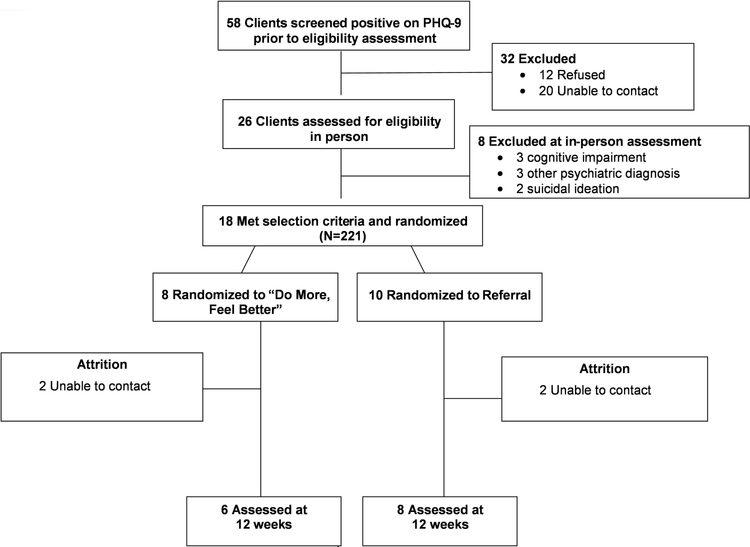
Methods: We trained 11 volunteers at two aging service settings in "Do More, Feel Better" and randomized 18 depressed clients to receive the intervention or referral to mental health services.
Results: Pilot data indicated that we can successfully train and certify 64% of older volunteers and that depressed clients receiving the intervention reported high levels of session attendance and satisfaction. While there were no significant differences in 12-week reduction in Hamilton Depression Rating Scale scores between groups, intervention clients showed an 8-point reduction in comparison with a 0-point reduction among referral clients.
Conclusions: "Do More, Feel Better" has the potential of transferring evidence-based behavioral interventions to the hands of supervised lay volunteers and can address the insufficient workforce providing geriatric mental health services.
Trial registration: ClinicalTrials.gov NCT02292849.
Keywords: aging service settings; behavioral activation; depression; geriatrics; lay health workers; task-sharing.
© 2019 John Wiley & Sons, Ltd.
Figures


References
-
- Eden J, Maslow K, Le M, Blazer D. The Mental Health and Substance Use Workforce for Older Adults: In Whose Hands? : National Academies Press; 2012. - PubMed
-
- Berman J, Furst L. Addressing the needs of depressed older New Yorkers: A public-private partnership: EASE-D and other interventions. Internal Report: NYC Department for the Aging 2014.
Publication types
MeSH terms
Associated data
Grants and funding
LinkOut - more resources
Full Text Sources
Medical
