Review
. 2019 Sep;11(9):e9854.
doi: 10.15252/emmm.201809854. Epub 2019 Aug 1.

From molecular promise to preclinical results: HDAC inhibitors in the race for healthy aging drugs

Affiliations
Review

From molecular promise to preclinical results: HDAC inhibitors in the race for healthy aging drugs

Rebecca L McIntyre et al. EMBO Mol Med. 2019 Sep.

Abstract

Reversing or slowing the aging process brings great promise to treat or prevent age-related disease, and targeting the hallmarks of aging is a strategy to achieve this. Epigenetics affects several if not all of the hallmarks of aging and has therefore emerged as a central target for intervention. One component of epigenetic regulation involves histone deacetylases (HDAC), which include the "classical" histone deacetylases (of class I, II, and IV) and sirtuin deacetylases (of class III). While targeting sirtuins for healthy aging has been extensively reviewed elsewhere, this review focuses on pharmacologically inhibiting the classical HDACs to promote health and longevity. We describe the theories of how classical HDAC inhibitors may operate to increase lifespan, supported by studies in model organisms. Furthermore, we explore potential mechanisms of how HDAC inhibitors may have such a strong grasp on health and longevity, summarizing their links to other hallmarks of aging. Finally, we show the wide range of age-related preclinical disease models, ranging from neurodegeneration to heart disease, diabetes to sarcopenia, which show improvement upon HDAC inhibition.

Keywords: HDAC inhibitors; epigenetics; geroprotector; hallmarks of aging; preclinical models.


Conflict of interest statement

The authors declare that they have no conflict of interest.

Figures
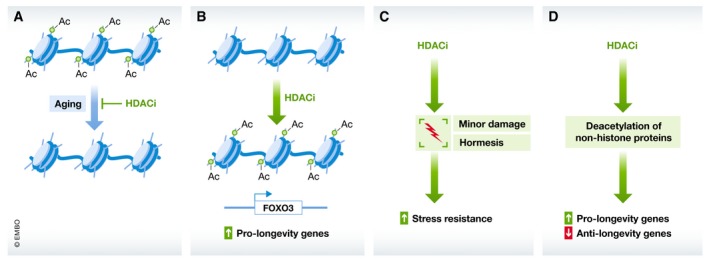
Figure 1
Figure 1. Potential models whereby HDAC inhibition (HDACi) extends lifespan
(A) HDACi may directly reverse age‐related deacetylation of chromatin, reverting the epigenome back to a more youthful state. (B) HDACi may result in acetylation of histones near pro‐longevity genes, increasing their transcription. (C) HDACi may act through a hormesis effect, causing low dose damage that activates stress resistance, resulting in a net benefit for the organism. (D) HDACi may target non‐histone proteins, activating pro‐longevity proteins, and/or de‐activating anti‐longevity proteins.
Figure 2
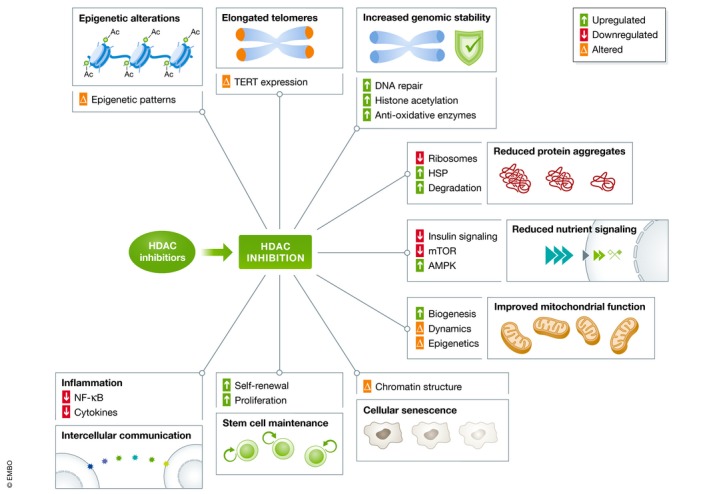
Figure 2. Influence of HDAC inhibition on the hallmarks of aging
HDAC inhibitors are listed as described in the text, along with evidence for the benefits they impart at the molecular level on the hallmarks of aging; epigenetic alterations, telomere attrition, genomic instability, loss of proteostasis, deregulated nutrient sensing, mitochondrial dysfunction, cellular senescence, stem cell exhaustion, and altered intercellular communication, and up‐ or downregulated processes are generally in line with beneficial changes for the health of the organism, while altered changes are indicative of potential synergies and interactions.
Figure 3
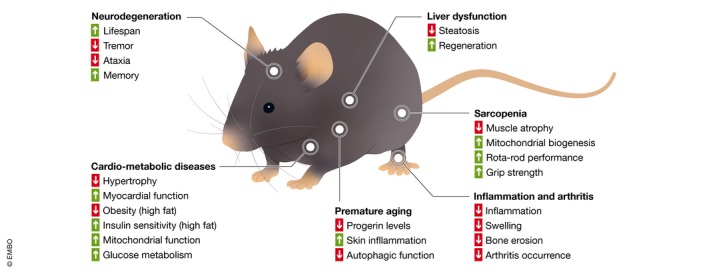
Figure 3. Benefits of HDAC inhibitors in preclinical models
HDAC inhibition benefits a large variety of preclinical models, including those related to neurodegeneration, cardio‐metabolic deficiencies, liver dysfunctions, sarcopenia, inflammation‐related disease, and diseases of premature aging. Specifics of improvements in each condition are described in the text.

References

    1. Adcock IM (2007) HDAC inhibitors as anti‐inflammatory agents. Br J Pharmacol 150: 829–831 - PMC - PubMed
    1. Andreux PA, Houtkooper RH, Auwerx J (2013) Pharmacological approaches to restore mitochondrial function. Nat Rev Drug Discov 12: 465–483 - PMC - PubMed
    1. Arancio W, Pizzolanti G, Genovese SI, Pitrone M, Giordano C (2014) Epigenetic involvement in Hutchinson‐Gilford progeria syndrome: a mini‐review. Gerontology 60: 197–203 - PubMed
    1. Bandyopadhyay D, Curry JL, Lin Q, Richards HW, Chen D, Hornsby PJ, Timchenko NA, Medrano EE (2007) Dynamic assembly of chromatin complexes during cellular senescence: implications for the growth arrest of human melanocytic nevi. Aging Cell 6: 577–591 - PMC - PubMed
    1. Beharry AW, Sandesara PB, Roberts BM, Ferreira LF, Senf SM, Judge AR (2014) HDAC1 activates FoxO and is both sufficient and required for skeletal muscle atrophy. J Cell Sci 127: 1441–1453 - PMC - PubMed

Publication types

MeSH terms

Substances