


Antibiotic- and Fluid-Focused Bundles Potentially Improve Sepsis Management, but High-Quality Evidence Is Lacking for the Specificity Required in the Centers for Medicare and Medicaid Service's Sepsis Bundle (SEP-1)
- PMID: 31369426
- PMCID: PMC10802116
- DOI: 10.1097/CCM.0000000000003892
Antibiotic- and Fluid-Focused Bundles Potentially Improve Sepsis Management, but High-Quality Evidence Is Lacking for the Specificity Required in the Centers for Medicare and Medicaid Service's Sepsis Bundle (SEP-1)
Abstract
Objective: To address three controversial components in the Centers for Medicare and Medicaid Service's sepsis bundle for performance measure (SEP-1): antibiotics within 3 hours, a 30 mL/kg fluid infusion for all hypotensive patients, and repeat lactate measurements within 6 hours if initially elevated. We hypothesized that antibiotic- and fluid-focused bundles like SEP-1 would probably show benefit, but evidence supporting specific antibiotic timing, fluid dosing, or serial lactate requirements would not be concordant. Therefore, we performed a meta-analysis of studies of sepsis bundles like SEP-1.
Data sources: PubMed, Embase, ClinicalTrials.gov through March 15, 2018.
Study selection: Studies comparing survival in septic adults receiving versus not receiving antibiotic- and fluid-focused bundles.
Data extraction: Two investigators (D.J.P., P.Q.E.).
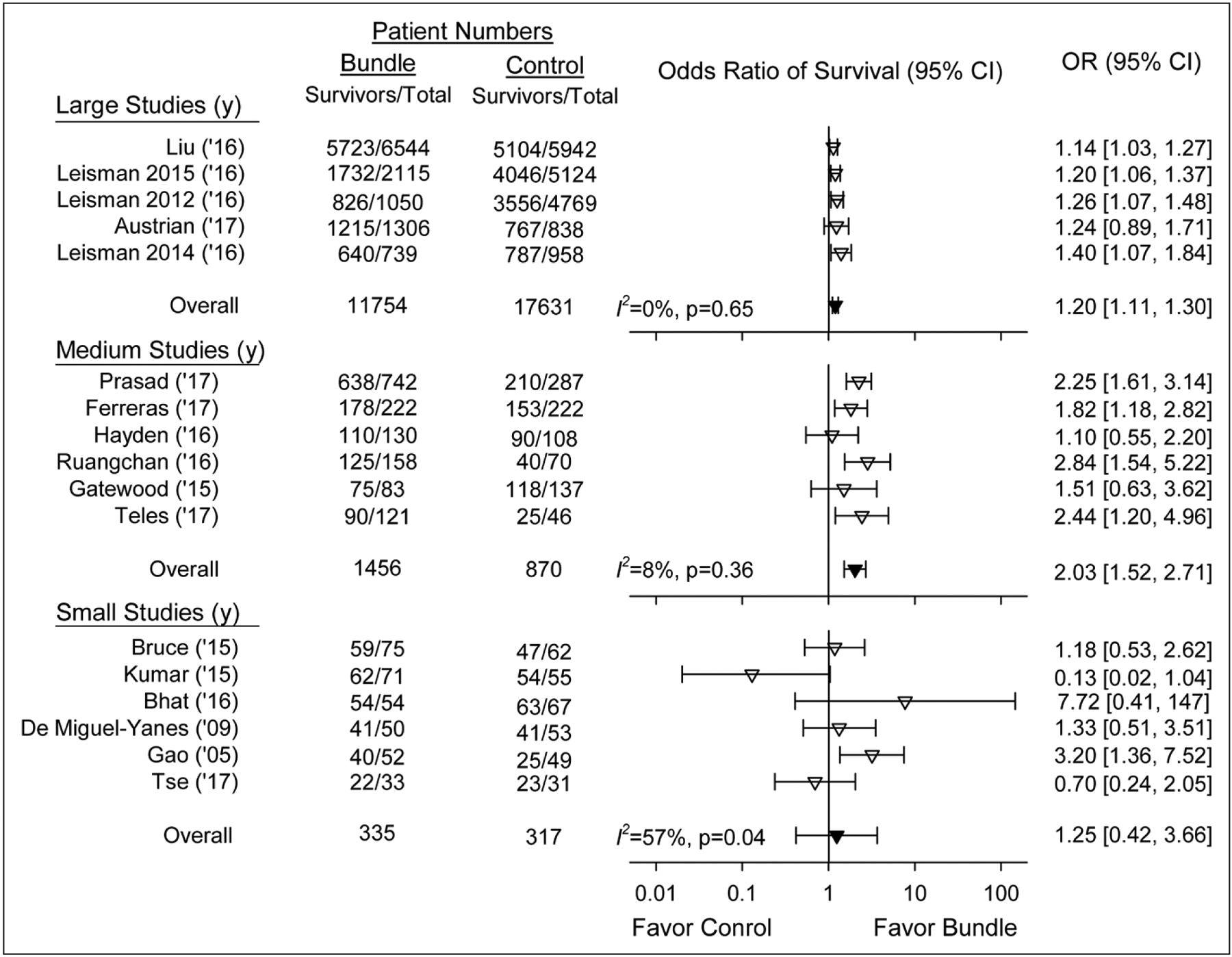
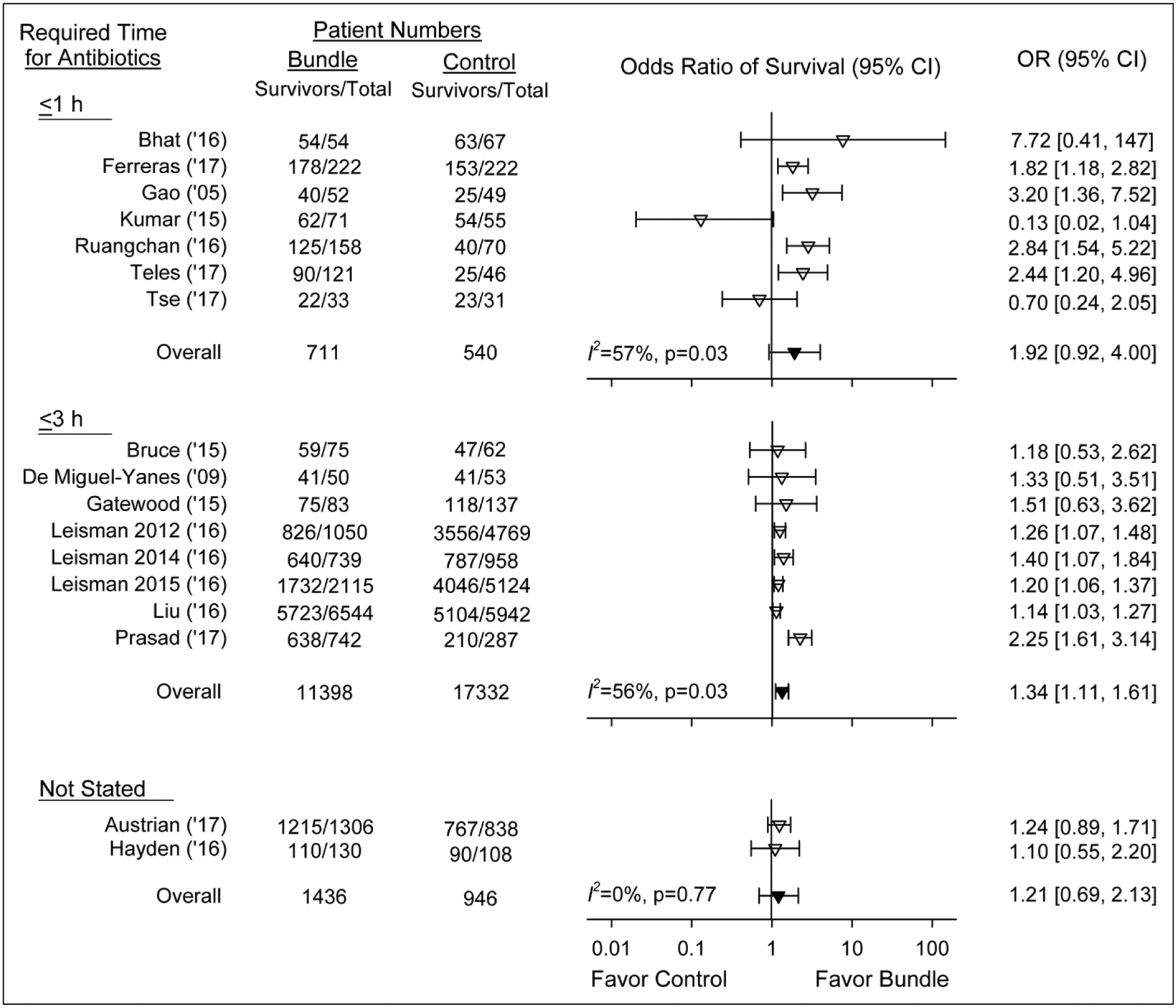
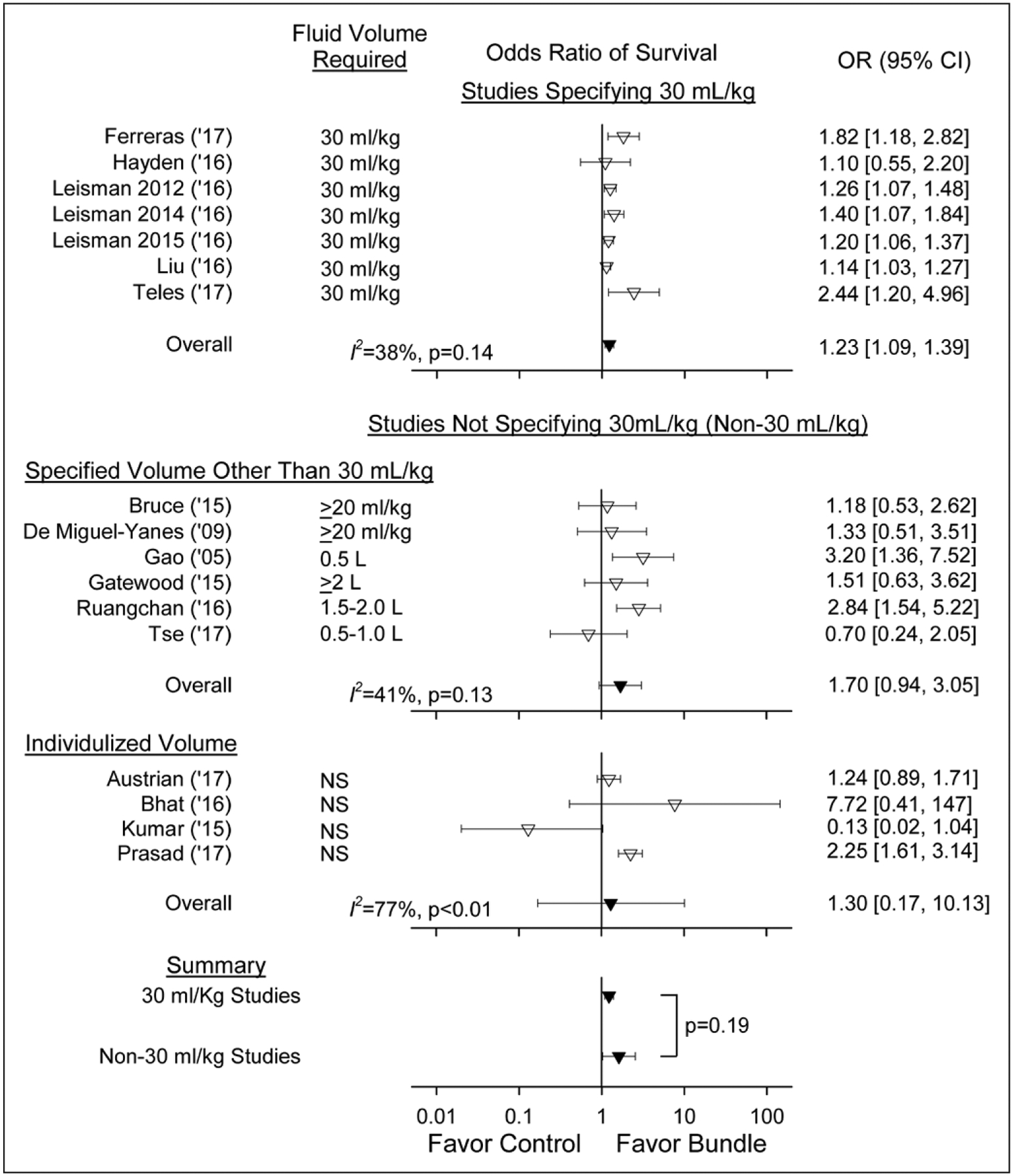
Data synthesis: Seventeen observational studies (11,303 controls and 4,977 bundle subjects) met inclusion criteria. Bundles were associated with increased odds ratios of survival (odds ratio [95% CI]) in 15 studies with substantial heterogeneity (I = 61%; p < 0.01). Survival benefits were consistent in the five largest (1,697-12,486 patients per study) (1.20 [1.11-1.30]; I = 0%) and six medium-sized studies (167-1,029) (2.03 [1.52-2.71]; I = 8%) but not the six smallest (64-137) (1.25 [0.42-3.66]; I = 57%). Bundles were associated with similarly increased survival benefits whether requiring antibiotics within 1 hour (n = 7 studies) versus 3 hours (n = 8) versus no specified time (n = 2); or 30 mL/kg fluid (n = 7) versus another volume (≥ 2 L, n = 1; ≥ 20 mL/kg, n = 2; 1.5-2 L or 500 mL, n = 1 each; none specified, n = 4) (p = 0.19 for each comparison). In the only study employing serial lactate measurements, survival was not increased versus others. No study had a low risk of bias or assessed potential adverse bundle effects.
Conclusions: Available studies support the notion that antibiotic- and fluid-focused sepsis bundles like SEP-1 improve survival but do not demonstrate the superiority of any specific antibiotic time or fluid volume or of serial lactate measurements. Until strong reproducible evidence demonstrates the safety and benefit of any fixed requirement for these interventions, the present findings support the revision of SEP-1 to allow flexibility in treatment according to physician judgment.
Figures
Comment in
-
Implementation of Sepsis Bundles: Just Do It!!Crit Care Med. 2019 Oct;47(10):1450-1451. doi: 10.1097/CCM.0000000000003941. Crit Care Med. 2019. PMID: 31524692 No abstract available.
References
-
- Quality Reporting Center: SEP-1 Early Management Bundle, Severe Sepsis/Septic Shock: v5.4 Measure Updates. Available at: https://www.qualityreportingcenter.com/event/sep-1-early-management-bund.... Accessed December 4, 2018
-
- Version 5.2 The Joint Commission: Specifications Manual for National Hospital Inpatient Quality Measures. Available at: www.jointcommission.org/specifications_manual_for_national_hospital_inpa.... Accessed December 4, 2018
-
- Version 5.3 The Joint Commission: Specifications Manual for National Hospital Inpatient Quality Measures. Available at: www.jointcom-mission.org/specifications_manual_for_national_hospital_inp.... Accessed December 4, 2018
-
- Version 5.4 The Joint Commission: Specifications Manual for National Hospital Inpatient Quality Measures. Available at: www.jointcommission.org/specifications_manual_for_national_hospital_inpa.... Accessed December 4, 2018
-
- Klompas M, Rhee C: The CMS sepsis mandate: Right disease, wrong measure. Ann Intern Med 2016; 165:517–518 - PubMed
Publication types
MeSH terms
Substances
Grants and funding
LinkOut - more resources
Full Text Sources
Medical
Miscellaneous
