


Inhibiting Acetylcholinesterase to Activate Pleiotropic Prodrugs with Therapeutic Interest in Alzheimer's Disease
- PMID: 31370232
- PMCID: PMC6696315
- DOI: 10.3390/molecules24152786
Inhibiting Acetylcholinesterase to Activate Pleiotropic Prodrugs with Therapeutic Interest in Alzheimer's Disease
Abstract
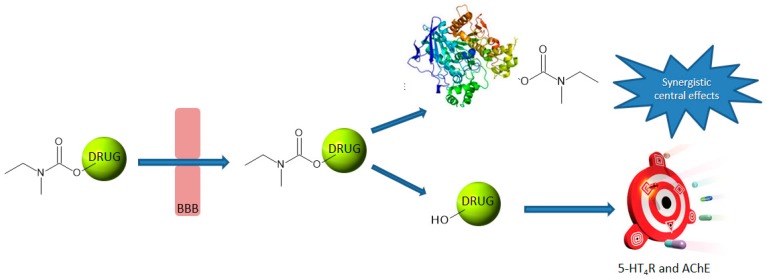
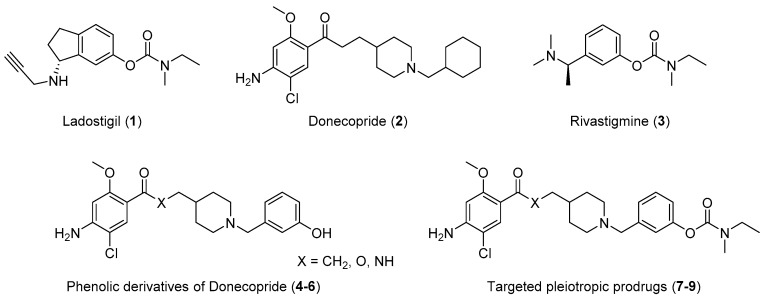
Alzheimer's disease (AD) is a multifactorial neurodegenerative disease which is still poorly understood. The drugs currently used against AD, mainly acetylcholinesterase inhibitors (AChEI), are considered clinically insufficient and are responsible for deleterious side effects. AChE is, however, currently receiving renewed interest through the discovery of a chaperone role played in the pathogenesis of AD. But AChE could also serve as an activating protein for pleiotropic prodrugs. Indeed, inhibiting central AChE with brain-penetrating designed carbamates which are able to covalently bind to the enzyme and to concomitantly liberate active metabolites in the brain could constitute a clinically more efficient approach which, additionally, is less likely to cause peripheral side effects. We aim in this article to pave the road of this new avenue with an in vitro and in vivo study of pleiotropic prodrugs targeting both the 5-HT4 receptor and AChE, in order to display a neuroprotective activity associated with a sustained restoration of the cholinergic neurotransmission and without the usual peripheral side effects associated with classic AChEI. This plural activity could bring to AD patients effective, relatively safe, symptomatic and disease-modifying therapeutic benefits.
Keywords: 5-HT4 receptors; Alzheimer’s disease; MTDL; acetylcholinesterase; prodrug.
Conflict of interest statement
The authors declare no conflict of interest.
Figures


References
-
- Zueva I., Dias J., Lushchekina S., Semenov V., Mukhamedyarov M., Pashirova T., Babaev V., Nachon F., Petrova N., Nurullin L., et al. New evidence for dual binding site inhibitors of acetylcholinesterase as improved drugs for treatment of Alzheimer’s disease. Neuropharmacology. 2019;155:131–141. doi: 10.1016/j.neuropharm.2019.05.025. - DOI - PubMed
-
- ClinicalTrials.gov. [(accessed on 8 July 2019)]; Available online: https://clinicaltrials.gov/
-
- Lecoutey C., Hedou D., Freret T., Giannoni P., Gaven F., Since M., Bouet V., Ballandonne C., Corvaisier S., Malzert Freon A., et al. Design of donecopride, a dual serotonin subtype 4 receptor agonist/acetylcholinesterase inhibitor with potential interest for Alzheimer’s disease treatment. Proc. Natl. Acad. Sci. USA. 2014;111:E3825–E3830. doi: 10.1073/pnas.1410315111. - DOI - PMC - PubMed
-
- Rochais C., Lecoutey C., Gaven F., Giannoni P., Hamidouche K., Hedou D., Dubost E., Genest D., Yahiaoui S., Freret T., et al. Novel multitarget-directed ligands (MTDLs) with acetylcholinesterase (AChE) inhibitory and serotonergic subtype 4 receptor (5-HT4R) agonist activities as potential agents against Alzheimer’s disease: The design of donecopride. J. Med. Chem. 2015;58:3172–3187. doi: 10.1021/acs.jmedchem.5b00115. - DOI - PubMed
MeSH terms
Substances
Grants and funding
LinkOut - more resources
Full Text Sources
Other Literature Sources
Medical
