


Synergistic Effects of Climate Change and Marine Pollution: An Overlooked Interaction in Coastal and Estuarine Areas
- PMID: 31370308
- PMCID: PMC6696450
- DOI: 10.3390/ijerph16152737
Synergistic Effects of Climate Change and Marine Pollution: An Overlooked Interaction in Coastal and Estuarine Areas
Abstract
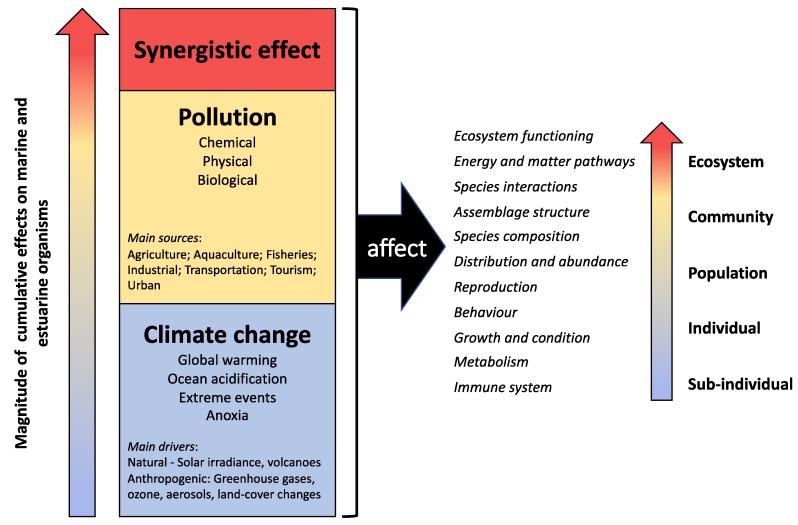
Coastal areas have been increasingly affected by human activities, marine pollution and climate change are among the most important pressures affecting these environments. Human-induced pressures occur in a cumulative way and generate additive, antagonistic or synergistic effects. Knowledge on synergistic effects is crucial to coastal zone management, since they may imply a change in human uses of these systems, as well as dedicated action plans in order to reduce hazards and environmental risks. In this work, we provide an overview of the available literature on synergistic effects between climate change and chemical pollution, and discuss current knowledge, methodological approaches, and research gaps and needs. Interactions between these two pressures may be climate change dominant (climate change leads to an increase in contaminant exposure or toxicity) or contaminant-dominant (chemical exposure leads to an increase in climate change susceptibility), but the mechanistic drivers of such processes are not well known. Results from a few meta-analyses studies and reviews showed that synergistic interactions tend to be more frequent compared to additive and antagonistic ones. However, most of the studies are individual-based and assess the cumulative effects of a few contaminants individually in laboratory settings together with few climate variables, particularly temperature and pH. Nevertheless, a wide diversity of contaminants have already been individually tested, spanning from metals, persistent organic pollutants and, more recently, emergent pollutants. Population and community based approaches are less frequent but have generated very interesting and more holistic perspectives. Methodological approaches are quite diverse, from laboratory studies to mesocosm and field studies, or based on statistical or modelling tools, each with their own potential and limitations. More holistic comparisons integrating several pressures and their combinations and a multitude of habitats, taxa, life-stages, among others, are needed, as well as insights from meta-analyses and systematic reviews.
Keywords: biological effects; coastal zones; contaminants; global change; interactions; literature review; methodological approaches; synergistic effects.
Conflict of interest statement
The authors declare no conflict of interest.
Figures
References
-
- Barbier E.B., Hacker S.D., Kennedy C., Koch E.W., Stier A.C., Silliman B.R. The value of estuarine and coastal ecosystem services. Ecol. Monogr. 2011;81:169–193. doi: 10.1890/10-1510.1. - DOI
-
- Costanza R., d’Arge R., de Groot R., Farber S., Grasso M., Hannon B., Limburg K., Naeem S., O’Neill R.V., Paruelo J., et al. The value of the world’s ecosystem services and natural capital. Nature. 1997;387:253–260. doi: 10.1038/387253a0. - DOI
-
- Díaz S., Settele J., Brondízio E., Ngo H.T., Guèze M., Agard J., Arneth A., Balvanera P., KBrauman K., Butchart S., et al. Summary for Policymakers of the Global Assessment Report on Biodiversity and Ecosystem Services of the Intergovernmental Science-Policy Platform on Biodiversity and Ecosystem Services. Global assessment; Bonn, Germany: 2019. p. 39.
-
- IPCC . Climate Change 2013: The Physical Science Basis. Contribution of the Working Group I to the Fifth Assessment Report of the Intergovernmental Panel on Climate Change. IPCC; Cambridge, MA, USA: 2013. p. 1535.
Publication types
MeSH terms
LinkOut - more resources
Full Text Sources
Medical
