


Dysregulated Irritability as a Window on Young Children's Psychiatric Risk: Transdiagnostic Effects via the Family Check-Up
- PMID: 31370913
- PMCID: PMC7279524
- DOI: 10.1017/S0954579419000816
Dysregulated Irritability as a Window on Young Children's Psychiatric Risk: Transdiagnostic Effects via the Family Check-Up
Abstract
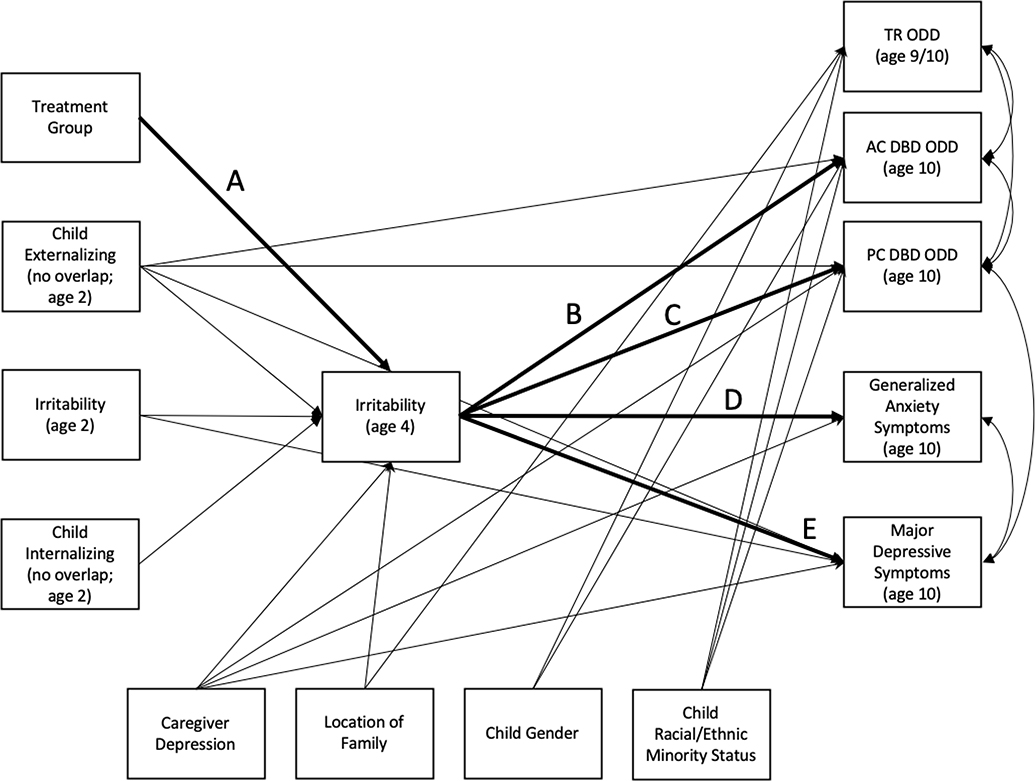
Building on prior work using Tom Dishion's Family Check-Up, the current article examined intervention effects on dysregulated irritability in early childhood. Dysregulated irritability, defined as reactive and intense response to frustration, and prolonged angry mood, is an ideal marker of neurodevelopmental vulnerability to later psychopathology because it is a transdiagnostic indicator of decrements in self-regulation that are measurable in the first years of life that have lifelong implications for health and disease. This study is perhaps the first randomized trial to examine the direct effects of an evidence- and family-based intervention, the Family Check-Up (FCU), on irritability in early childhood and the effects of reductions in irritability on later risk of child internalizing and externalizing symptomatology. Data from the geographically and sociodemographically diverse multisite Early Steps randomized prevention trial were used. Path modeling revealed intervention effects on irritability at age 4, which predicted lower externalizing and internalizing symptoms at age 10.5. Results indicate that family-based programs initiated in early childhood can reduce early childhood irritability and later risk for psychopathology. This holds promise for earlier identification and prevention approaches that target transdiagnostic pathways. Implications for future basic and prevention research are discussed.
Keywords: Family Check-Up; early childhood; irritability; mental health; parent training; prevention; transdiagnostic.
Figures
References
-
- Achenbach TM, & Rescorla LA (2001). Manual for the ASEBA school-age forms and profiles. Burlington, VT: University of Vermont, Research Center for Children, Youth, & Families.
-
- American Psychiatric Association. (2000). Diagnostic and statistical manual of mental disorders, text revision (4th ed.). Washington, DC: American Psychiatric Publishing.
-
- American Psychiatric Association. (2013). Diagnostic and statistical manual of mental disorders (5th ed.). Arlington, VA: American Psychiatric Publishing.
-
- Barlow A, Mullany B, Neault N, Compton S, Carter A, Hastings R, …Walkup JT (2013). Effect of a paraprofessional home-visiting intervention on American Indian teen mothers’ and infants’ behavioral risks: A randomized controlled trial. American Journal of Psychiatry, 170(1), 83–93. doi:10.1176/appi.ajp.2012.12010121 - DOI - PMC - PubMed
-
- Barlow A, Mullany B, Neault N, Goklish N, Billy T, Hastings R, …Walkup JT (2015). Paraprofessional-delivered home-visiting intervention for American Indian teen mothers and children: 3-Year outcomes from a randomized controlled trial. American Journal of Psychiatry, 172(2), 154–162. doi:10.1176/appi.ajp.2014.14030332 - DOI - PubMed
Publication types
MeSH terms
Grants and funding
LinkOut - more resources
Full Text Sources
Medical
