. 2019 Aug 1;9(1):11171.
doi: 10.1038/s41598-019-47549-y.

Establishment of an RNA polymerase II-driven reverse genetics system for Nipah virus strains from Malaysia and Bangladesh

Affiliations

Establishment of an RNA polymerase II-driven reverse genetics system for Nipah virus strains from Malaysia and Bangladesh

Bryan D Griffin et al. Sci Rep. .

Abstract

Nipah virus (NiV) has emerged as a highly lethal zoonotic paramyxovirus that is capable of causing a febrile encephalitis and/or respiratory disease in humans for which no vaccines or licensed treatments are currently available. There are two genetically and geographically distinct lineages of NiV: NiV-Malaysia (NiV-M), the strain that caused the initial outbreak in Malaysia, and NiV-Bangladesh (NiV-B), the strain that has been implicated in subsequent outbreaks in India and Bangladesh. NiV-B appears to be both more lethal and have a greater propensity for person-to-person transmission than NiV-M. Here we describe the generation and characterization of stable RNA polymerase II-driven infectious cDNA clones of NiV-M and NiV-B. In vitro, reverse genetics-derived NiV-M and NiV-B were indistinguishable from a wildtype isolate of NiV-M, and both viruses were pathogenic in the Syrian hamster model of NiV infection. We also describe recombinant NiV-M and NiV-B with enhanced green fluorescent protein (EGFP) inserted between the G and L genes that enable rapid and sensitive detection of NiV infection in vitro. This panel of molecular clones will enable studies to investigate the virologic determinants of henipavirus pathogenesis, including the pathogenic differences between NiV-M and NiV-B, and the high-throughput screening of candidate therapeutics.


Conflict of interest statement

The authors declare no competing interests.

Figures
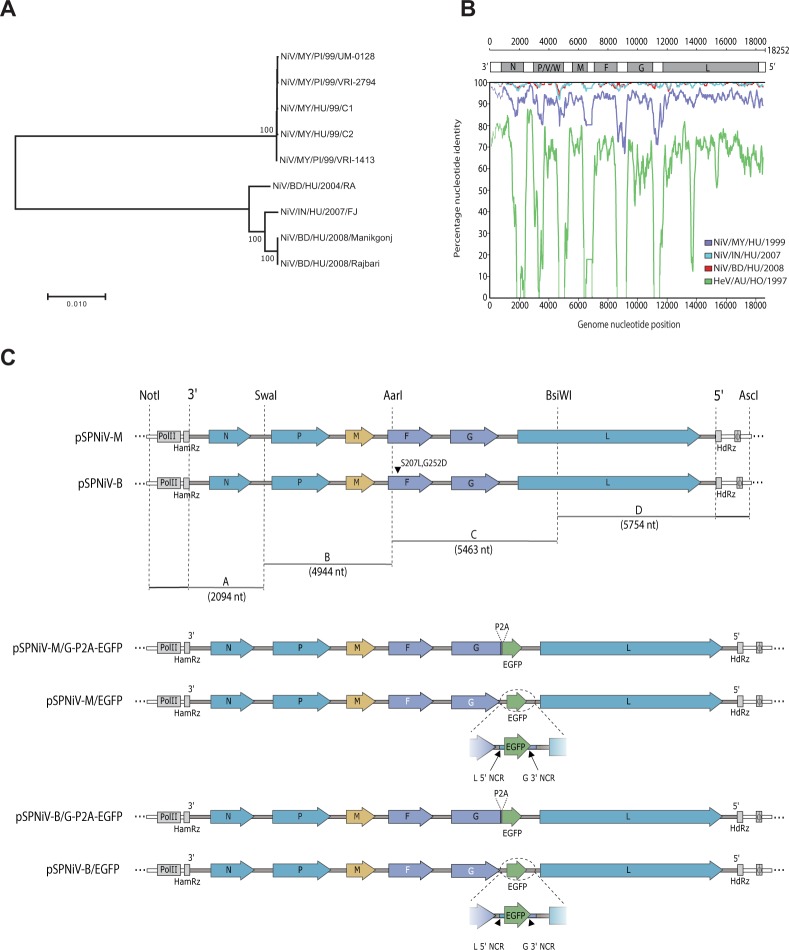
Figure 1
Figure 1
Design and generation of reverse genetics-derived NiV. (A) A phylogenetic tree based on full-length genomic sequences of various NiV. Sequence alignment was performed with ClustalW, using the MEGA Version 7.0 software package. The trees were constructed using the neighbor-joining algorithm with 1000 bootstrap replicates. The reproducibility of relevant nodes is shown as percentages. GenBank accession numbers for each sequence are listed below. The tree is drawn to scale, with branch lengths corresponding to the evolutionary distances used to infer the phylogenetic tree. (B) Similarity plot of nucleotide genome alignment using NiV/BD/HY/2004/RA as the query sequence were generated with Simplot v 3.5.1. Prior to the analysis genome sequences were aligned with the Clustal Omega version 1.2.4. After gaps were stripped the alignment comprised 18, 246 nucleotides (nt) and was assessed using a window of 500 nt and a step of 50 nt. The strains included were NiV/IN/HU/2007/FJ (blue), NiV/BD/HU/2008/Manikgonj (red), NiV/MY/HU/99/C2 (purple), and HeV/AU/HO/1997(green). (C) Schematic depictions of the constructed full-length cDNA expression constructs, pSPNiV-M, pSPNiV-B, and the recombinant NiV EGFP-expressing constructs, pSPNiV-M/G-P2A-EGFP, pSPNiV-M/EGFP, pSPNiV-B/G-P2A-EGFP, and pSPNiV-B/EGFP are shown. Non-coding regions and untranslated regions are depicted as narrow rectangles, and coding regions are represented as arrows with their respective gene names (N, P, M, F, G, and L) and are grouped by colour (blue: transcriptase complex, yellow: matrix protein, purple: attachment and fusion glycoproteins, green: inserted enhanced green fluorescent protein, EGFP). The dashed vertical lines indicate the unique restriction sites used to assemble the 4 cDNA fragments (AD) that spanned each genome. The two mutations (S207L and G252D) introduced into the fusion protein of the pSPNiV-B are indicated with a black arrowhead. Additional structural features included are polII, the CMV promoter sequence for RNA polymerase II; HamRz, hammerhead ribozyme sequence; HdRz, hepatitis delta virus ribozyme; ϕ, beta globin transcription terminator; 3′, 3′ leader; 5′, 5′ leader; and P2A, porcine teschovirus 2A protease cleavage peptide-encoding sequence. The following short-forms were used in the strain names: MY, Malaysia; BD, Bangladesh; IN, India; HO, horse; PI, pig; HU, human; BA, bat. The GenBank accession numbers for the strains used include: NV/MY/PI/99/UM-0128 (AJ564623), NV/MY/PI/99/VRI-2794 (AJ564621), NiV/MY/HU/99/C1 (AY029767), NiV/MY/HU/1999/C2 (AY029768), NiV/MY/PI/99/VRI-1413 (AJ564622), NiV/BD/HU/2004/RA (AY988601), NiV/IN/HU/2007/FJ (FJ513078), NiV/BD/HU/2008/Manikgonj (JN808857), NiV/BD/HU/2008/Rajbari (JN808863), and HeV/AU/HO/1997 (AF017149.3).
Figure 2
Figure 2
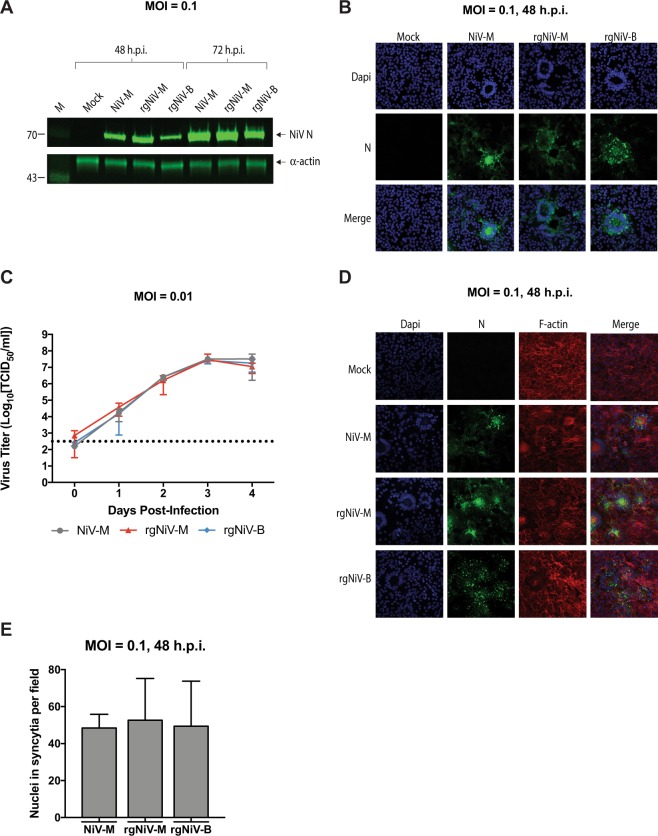
Characterization of reverse-genetics derived NiVs. (A) Western blot analysis of the NiV nucleoprotein (N) from infected cell lysates. Vero E6 cells were mock-infected, infected with NiV-M isolate, rgNiV-M, or rgNiV-B (MOI = 0.1), and lysates were harvested 48 hours later. Lysates were subjected to SDS-PAGE followed by Western blotting and were probed a monoclonal antibody against the N protein of NiV-M. α-actin served as a loading control. The lysates were run on duplicate SDS-PAGE gels and the respective Western blots were stained for NiV N or α-actin. Protein standards are in lane 1 and the band sizes are indicated in kilodaltons. (B) Immunofluorescence analysis of Vero E6 cells that were mock-infected, infected with NiV-M, rgNiV-M, or rgNiV-B. Cells were fixed 48 hours after infection and were subsequently stained with monoclonal antibody against the N protein and visualized by confocal microscopy. (C) Growth kinetics of NiV-M and reverse genetics-derived NiV. Vero E6 cells were infected with NiV-M, rgNiV-M, or rgNiV-B at an MOI of 0.01. Supernatants were collected at the indicated days post-infection and titrated by standard TCID50 analysis in VeroE6 cells. The mean and standard deviations from three biological replicates are shown. The dashed line indicates the limit of detection for the assay. (D) Fusogenicity of wildtype NiV-M and reverse-genetics derived NiVs. Vero E6 cells were mock-infected, infected with NiV-M, rgNiV-M, rgNiV-B (MOI = 0.1) and cells were fixed 48 hours later. To reveal the presence of infected cells with multinucleated syncytia, fixed cells were stained with Mab against the N protein (green), phalloidin to detect F-actin (red), allowing for the demarcation of individual cells, and DAPI to detect nuclei (blue). (E) Cells with three or more nuclei within an N protein positive cell were counted in five different fields (magnification, x40) per treatment. Bars indicate mean values and error bars indicate s.d. Scale bars, 2 mm in b and d. Statistical differences were not significant as determined by the student T test (p > 0.05). The limit of detection for the TCID50 assays was 102.5 TCID/ml.
Figure 3
Figure 3
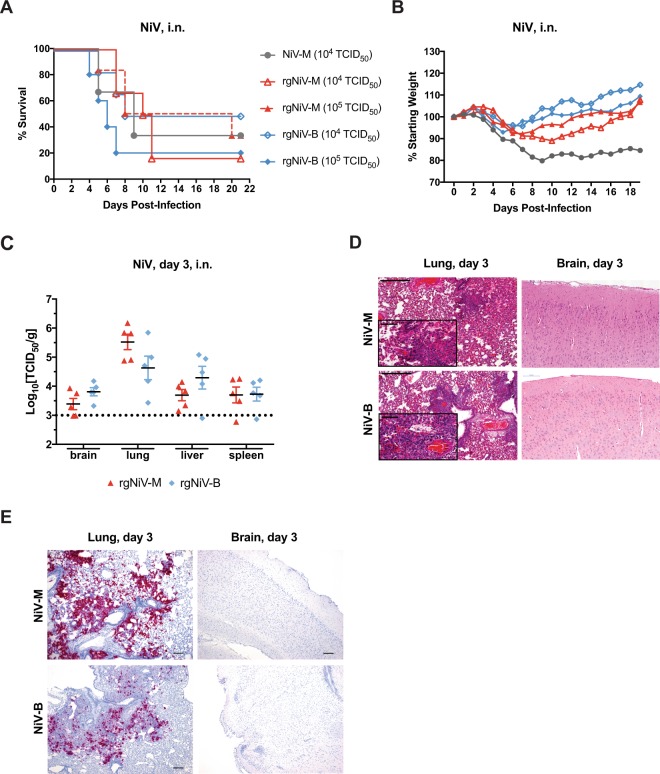
NiV infection of Syrian hamsters. Groups of five-to-six-week week-old female hamsters were inoculated with 1 × 104 or 1 × 105 TCID50 of rgNiV-M (n = 6), 1 × 104 or 1 × 105 TCID50 rgNiV-B (n = 6) or 1 × 104 TCID50 NiV-M (n = 3) by the intranasal route (i.n.). Hamsters were observed daily to assess the clinical signs and survival. The results from two separate experiments were pooled, and the Kaplan-Meier curves representing survival data (A) and the weight loss (B) represent combined data. The log rank test of the Kaplan-Meier curves yielded P values greater than 0.05 and were not significant. At day three post-infection, the indicated tissues were harvested, weighed, homogenized, and analyzed by TCID50 assay (C). Histopathological analysis (H&E staining) of the lung and brain (D) were performed. Areas of hemorrhage and infiltration of inflammatory cells are shown. Evaluation of lung and brain tissue samples for the presence of NiV target RNA using in situ hybridization by RNAScope assay (E). Multifocal areas of intense viral RNA staining in a lung section (red, left panels). Brain sections were negative for the presence of viral RNA (right panels). Scale bars, 500 µM (D), 50 µM (inserts) (D), and 200 µm (E). The limit of detection for both TCID50 assays was 103 TCID50/g.
Figure 4
Figure 4
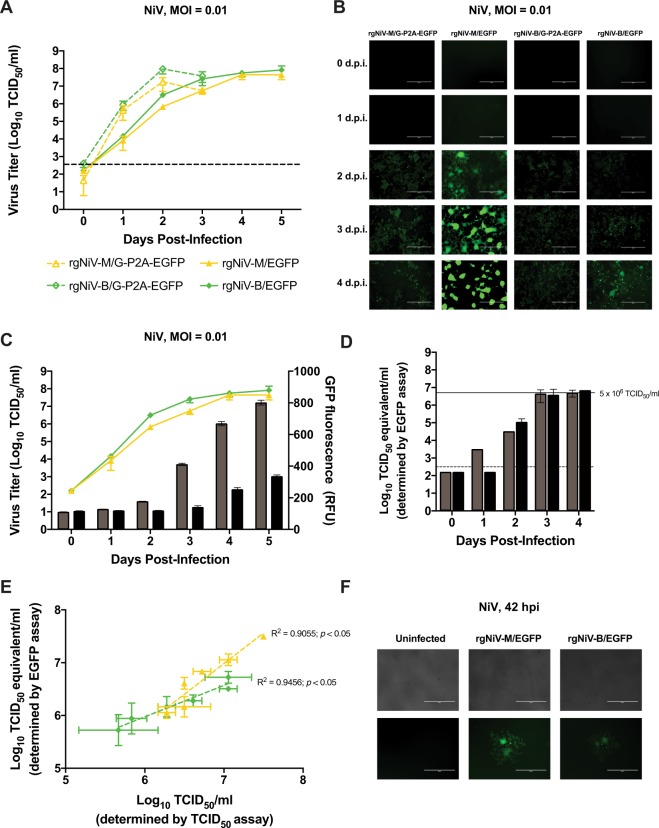
Characterization of recombinant, EGFP-expressing NiVs. (A) Growth kinetics of recombinant NiV expressing EGFP. Vero E6 cells were infected with rgNiV-M/G-P2A-EGFP, rgNiV-M/EGFP, rgNiV-B/G-P2A-EGFP, or rgNiV-B/EGFP at an MOI of 0.01. Supernatants were collected at the indicated days post-infection and titrated by standard TCID50 analysis in VeroE6 cells. The mean and standard deviation from three biological replicates are shown. The dashed line indicates the limit of detection for the assay. (B) Epifluorescence microscopy of cells infected with EGFP-expressing NiVs. Vero E6 cells were infected with rgNiV-M/G-P2A-EGFP, rgNiV-M/EGFP, rgNiV-B/G-P2A-EGFP, or rgNiV-B/EGFP at an MOI of 0.01 and representative images were taken of EGFP expression. (C) Quantification of EGFP expression in rgNiV-M/EGFP or rgNiV-B/EGFP-infected cells. EGFP activity resulting from the infection of Vero E6 cells with rgNiV-M/EGFP (grey bars) or rgNiV-B/EGFP (black bars) at a MOI of 0.01 was measured daily for five days using a fluorescence-based microplate reader and plotted against viral titer in rgNiV-M/EGFP (yellow line or rgNiV-B/EGFP-infected supernatants (green line), as described above (same viral titer data as panel A). (D) EGFP-based TCID50 assay. A TCID50 assay using EGFP as a readout was carried out on rgNiV-M/EGFP (grey bars) or rgNiV-B/EGFP samples (black bars) of known concentration diluted to 5 × 106 TCID50/ml, indicated by a solid line. Fluorescence foci were identified on the indicated days post-infection and the TCID50/ml equivalent titers of the input were calculated. The dashed line indicates the limit of detection for the assay. Bars indicate mean values and error bars indicate s.d. from four replicates. (E) Comparison of EGFP-based titration assay and conventional TCID50 assay. Samples containing two-fold dilutions of rgNiV-M/EGFP (yellow line) or rgNiV-B/EGFP (green line) were titrated in duplicate by the EGFP-based titration assay at three dpi and a conventional TCID50 assay at five dpi and were plotted on the same graph. The dashed line indicates the line of best fit, and the R2 value is given. (F) Fluorescence foci in rgNiV-M/EGFP or rgNiV-B/EGFP-infected cells. Vero E6 cells were mock-infected or infected with the respective viruses at an MOI of 0.01 and representative images were taken of EGFP expression at 48 hpi. Bars indicate mean values and error bars indicate sd. The limit of detection for the TCID50 assays was 102.5 TCID/ml.
Figure 5
Figure 5
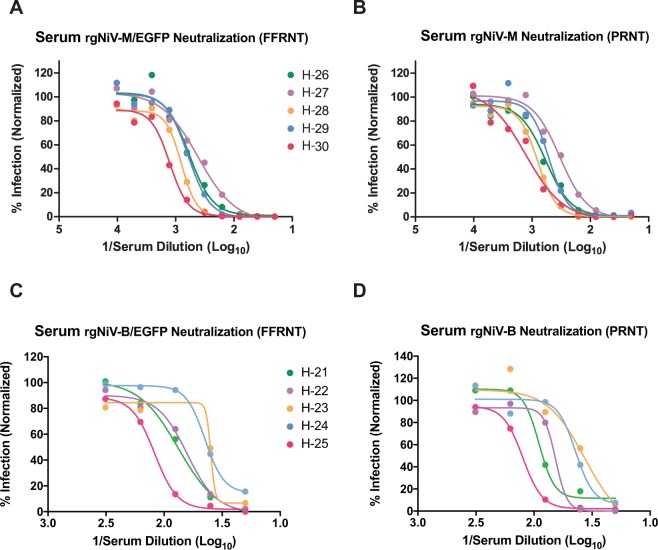
Evaluation of neutralizing antibodies with rgNiV-M/EGFP or rgNiV-B/EGFP. Increasing concentrations of serum from hamsters exposed to attenuated rgNiV-M or rgNiV-B were incubated with 50 pfu of rgNiV-M/EGFP (A), rgNiV-M (B), rgNiV-B/EGFP (C) or rgNiV-B (D) and inhibition was assessed with a fluorescence focus reduction neutralization test (FFRNT) (A,C) and a conventional plaque reduction neutralization test (PRNT) (B,D). Regression analysis and graphing was performed with Prism statistical software (GraphPad).

References

    1. Chong HT, et al. Nipah encephalitis outbreak in Malaysia, clinical features in patients from Seremban. Can J Neurol Sci. 2002;29:83–87. doi: 10.1017/S0317167100001785. - DOI - PubMed
    1. Goh KJ, et al. Clinical features of Nipah virus encephalitis among pig farmers in Malaysia. New Engl. J. Med. 2000;342:1229–1235. doi: 10.1056/NEJM200004273421701. - DOI - PubMed
    1. Middleton DJ, et al. Experimental Nipah virus infection in pigs and cats. J Comp Pathol. 2002;126:124–136. doi: 10.1053/jcpa.2001.0532. - DOI - PubMed
    1. Wong KT, et al. A golden hamster model for human acute Nipah virus infection. Am J Pathol. 2003;163:2127–2137. doi: 10.1016/S0002-9440(10)63569-9. - DOI - PMC - PubMed
    1. Bossart KN, et al. A neutralizing human monoclonal antibody protects against lethal disease in a new ferret model of acute nipah virus infection. PLoS Pathog. 2009;5:e1000642. doi: 10.1371/journal.ppat.1000642. - DOI - PMC - PubMed

Publication types

Substances