


Nutrition, Hygiene and Stimulation Education for Impoverished Mothers in Rural Uganda: Effect on Maternal Depression Symptoms and Their Associations to Child Development Outcomes
- PMID: 31373314
- PMCID: PMC6683265
- DOI: 10.3390/nu11071561
Nutrition, Hygiene and Stimulation Education for Impoverished Mothers in Rural Uganda: Effect on Maternal Depression Symptoms and Their Associations to Child Development Outcomes
Abstract
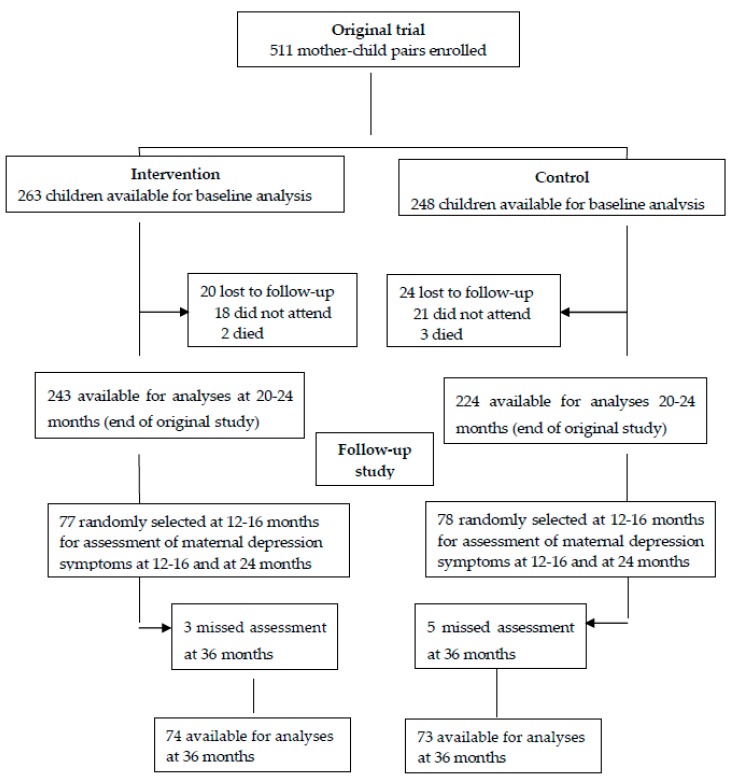
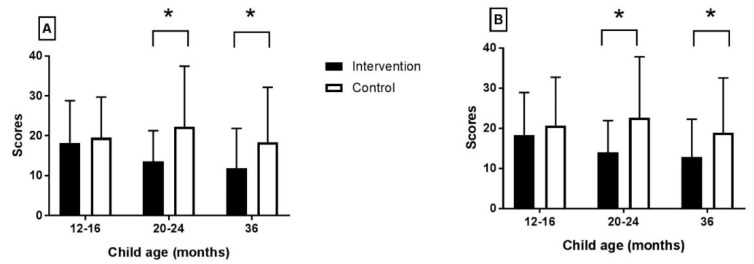
Optimal nutrition improves child development, and impaired development is associated with maternal depression symptoms, in particular in low resource settings. In this follow-up of an open cluster-randomized education trial, we examined its effects among mothers in rural Uganda on their depression symptoms and the association of these symptoms to child development. The education comprised complementary feeding, stimulation, and hygiene. We assessed 77 intervention mothers and 78 controls using Beck Depression Inventory-II (BDI-II) and Center for Epidemiologic Studies Depression Scale (CES-D) scores. Child development was assessed with Bayley Scales of Infant and Toddler Development-III (BSID-III) composite scores for cognitive, language and motor development. Compared to controls, the intervention reduced depression symptoms' scores with mean (95% CI) differences: -8.26 (-11.49 to -1.13, p = 0.0001) and -6.54; (-8.69 to -2.99, p = 0.004) for BDI II at 20-24 and 36 months, respectively. Similar results were obtained with CES-D. There was a negative association of BDI-II scores and BSID-III cognitive and language scores at 20-24 (p = 0.01 and 0.008, respectively) and 36 months (p = 0.017 and 0.001, respectively). CES-D associations with BSID-III cognitive and language scores showed similar trends. BSID-III motor scores were associated with depression scores at 36 months for both BDI-II and CES-D (p = 0.043 and 0.028, respectively). In conclusion, the group education was associated with reduced maternal depression scores. Moreover, the depression scores were inversely associated with child cognitive and language development outcomes.
Keywords: children; complementary feeding; developmental outcomes; group dynamics theory; maternal depression; nutrition education.
Conflict of interest statement
The authors declare no conflict of interest. The funders had no role in the design of the study; in the collection, analyses, or interpretation of data; in the writing of the manuscript, or in the decision to publish the results.
Figures
References
-
- PAHO/WHO . Guiding Priciples for Complementary Feeding of the Breastfed Child. World Health Organization; Washington, DC, USA: 2003. Division of Health Promotion and Protection.
-
- Smith Fawzi M.C., Andrews K.G., Fink G., Danaei G., McCoy D.C., Sudfeld C.R., Peet E.D., Cho J., Liu Y., Finlay J.E., et al. Lifetime economic impact of the burden of childhood stunting attributable to maternal psychosocial risk factors in 137 low/middle-income countries. BMJ Glob. Health. 2019;4:e001144. doi: 10.1136/bmjgh-2018-001144. - DOI - PMC - PubMed
Publication types
MeSH terms
LinkOut - more resources
Full Text Sources
Medical
