


Unpacking Genetic Risk Pathways for College Student Alcohol Consumption: The Mediating Role of Impulsivity
- PMID: 31373688
- PMCID: PMC6779491
- DOI: 10.1111/acer.14157
Unpacking Genetic Risk Pathways for College Student Alcohol Consumption: The Mediating Role of Impulsivity
Abstract
Background: The period of college represents a particularly risky developmental stage with regard to alcohol use, as college students engage in more risky drinking behaviors than their noncollege peers, and such problematic alcohol use is associated with far-reaching negative consequences. Existing findings from genome-wide association studies (GWAS) indicate that alcohol consumption has a complex polygenic etiology. Currently, there is a lack of studies examining genetic risk for alcohol consumption using polygenic risk scores (PRS) in college samples. In this study, we examined whether alcohol-specific and risky behavior-related PRS were longitudinally associated with alcohol consumption among college students and whether this effect might be partially mediated by impulsivity domains.
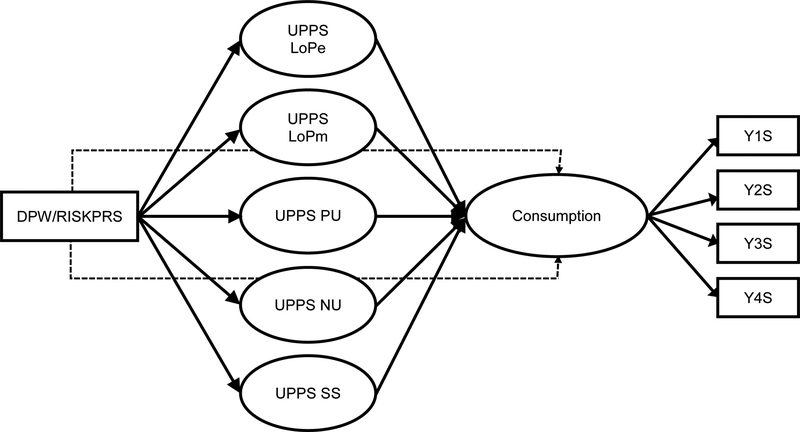
Methods: The sample included n = 2,385 European ancestry (EA) and n = 1,153 African ancestry (AA) college students assessed over the course of 4 years. To indicate genetic risk, 2 PRS were created based on recent large-scale GWAS: alcohol consumption (Liu et al., 2019) -drinks per week (DPW)-PRS and risky behaviors (Linnér et al., 2019) -RISK-PRS. The main outcome was alcohol consumption, measured across 4 waves of follow-up data. The UPPS-P impulsivity subscales were examined as mediators of the genetic effect on alcohol consumption.
Results: The results from structural equation modeling showed that among EA students, both DPW-PRS and RISK-PRS had significant positive effects on alcohol consumption above and beyond UPPS dimensions and control variables. RISK-PRS explained larger portion of variance in alcohol consumption than DPW-PRS. RISK-PRS showed a significant indirect effect on alcohol consumption through sensation seeking and lack of perseverance; no significant indirect effect of DPW-PRS was found. No significant association of either PRS or alcohol consumption was found for AA participants.
Conclusions: The current results found that PRS related to more broadly defined risky behaviors predicted alcohol consumption across college years and that this association was partially mediated via dimensions of impulsivity.
Keywords: Alcohol Consumption; College; Impulsivity; Polygenic Risk Scores; Risky Behaviors.
© 2019 by the Research Society on Alcoholism.
Conflict of interest statement
Conflict of interest: none
Figures
References
-
- Berg JM, Latzman RD, Bliwise NG, Lilienfeld SO (2015) Parsing the heterogeneity of impulsivity: A meta-analytic review of the behavioral implications of the UPPS for psychopathology. Psychol Assess 27:1129–1146. - PubMed
Publication types
MeSH terms
Grants and funding
LinkOut - more resources
Full Text Sources
Medical
