Review
. 2019 Oct;43(10):2014-2027.
doi: 10.1111/acer.14159. Epub 2019 Aug 21.

Endocannabinoid Signaling in the Central Amygdala and Bed Nucleus of the Stria Terminalis: Implications for the Pathophysiology and Treatment of Alcohol Use Disorder

Affiliations
Review

Endocannabinoid Signaling in the Central Amygdala and Bed Nucleus of the Stria Terminalis: Implications for the Pathophysiology and Treatment of Alcohol Use Disorder

Gaurav Bedse et al. Alcohol Clin Exp Res. 2019 Oct.

Abstract

High rates of relapse are a chronic and debilitating obstacle to effective treatment of alcohol use disorder (AUD); however, no effective treatments are available to treat symptoms induced by protracted abstinence. In the first part of this 2-part review series, we examine the literature supporting the effects of alcohol exposure within the extended amygdala (EA) neural circuitry. In Part 2, we focus on a potential way to combat negative affect associated with AUD, by exploring the therapeutic potential of the endogenous cannabinoid (eCB) system. The eCB system is a potent modulator of neural activity in the brain, and its ability to mitigate stress and negative affect has long been an area of interest for developing novel therapeutics. This review details the recent advances in our understanding of eCB signaling in 2 key regions of the EA, the central nucleus of the amygdala and the bed nucleus of the stria terminalis (BNST), and their role in regulating negative affect. Despite an established role for EA eCB signaling in reducing negative affect, few studies have examined the potential for eCB-based therapies to treat AUD-associated negative affect. In this review, we present an overview of studies focusing on eCB signaling in EA and cannabinoid modulation on EA synaptic activity. We further discuss studies suggesting dysregulation of eCB signaling in models of AUD and propose that pharmacological augmentation of eCB could be a novel approach to treat aspects of AUD. Lastly, future directions are proposed to advance our understanding of the relationship between AUD-associated negative affect and the EA eCB system that could yield new pharmacotherapies targeting negative affective symptoms associated with AUD.

Keywords: Alcohol; Cannabis; Endocannabinoid; Extended Amygdala; Stress.


Figures

Figure 1
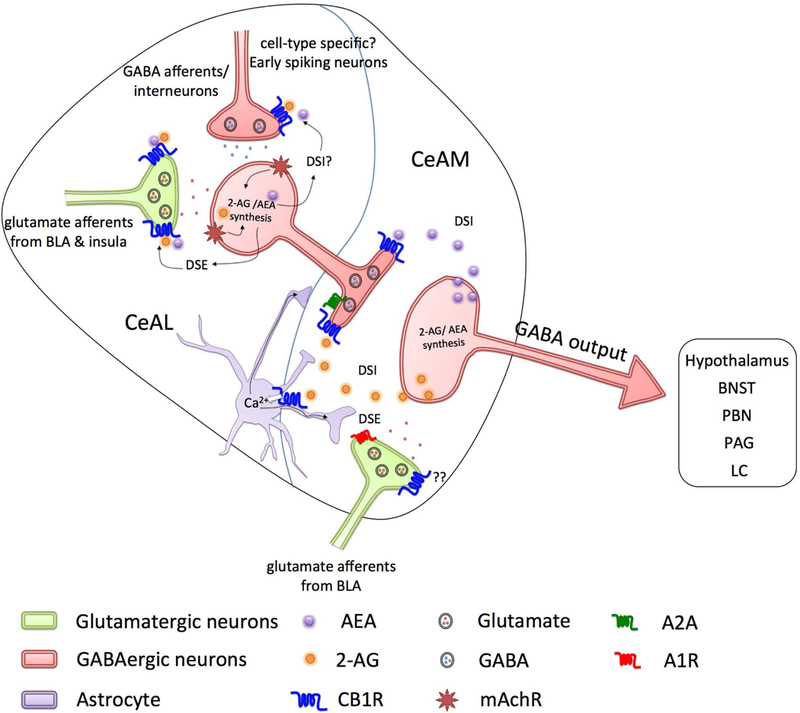
Figure 1. Endocannabinoid signaling in the central nucleus of the amygdala (CeA).
Glutamatergic inputs (light green) from the basolateral amygdala (BLA) and the insula project onto GABAergic neurons (light red) in the lateral subdivision of the CeA (CeAL). These GABAergic neurons send axon terminals to the medial subdivision of the CeA (CeAM). Both inputs are strongly regulated by the endocannabinoid (eCB) system via presynaptic CB1 receptors. In the CeAL, activation of mAChRs initiates 2-arachidonoyl glycerol (2-AG) and anandamide (AEA) production, and subsequent activation of presynaptic CB1 receptors by eCBs at excitatory inputs inhibits glutamate release (depolarization-induced suppression of excitation, DSE). Tonic eCB signaling in the CeAM inhibits the GABA release onto the GABAergic projection neurons (depolarization-induced suppression of inhibition, DSI), regulating CeA output. eCBs also regulate synaptic neurotransmission in the CeAM through activation of CB1 receptors on astrocytes (light violet). Activation of astrocytic CB1 receptors increases astrocytic calcium and results in increasing synaptic vesicle release probability in the CeL-CeM through activation of A2A receptors and decreases synaptic probability of release through activation of A1 receptors in BLA-CeAM synapses. CeA sends inhibitory efferent projections to lateral hypothalamus, the bed nucleus of stria terminalis (BNST), parabrachial nucleus (PBN), periaqueductal gray (PAG) and locus coeruleus (LC).
Figure 2.
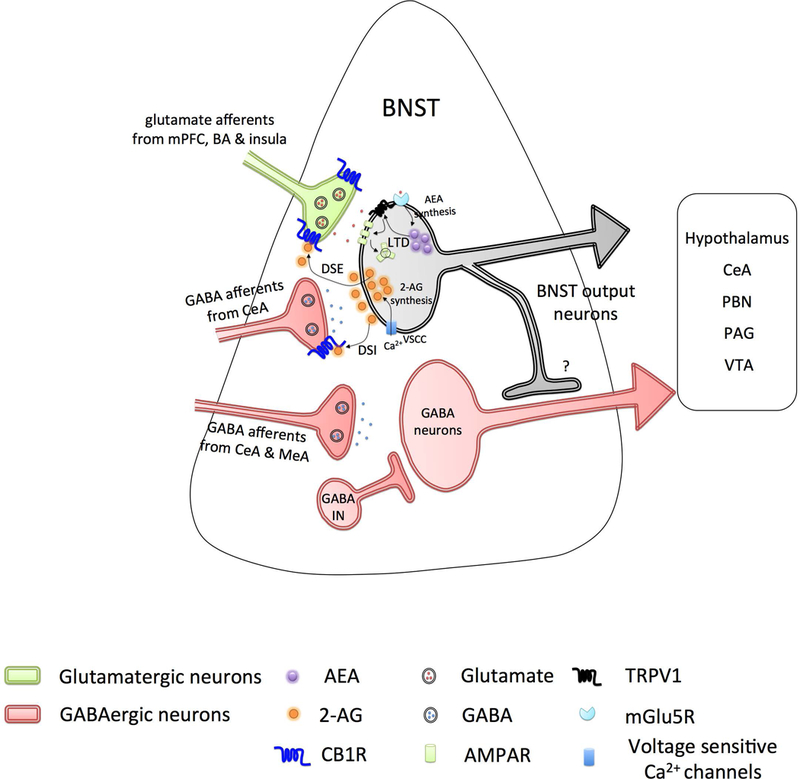
Figure 2.. Endocannabinoid signaling in the bed nucleus of the stria terminalis (BNST).
Excitatory inputs (light green) from medial prefrontal cortex (mPFC), basal amygdala (BA) and insula, and inhibitory inputs (light red) from central nucleus of the amygdala (CeA) project onto BNST neurons and are regulated by the endocannabinoid system via presynaptic CB1 receptors. Inhibitory inputs from CeA and medial amygdala (MeA) projecting onto GABAergic BNST neurons (light red) are devoid of CB1 receptors. Activity at excitatory inputs evokes postsynaptic depolarization of BNST neurons, subsequent Ca2+ entry via voltage sensitive calcium channels (VSCC), initiates the production of 2-arachidonoyl glycerol (2-AG), activation of presynaptic CB1 receptors at both excitatory and inhibitory inputs, in turn, resulting in short-term suppression of glutamate (depolarization-induced suppression of excitation, DSE) and GABA (depolarization-induced suppression of inhibition, DSI) release. Activation of mGluR5 receptor initiates the production of anandamide (AEA), which further activates the postsynaptic TRPV1 channels in an autocrine manner. TRPV1 triggers internalization of postsynaptic AMPA receptors and induce long-term depression (LTD). BNST neurons send dense projections to the lateral hypothalamus, CeA, parabrachial nucleus (PBN), periaqueductal gray (PAG), and ventral tegmental area (VTA).
Figure 3.
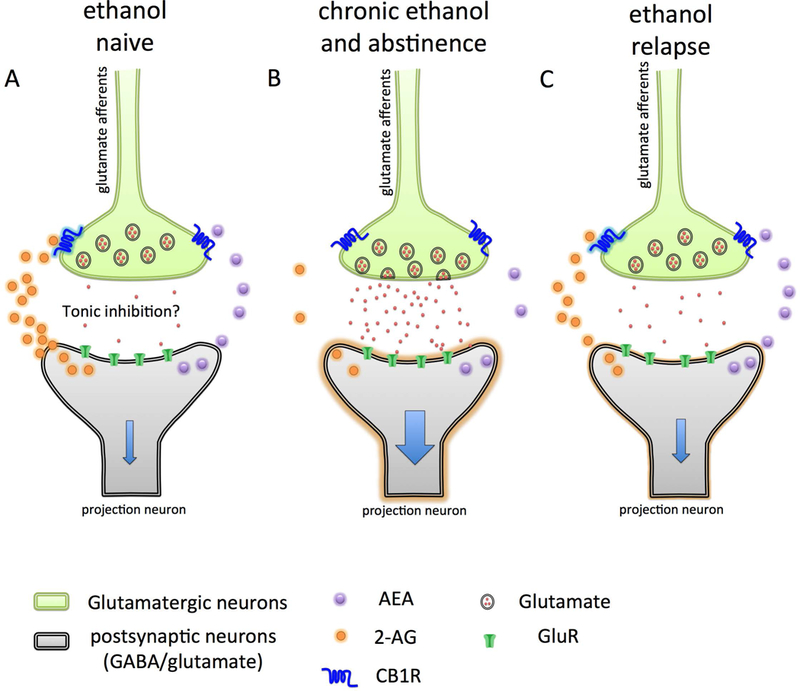
Figure 3.. A proposed mechanism of ethanol-induced dysregulation of endocannabinoid signaling in extended amygdala.
In ethanol naïve conditions (A) endocannabinoid signaling within the central nucleus of amygdala (CeA) and bed nucleus of stria terminalis (BNST) regulates the presynaptic release of glutamate through activation of CB1 receptors on glutamatergic inputs (light green), which dampens the activation of neurons of CeA and BNST (light gray). In ethanol abstinence, the levels of 2-arachidonoyl glycerol (2-AG) decreases, possibly through enhanced degradation by monoacylglycerol lipase (MAGL). The reduced 2-AG signaling at CB1 disinhibits glutamatergic inputs to CeA and BNST, resulting in increased glutamate release and firing of CeA and BNST neurons. Activation of CeA and BNST neurons further activates downstream brain nuclei involved in the brain stress system regulating the negative affective state. (C) Ethanol re-exposure increases the 2-AG levels through an unknown mechanism and temporarily alleviates negative emotional state. This model also suggests pharmacological inhibition of MAGL, which would increase 2-AG signaling, could reduce abstinence-induced EA over activation and negative affective states.

References

    1. Aydin C, Oztan O, Isgor C (2012) Long-term effects of juvenile nicotine exposure on abstinence-related social anxiety-like behavior and amygdalar cannabinoid receptor 1 (CB1R) mRNA expression in the novelty-seeking phenotype. Behav Brain Res 228:236–239. - PMC - PubMed
    1. Becker JAJ, Kieffer BL, Le Merrer J (2017) Differential behavioral and molecular alterations upon protracted abstinence from cocaine versus morphine, nicotine, THC and alcohol. Addict Biol 22:1205–1217. - PMC - PubMed
    1. Bedse G, Bluett RJ, Patrick TA, Romness NK, Gaulden AD, Kingsley PJ, Plath N, Marnett LJ, Patel S (2018) Therapeutic endocannabinoid augmentation for mood and anxiety disorders: comparative profiling of FAAH, MAGL and dual inhibitors. Transl Psychiatry 8:92. - PMC - PubMed
    1. Bedse G, Colangeli R, Lavecchia AM, Romano A, Altieri F, Cifani C, Cassano T, Gaetani S (2014) Role of the basolateral amygdala in mediating the effects of the fatty acid amide hydrolase inhibitor URB597 on HPA axis response to stress. Eur Neuropsychopharmacol 24:1511–1523. - PubMed
    1. Bedse G, Hartley ND, Neale E, Gaulden AD, Patrick TA, Kingsley PJ, Uddin MJ, Plath N, Marnett LJ, Patel S (2017) Functional Redundancy Between Canonical Endocannabinoid Signaling Systems in the Modulation of Anxiety. Biol Psychiatry 82:488–499. - PMC - PubMed

Publication types