


Can Persons with Dementia Meaningfully Participate in Advance Care Planning Discussions? A Mixed-Methods Study of SPIRIT
- PMID: 31373868
- PMCID: PMC6818478
- DOI: 10.1089/jpm.2019.0088
Can Persons with Dementia Meaningfully Participate in Advance Care Planning Discussions? A Mixed-Methods Study of SPIRIT
Abstract
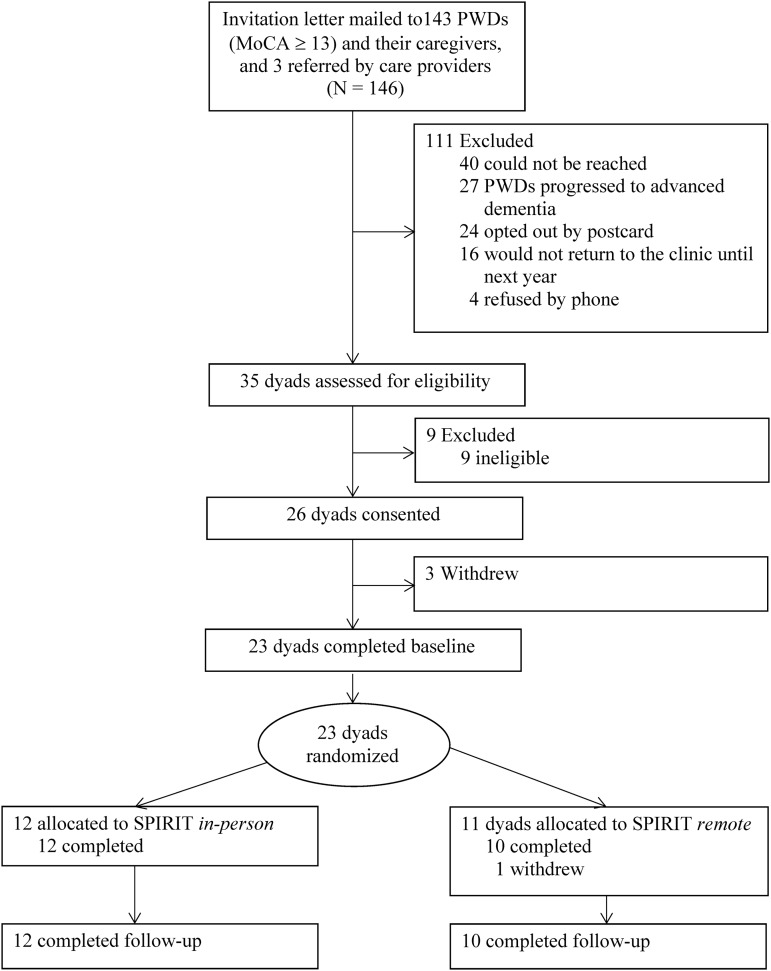
Background: Despite the importance of persons with dementia (PWDs) engaging in advance care planning (ACP) at a time when they are still competent to appoint a surrogate decision maker and meaningfully participate in ACP discussions, studies of ACP in PWDs are rare. Objective: We conducted an intervention development study to adapt an efficacious ACP intervention, SPIRIT (sharing patient's illness representations to increase trust), for PWDs in early stages (recent Montreal Cognitive Assessment [MoCA] score ≥13) and their surrogates and assess whether SPIRIT could help PWDs engage in ACP. Design: A formative expert panel review of the adapted SPIRIT, followed by a randomized trial with qualitative interviews, was conducted. Patient-surrogate dyads were randomized to SPIRIT in person (in a private room in a memory clinic) or SPIRIT remote (via videoconferencing from home). Setting/Subjects: Twenty-three dyads of PWDs and their surrogates were recruited from an outpatient brain health center. Participants completed preparedness outcome measures (dyad congruence on goals of care, patient decisional conflict, and surrogate decision-making confidence) at baseline and two to three days post-intervention, plus a semistructured interview. Levels of articulation of end-of-life wishes of PWDs during SPIRIT sessions were rated (3 = expressed wishes very coherently, 2 = somewhat coherently, and 1 = unable to express coherently). Results: All 23 were able to articulate their end-of-life wishes very or somewhat coherently during the SPIRIT session; of those, 14 PWDs had moderate dementia. While decision-making capacity was higher in PWDs who articulated their wishes very coherently, MoCA scores did not differ by articulation levels. PWDs and surrogates perceived SPIRIT as beneficial, but the preparedness outcomes did not change pre-post. Conclusions: SPIRIT engaged PWDs and surrogates in meaningful ACP discussions, but requires testing of efficacy and long-term outcomes.
Trial registration: ClinicalTrials.gov NCT03311711.
Keywords: Alzheimer's disease; advance care planning; dementia; end-of-life care; surrogate decision making.
Conflict of interest statement
No competing financial interests exist.
References
-
- Tay SY, Davison J, Jin NC, Yap PL: Education and executive function mediate engagement in advance care planning in early cognitive impairment. J Am Med Dir Assoc 2015;16:957–962 - PubMed
Publication types
MeSH terms
Associated data
Grants and funding
LinkOut - more resources
Full Text Sources
Medical
