Review
. 2019 Dec:61:1-9.
doi: 10.1016/j.coi.2019.06.005. Epub 2019 Jul 30.

Spatial and functional heterogeneity of follicular helper T cells in autoimmunity

Affiliations
Review

Spatial and functional heterogeneity of follicular helper T cells in autoimmunity

Abhinav Seth et al. Curr Opin Immunol. 2019 Dec.

Abstract

Follicular helper T cells provide signals that promote B cell development, proliferation, and production of affinity matured and appropriately isotype switched antibodies. In addition to their classical locations within B cell follicles and germinal centers therein, B cell helper T cells are also found in extrafollicular spaces - either in secondary lymphoid or non-lymphoid tissues. Both follicular and extrafollicular T helper cells drive autoantibody-mediated autoimmunity. Interfering with B cell help provided by T cells can ameliorate autoimmune disease in animal models and human patients. The next frontier in Tfh cell biology will be identification of Tfh cell-specific pathogenic changes in autoimmunity and exploiting them for therapeutic purposes.


Conflict of interest statement

Declaration of Interests: None

Figures
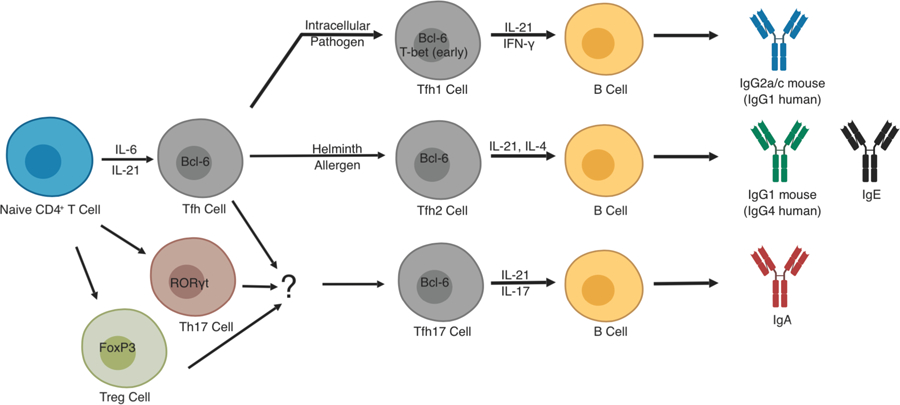
Figure 1.
Figure 1.. Functional heterogeneity of T cells that help B cells.
Tfh cells can adopt functional subtypes that correlate with the fate decisions of their T effector counterparts. This is best exemplified for type 1 and 2 immune responses where Tfh cells can adopt Tfh1 or Tfh2 subtypes, respectively. IFN-γ expressed early during a type I immune to virus, for example, will lead to early T-bet expression in Bcl6+ Tfh cells. This leads to IL-21 and IFN-γ co-expression by Tfh1 cells and skews GC B cells to switch to pro-inflammatory IgG2a/c isotypes for aid in clearance of intracellular pathogens. In the case of type 2 infection, Tfh cells adopt a Tfh2 subtype characterized by sequential expression of IL-21 and IL-4 leading to GC B cells isotype switching to IgG1 or IgE for pathogen neutralization and activation of mast cells, respectively. The situation for Tfh17 development is more complex. Current thinking suggests that Tfh17 subsets exist, particularly in Peyer’s patches or other lymphoid tissue associated with mucosal surfaces. These Tfh17 cells are thought to arise primarily from Th17 cells, or perhaps, Treg cells, which can then induce IgA production by GC B cells. All of these subtypes of Tfh cells, Tfh1, Tfh2, and Tfh17 have been implicated in various autoimmune conditions as described in the text.
Figure 2.
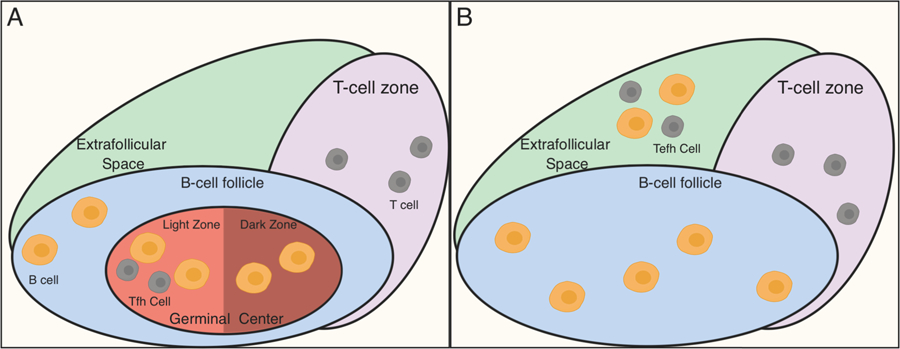
Figure 2.. Spatial heterogeneity of T cells that help B cells.
A) The classical model of Tfh function is shown. In this model, T:B cell collaboration occurs mainly in germinal centers (GCs), highly anatomically organized structures within B follicles of lymphoid tissue. Both Tfh cells and GC B cells contribute to GC organization. GCs can be further subdivided into light zones and dark zones. GC B cells cycle between the dark and light zones, proliferating in the former and receiving selective and instructive cues from Tfh cells in the latter where they undergo selection. Upon maturation, GC B cells exit the GCs as long-lived plasmablasts or memory B cells. B) An alternate mode of T:B cell collaboration can occur in extrafollicular spaces. Here, Tefh provide soluble and cell-contact dependent cues for B cell maturation with affinity maturation and isotype switch. This mode of B cell help has been demonstrated both during physiologic immune responses to pathogens as well as in settings of autoimmunity. Further, extrafollicular responses need not be confined to lymphoid tissue (as shown), but may also occur within local tissues, such as the kidneys, lungs or brain as discussed in the text.

References

    1. DeFranco AL: Germinal centers and autoimmune disease in humans and mice. Immunol Cell Biol 2016, 94:918–924. - PMC - PubMed
    1. Craft JE: Follicular helper T cells in immunity and systemic autoimmunity. Nat Rev Rheumatol 2012, 8:337–347. - PMC - PubMed
    1. Crotty S: T follicular helper cell differentiation, function, and roles in disease. Immunity 2014, 41:529–542. - PMC - PubMed
    1. Vinuesa CG, Linterman MA, Goodnow CC, Randall KL: T cells and follicular dendritic cells in germinal center B-cell formation and selection. Immunol Rev 2010, 237:72–89. - PubMed
    1. Song W, Craft J: T follicular helper cell heterogeneity: Time, space, and function. Immunol Rev 2019, 288:85–96.

      •• This recent thorough review describes our current understanding of physiologic Tfh cell development and function.

Publication types