


Dietary pattern in midlife and cognitive impairment in late life: a prospective study in Chinese adults
- PMID: 31374567
- PMCID: PMC6766457
- DOI: 10.1093/ajcn/nqz150
Dietary pattern in midlife and cognitive impairment in late life: a prospective study in Chinese adults
Abstract
Background: Prospective studies linking dietary pattern and cognitive function in the elderly are limited in Asian populations.
Objective: We examined the associations between various healthful dietary patterns and risk of cognitive impairment in Chinese adults.
Methods: We used data from the Singapore Chinese Health Study of 16,948 men and women who were aged 45-74 y at baseline (1993-1998) and reinterviewed at the third follow-up visit (2014-2016), ∼20 y later. Diet quality at baseline was assessed according to the alternate Mediterranean diet (aMED), the Dietary Approaches to Stop Hypertension (DASH) diet, the alternative Healthy Eating Index (AHEI)-2010, overall plant-based diet index (PDI), and healthful plant-based diet index (hPDI). Cognitive function was evaluated using a Singapore-modified Mini-Mental State Examination during the third follow-up visit when subjects were aged 61-96 y. Multivariable logistic regression models were used to compute ORs and 95% CIs associated with the risk of cognitive impairment defined using education-specific cut-offs.
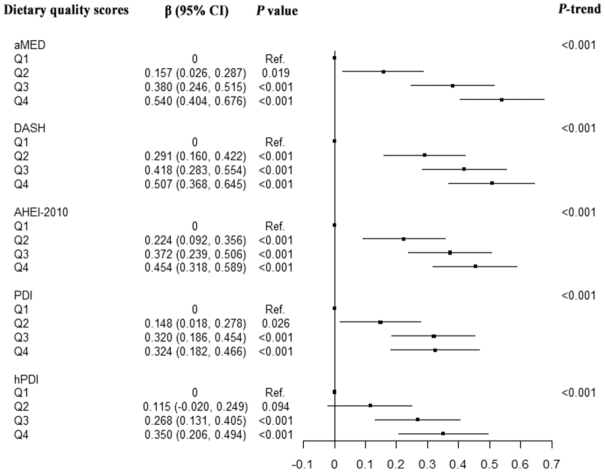
Results: Cognitive impairment was present in 2443 (14.4%) participants. The OR (95% CI) for cognitive impairment comparing the highest with the lowest quartile of diet quality scores was 0.67 (0.59, 0.77) for aMED, 0.71 (0.62, 0.81) for DASH, 0.75 (0.66, 0.85) for AHEI-2010, 0.82 (0.71, 0.94) for PDI, and 0.78 (0.68, 0.90) for hPDI (all P values for trend <0.001). Each SD increment in different diet quality scores was associated with 7-16% lower risk of cognitive impairment.
Conclusions: These results provide evidence that adherence to healthy dietary patterns in midlife is associated with a lower risk of cognitive impairment in late life in Chinese adults.
Keywords: Chinese; Dietary Approaches to Stop Hypertension diet; Healthy Eating Index; Mediterranean diet; cognition; cohort study; diet pattern; epidemiological study; plant-based diet index.
Copyright © American Society for Nutrition 2019.
Figures
Comment in
-
Dietary patterns and cognition: food for thought or … still more thought necessary?Am J Clin Nutr. 2019 Oct 1;110(4):801-802. doi: 10.1093/ajcn/nqz203. Am J Clin Nutr. 2019. PMID: 31504092 No abstract available.
References
-
- Livingston G, Sommerlad A, Orgeta V, Costafreda SG, Huntley J, Ames D, Ballard C, Banerjee S, Burns A, Cohenmansfield J. Dementia prevention, intervention, and care. Lancet. 2017;390(10113):2673–734. - PubMed
-
- Petersen RC, Smith GE, Waring SC, Ivnik RJ, Tangalos EG, Kokmen E. Mild cognitive impairment: clinical characterization and outcome. Arch Neurol. 1999;56(3):303–8. - PubMed
-
- Solfrizzi V, Custodero C, Lozupone M, Imbimbo BP, Valiani V, Agosti P, Schilardi A, D'Introno A, La Montagna M, Calvani M et al.. Relationships of dietary patterns, foods, and micro- and macronutrients with Alzheimer's disease and late-life cognitive disorders: a systematic review. J Alzheimers Dis. 2017;59(3):815–49. - PubMed
-
- Alles B, Samieri C, Feart C, Jutand MA, Laurin D, Barberger-Gateau P. Dietary patterns: a novel approach to examine the link between nutrition and cognitive function in older individuals. Nutr Res Rev. 2012;25(2):207–22. - PubMed
Publication types
MeSH terms
Grants and funding
LinkOut - more resources
Full Text Sources
Medical
