


Antioxidants Profiling of By-Products from Eucalyptus Greenboards Manufacture
- PMID: 31374921
- PMCID: PMC6719899
- DOI: 10.3390/antiox8080263
Antioxidants Profiling of By-Products from Eucalyptus Greenboards Manufacture
Abstract
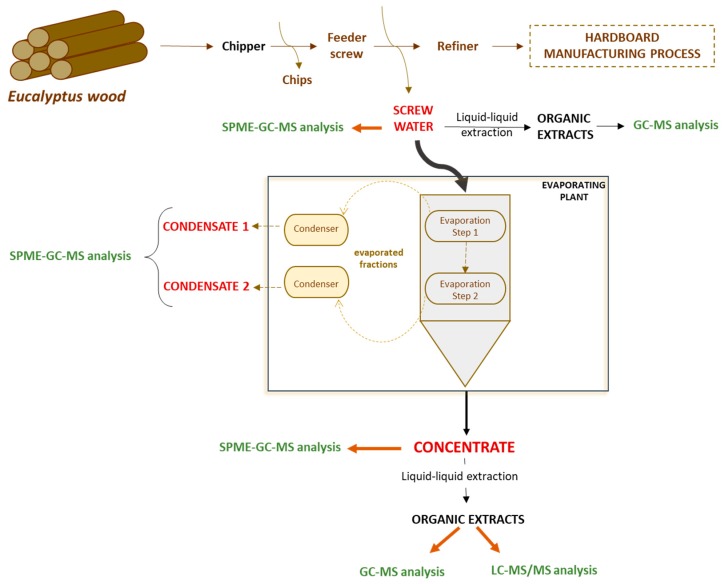
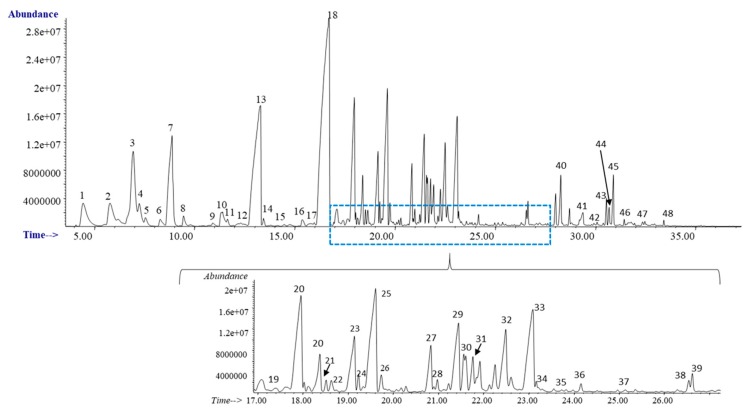
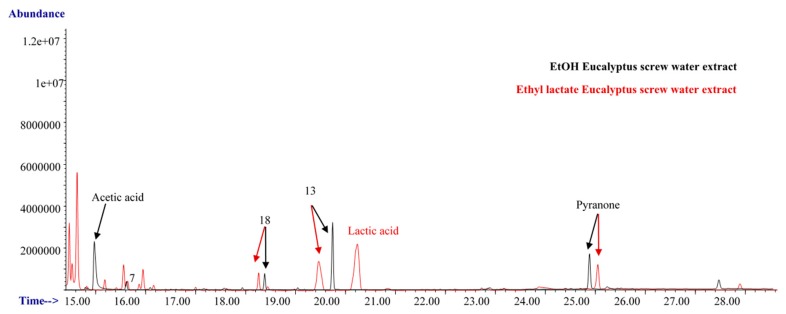
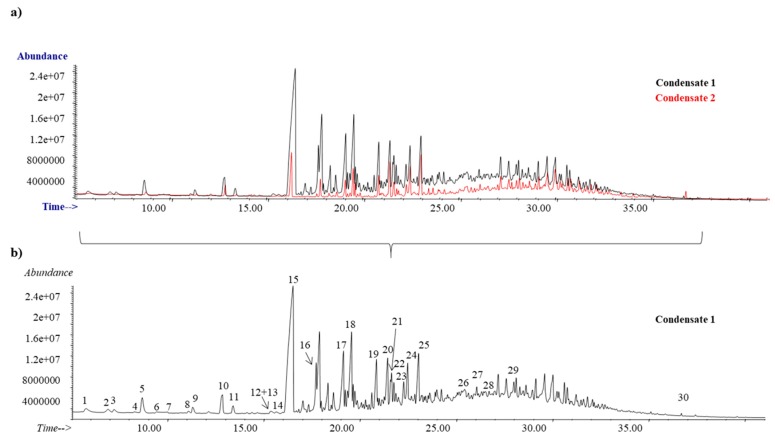
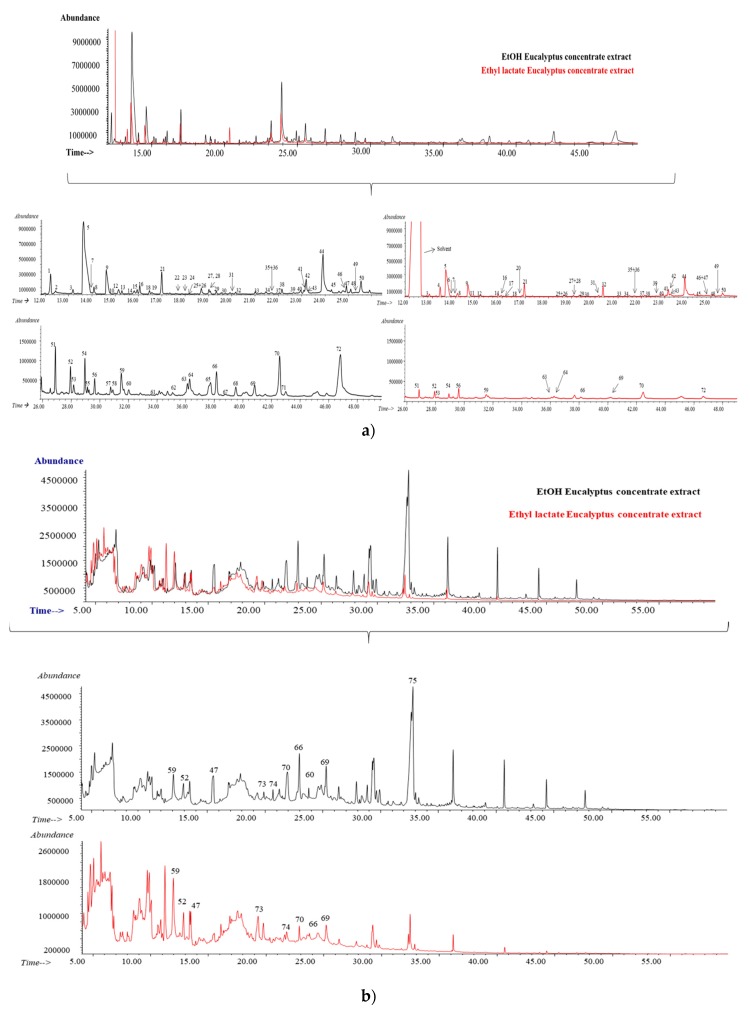
Three different by-products from the Eucalyptus wood industry have been exhaustively characterized to find compounds with antioxidant properties. The industrial process to manufacture Eucalyptus greenboards is distinguished by using just wood and water, which converts the generated by-products in a highly attractive source of bioactive compounds that are originally in the raw material. The studied by-products were: the screw water, derived from the washing of the wood chips; the condensates, obtained after the evaporation and further condensation of the screw water; and finally, the concentrate of eucalyptus. For all of them and for their derived organic extracts, the total polyphenols content (TPC) and antioxidant activity (AA) have been evaluated. The chromatographic fingerprints, based on gas chromatography-mass spectrometry (GC-MS), and liquid chromatography-tandem mass spectrometry (LC-MS/MS) have been obtained to identify the main extractable organic wood components. Besides, solid-phase microextraction (SPME) has been employed to characterize the most volatile compounds. Significant differences were observed for the chromatographic profiles of the studied by-products. Up to 48 and 30 different compounds were identified in the screw water, and condensate by-products, respectively; whereas the highest number of compounds, up to 72, have been identified in the organic extracts derived from the concentrate of Eucalyptus, highlighting the presence of monoterpenes, sesquiterpenes, polyphenols, and other bioactive compounds with antioxidant properties. Therefore, these by-products could be exploited to obtain natural extracts with added value which could be reused in the food, cosmetic or pharmaceutical industry, reducing the environmental impact of the industrial activity.
Keywords: analytical characterization; antioxidants; bioactive compounds; wood industry by-products.
Conflict of interest statement
The authors declare no conflicts of interest
Figures
References
-
- Cadahía E., Conde E., García-Vallejo M.C., Fernández de Simón B. High pressure liquid chromatographic analysis of polyphenols in leaves of Eucalyptus camaldulensis, E. globulus and E. rudis: Proanthocyanidins, ellagitannins and flavonol glycosides. Phytochem. Anal. 1997;8:78–83. doi: 10.1002/(SICI)1099-1565(199703)8:2<78::AID-PCA335>3.0.CO;2-O. - DOI
-
- Dezsi S., Bãdãrãu A.S., Bischin C., Vodnar D.C., Silaghi-Dumitrescu R., Gheldiu A.M., Mocan A., Vlase L. Antimicrobial and antioxidant activities and phenolic profile of Eucalyptus globulus Labill. and Corymbia ficifolia (F. Muell.) KD Hill & LAS Johnson leaves. Molecules. 2015;20:4720–4734. - PMC - PubMed
-
- Mota I., Rodrigues Pinto P.C., Novo C., Sousa G., Guerreiro O., Guerra A.N.R., Duarte M.F., Rodrigues A.R.E. Extraction of polyphenolic compounds from Eucalyptus globulus bark: Process optimization and screening for biological activity. Ind. Eng. Chem. Res. 2012;51:6991–7000. doi: 10.1021/ie300103z. - DOI
Grants and funding
LinkOut - more resources
Full Text Sources
Miscellaneous
