Review
. 2019 Aug 1;19(15):3385.
doi: 10.3390/s19153385.

Chipless-RFID: A Review and Recent Developments

Affiliations
Review

Chipless-RFID: A Review and Recent Developments

Cristian Herrojo et al. Sensors (Basel). .

Abstract

In this paper, a review of the state-of-the-art chipless radiofrequency identification (RFID) technology is carried out. This recent technology may provide low cost tags as long as these tags are not equipped with application specific integrated circuits (ASICs). Nevertheless, chipless-RFID presents a series of technological challenges that have been addressed by different research groups in the last decade. One of these challenges is to increase the data storage capacity of tags, in order to be competitive with optical barcodes, or even with chip-based RFID tags. Thus, the main aim of this paper is to properly clarify the advantages and disadvantages of chipless-RFID technology. Moreover, since the coding information is an important aspect in such technology, the different coding techniques, as well as the main figures of merit used to compare different chipless-RFID tags, will be analyzed.

Keywords: chipless-RFID; coding techniques; frequency domain; hybrid chipless-RFID tags; time domain.


Conflict of interest statement

The authors declare no conflicts of interest.

Figures
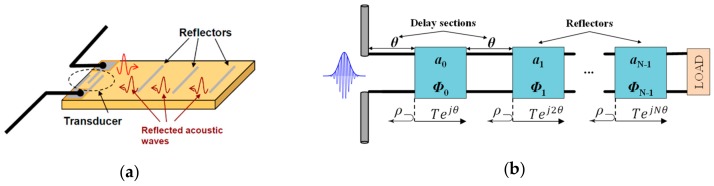
Figure 1
Figure 1
Working principle of a chipless radiofrequency identification (RFID) system based on (a) surface acoustic wave (SAW) technology and (b) delay lines. In both cases, the functionality is known as time domain reflectometry (TDR).
Figure 2
Figure 2
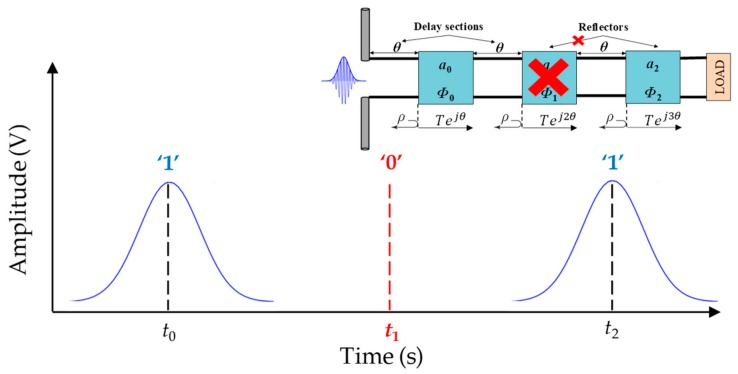
Working principle of on-off keying encoding.
Figure 3
Figure 3
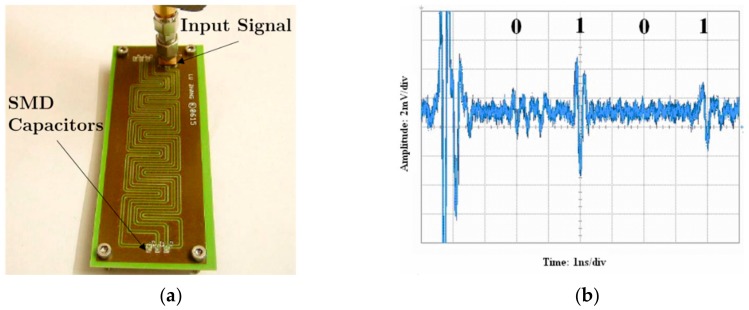
(a) Photograph of the chipless-RFID tag proposed by Zhang et al. (code ‘0101’); (b) measured code ‘0101’. Figure extracted from [21].
Figure 4
Figure 4
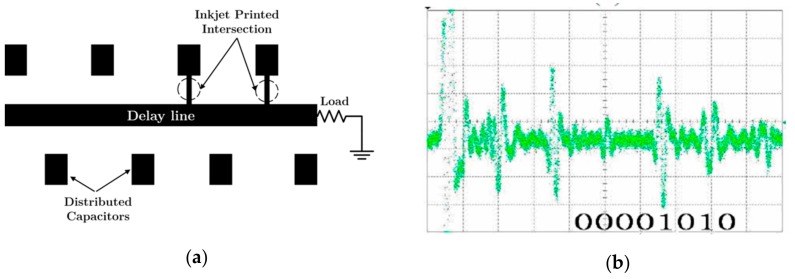
(a) Layout of the chipless-RFID tag proposed by Zheng et al. programmed with the code ‘00001010’ and (b) measurement of the code ‘00001010’. Figure extracted from [22].
Figure 5
Figure 5
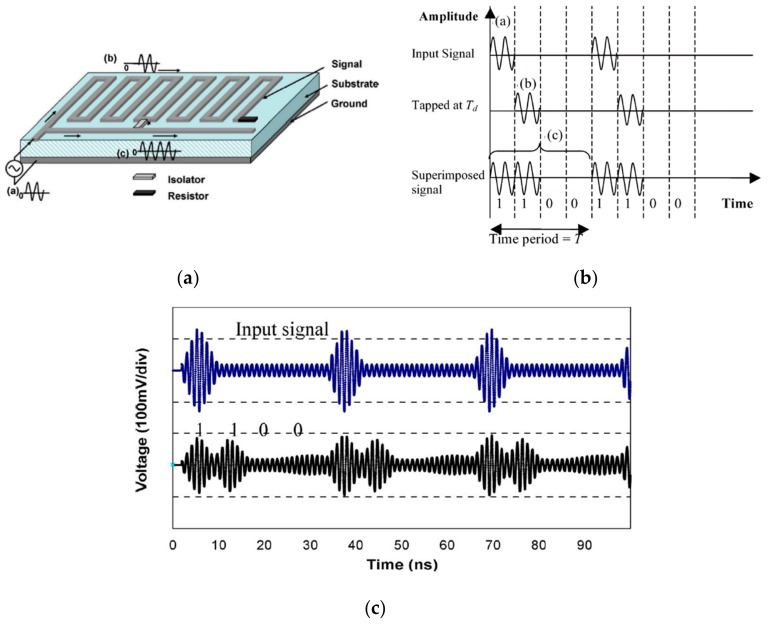
(a) Sketch of the delay line proposed by Chamarti et al.; (b) binary code generation by the superposition of delayed lines; (c) simulated input and output signals. Figure extracted from [24].
Figure 6
Figure 6
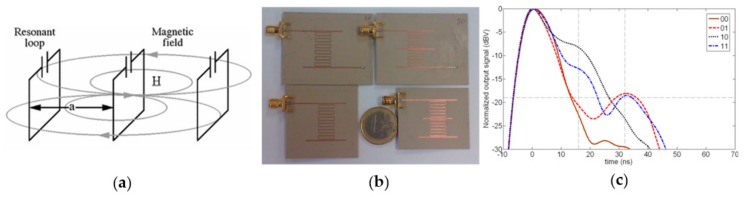
(a) Magneto inductive waveguide which consists of a set of capacitively loaded loops, magnetically coupled to each other. Figure extracted from [30]; (b) photograph of the fabricated set of 2-bit chipless RFID tags proposed by Herraiz et al. and (c) measured response. Figure extracted from [26].
Figure 7
Figure 7
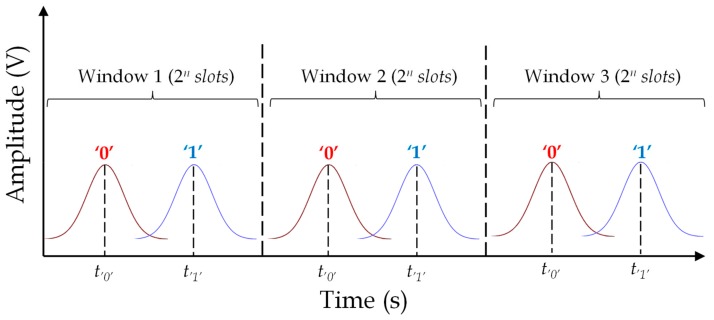
Working principle of pulse position modulation encoding.
Figure 8
Figure 8
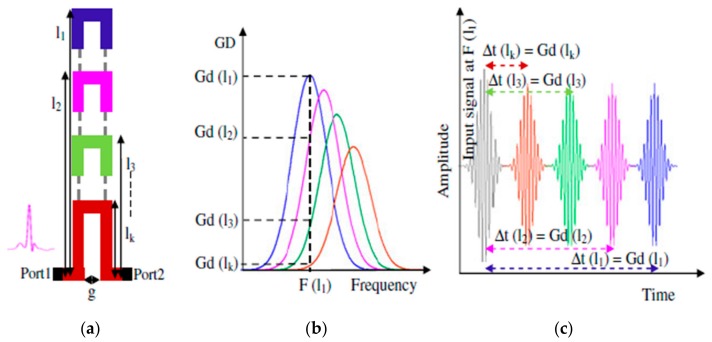
Principle of encoding by means of group delay: (a) structure of the chipless-RFID tag; (b) group delay vs. frequency for different lengths of C-sections, and (c) the corresponding time domain response. Figure extracted from [34].
Figure 9
Figure 9
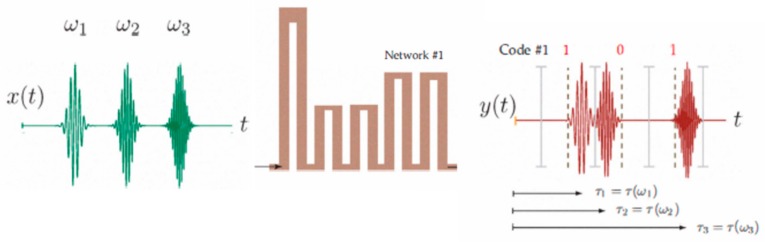
Chipless-RFID tag proposed by Gupta et al. fed with three Gaussian pulses with frequency ω1, ω2, and ω3 and an example of PPM encoding. Figure extracted from [35].
Figure 10
Figure 10
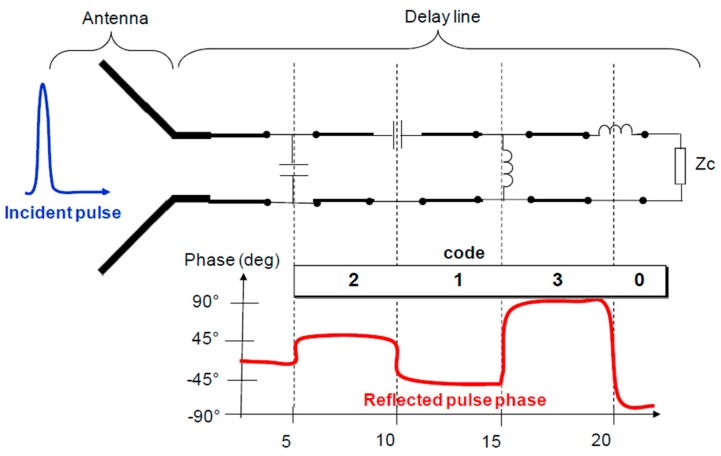
Temporal encoding based on the phase modulation of the input pulse to the tag. Figure extracted from [3].
Figure 11
Figure 11
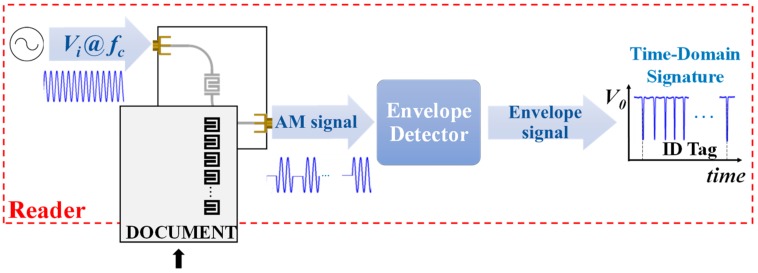
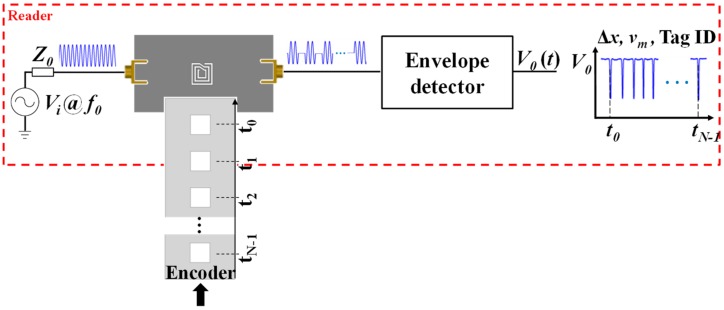
Sketch of the working principle of time domain chipless-RFID systems based on near-field coupling and sequential bit reading.
Figure 12
Figure 12
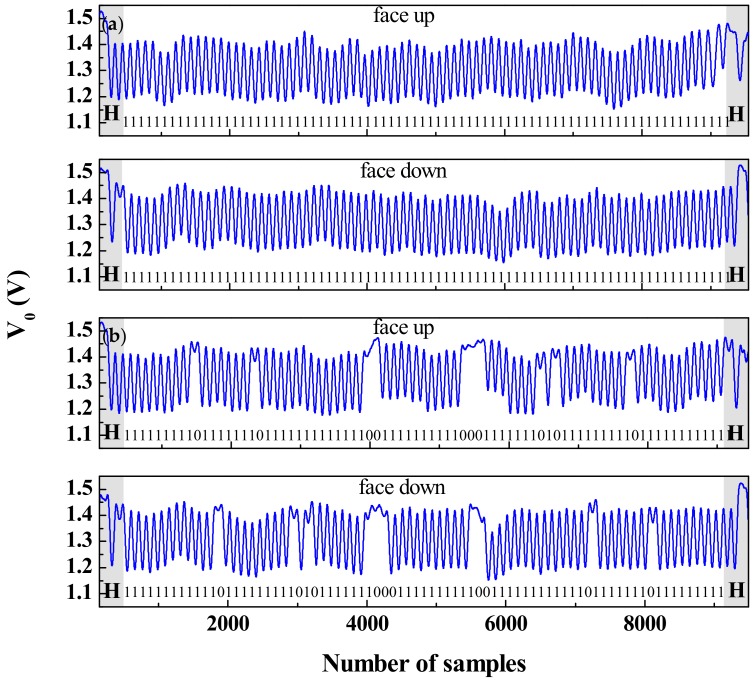
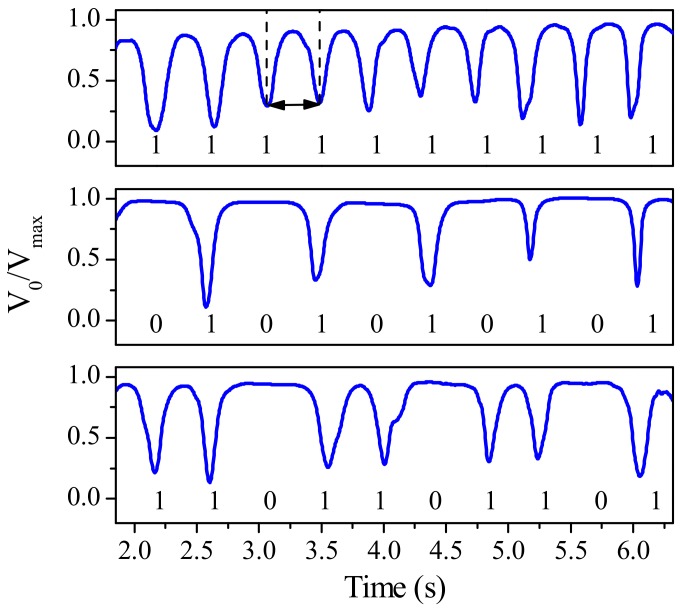
(a) Measured envelope of the inkjet-printed 80-bit tag with all bits set to the logic state ‘1’ and (b) 80-bit programmed tag with the indicated code. Figure extracted from [48].
Figure 13
Figure 13
Sketch of the working principle of the all-dielectric electromagnetic encoders based on permittivity contrast. Figure extracted from [53].
Figure 14
Figure 14
Normalized measured envelope functions of the indicated codes. Figure extracted from [53].
Figure 15
Figure 15
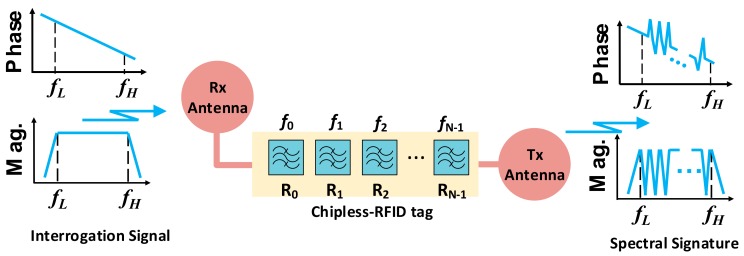
The working principle of retransmission frequency domain chipless-RFID systems.
Figure 16
Figure 16
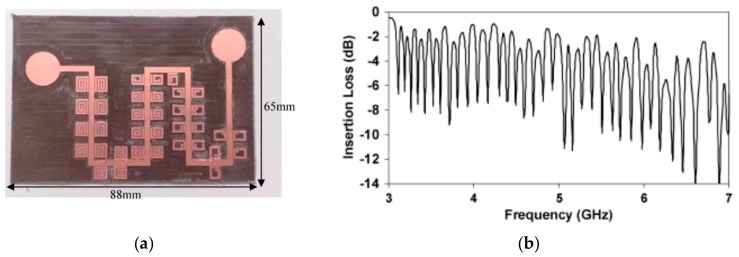
(a) Photograph and (b) measured response of a 35-bit tag implemented by Preradovic et al. Figure extracted from [56].
Figure 17
Figure 17
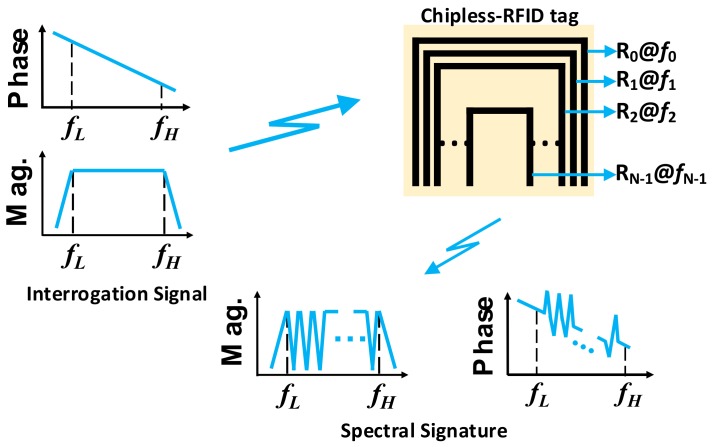
The working principle of backscattered frequency domain chipless-RFID systems.
Figure 18
Figure 18
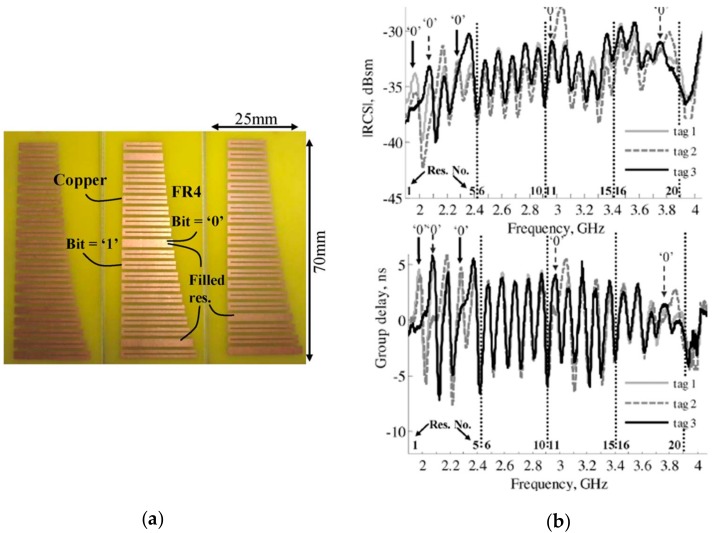
(a) Photograph and (b) measured radar cross section (RCS), and group delay of three different 20-bit tags implemented by Vena et al. Figure extracted from [69].
Figure 19
Figure 19
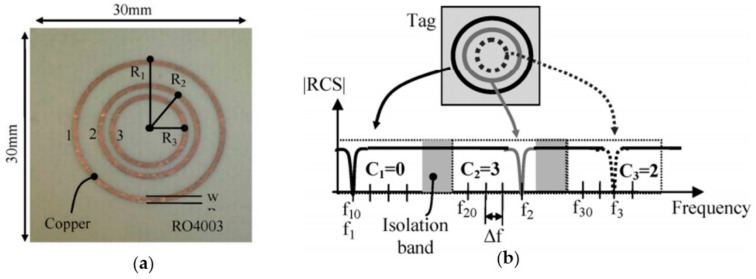
(a) Photograph of a chipless-RFID tag constituted by three circular rings and (b) the coding principle. Figure extracted from [80].
Figure 20
Figure 20
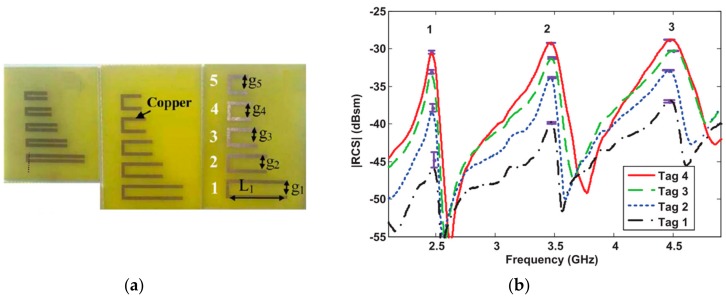
(a) Photograph of three chipless-RFID tags proposed by Vena et al. and (b) the measured frequency response. Figure extracted from [89].
Figure 21
Figure 21
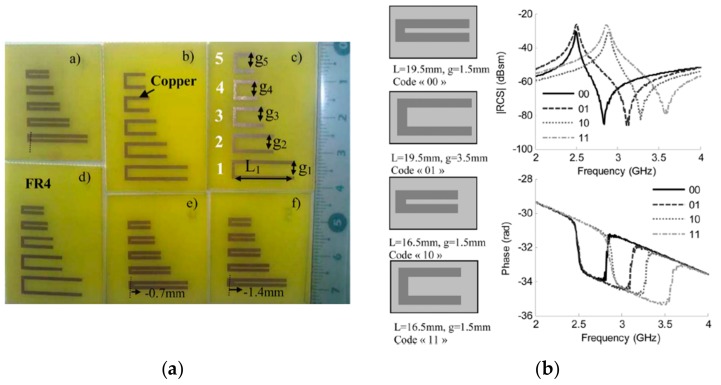
(a) Photograph of six chipless-RFID tags proposed by Vena et al. and (b) the measured frequency response. Figure extracted from [90].
Figure 22
Figure 22
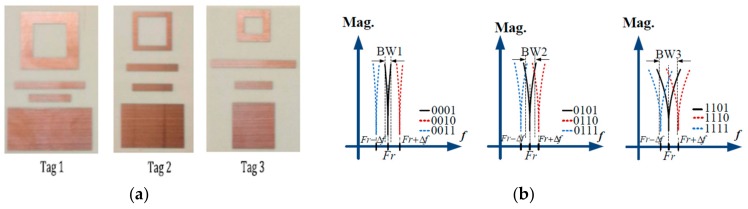
(a) Photograph of three chipless-RFID tags proposed by El-Awamry et al. and (b) the working principle of the proposed encoding. Figure extracted from [91].
Figure 23
Figure 23
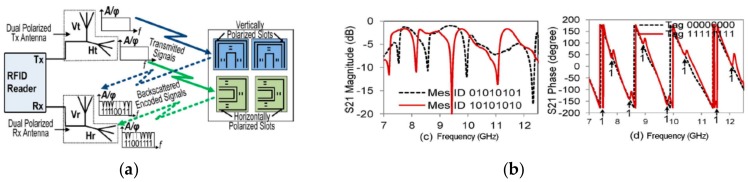
(a) Chipless-RFID based on polarization diversity proposed by Islam et al. and (b) measured frequency response of a tag with the indicated code. Figure extracted from [93].
Figure 24
Figure 24
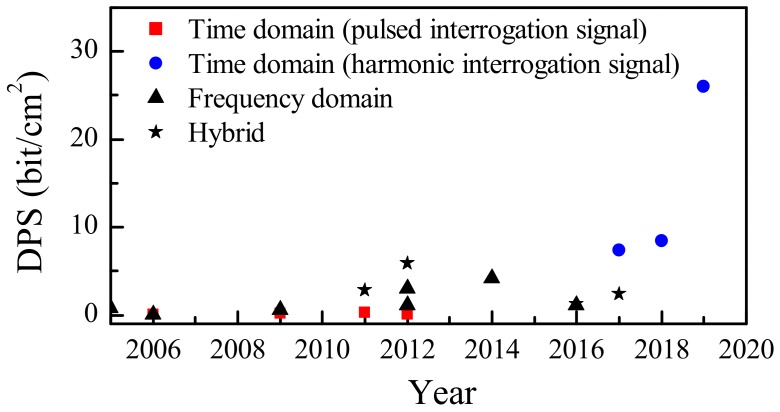
Historic evolution of DPS for different encoding methods.

References

    1. Rance O., Perret E., Siragusa R., Lemaître-Auger P. RCS Synthesis for Chipless RFID: Theory and Design. Elsevier; Atlanta, GA, USA: 2017.
    1. Perret E. Radio Frequency Identification and Sensors: From RFID to Chipless RFID. John Wiley & Sons, Inc.; Hoboken, NJ, USA: 2014.
    1. Vena A., Perret E., Tedjini S. Chipless RFID Based on RF Encoding Particle: Realization, Coding and Reading System. ISTE Press—Elsevier; Atlanta, GA, USA: 2016.
    1. Karmakar N.C., Amin E.M., Saha J.K. Chipless RFID Sensors. John Wiley & Sons, Inc.; Hoboken, NJ, USA: 2016.
    1. Karmakar N.C., editor. Handbook of Smart Antennas for RFID Systems. John Wiley & Sons, Inc.; Hoboken, NJ, USA: 2010.

LinkOut - more resources