. 2019 Aug 1;11(8):708.
doi: 10.3390/v11080708.

Genome of Alaskapox Virus, A Novel Orthopoxvirus Isolated from Alaska

Affiliations

Genome of Alaskapox Virus, A Novel Orthopoxvirus Isolated from Alaska

Crystal M Gigante et al. Viruses. .

Abstract

Since the eradication of smallpox, there have been increases in poxvirus infections and the emergence of several novel poxviruses that can infect humans and domestic animals. In 2015, a novel poxvirus was isolated from a resident of Alaska. Diagnostic testing and limited sequence analysis suggested this isolate was a member of the Orthopoxvirus (OPXV) genus but was highly diverged from currently known species, including Akhmeta virus. Here, we present the complete 210,797 bp genome sequence of the Alaska poxvirus isolate, containing 206 predicted open reading frames. Phylogenetic analysis of the conserved central region of the genome suggested the Alaska isolate shares a common ancestor with Old World OPXVs and is diverged from New World OPXVs. We propose this isolate as a member of a new OPXV species, Alaskapox virus (AKPV). The AKPV genome contained host range and virulence genes typical of OPXVs but lacked homologs of C4L and B7R, and the hemagglutinin gene contained a unique 120 amino acid insertion. Seven predicted AKPV proteins were most similar to proteins in non-OPXV Murmansk or NY_014 poxviruses. Genomic analysis revealed evidence suggestive of recombination with Ectromelia virus in two putative regions that contain seven predicted coding sequences, including the A-type inclusion protein.

Keywords: Alaska; alaskapox; orthopox; orthopoxvirus; phylogenetics; poxvirus; recombination.


Conflict of interest statement

The authors declare no conflict of interest. The funders had no role in the design of the study; in the collection, analyses, or interpretation of data; in the writing of the manuscript, or in the decision to publish the results.

Figures
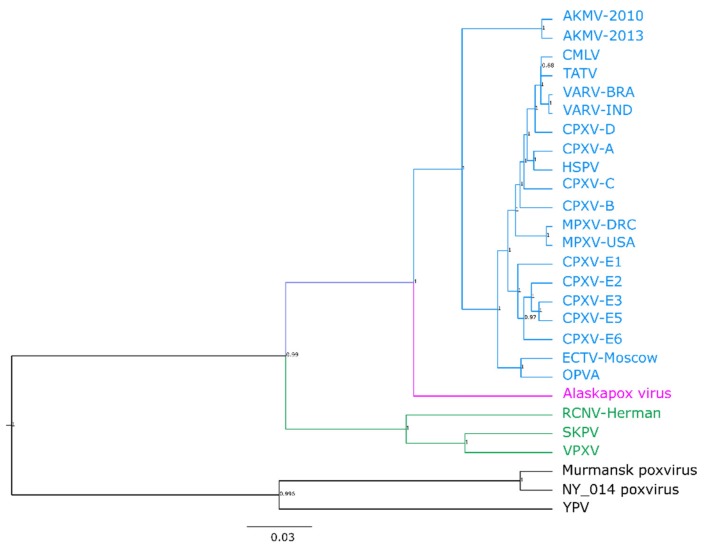
Figure 1
Figure 1
Phylogenetic analysis of the conserved central region of the Alaskapox virus (AKPV) genome with representative OPXVs, Murmansk poxvirus, NY_014 poxvirus, and Yoka poxvirus (YPV). Twenty-seven poxvirus sequences (Table S1) were aligned using MAFFT. Old World OPXVs are highlighted in blue; New World OPXVs are highlighted in green; AKPV is highlighted in pink. Phylogenetic tree was estimated using BEAST v. 2.5.1 using the GTR+G+I model under a relaxed lognormal molecular clock. Posterior probability is shown next to each node.
Figure 2
Figure 2
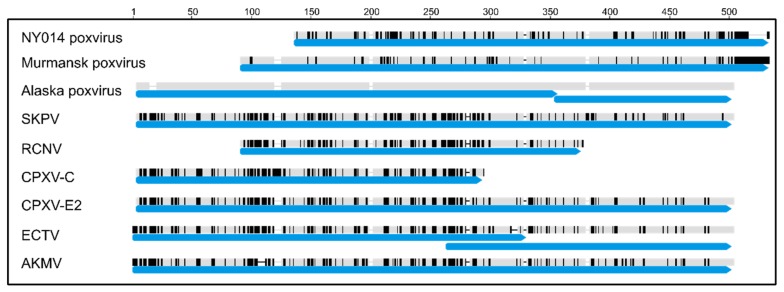
Alignment of C-type lectin genes from AKPV and reference OPXVs. Nucleotide identity to AKPV is shown by black or gray shading: identities are shown in gray, differences in black. Black or gray bars indicate sequence, whereas black or gray horizontal lines indicate gaps. Blue arrows indicate the locations of annotated CDS. Alignment position is shown above the graph.
Figure 3
Figure 3
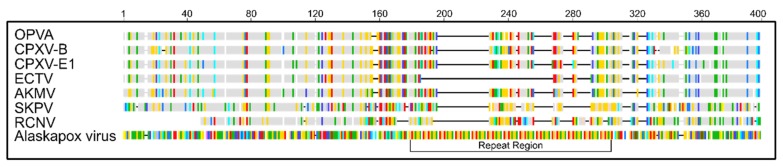
Comparison of predicted hemagglutinin protein from Alaskapox virus (AKPV) and reference OPXVs. Amino acid sequence of AKPV hemagglutinin is shown in RasMol color scheme. For others, amino acid sequence is colored compared to AKPV protein: identities are shown in gray; differences are colored according to RasMol scheme. Gaps not shared with AKPV are shown by black horizontal lines. Sequences from OPVA, CPXV-B, CPXV-E1, ECTV-Moscow, AKMV-2013, SKPV, and RCNV-85A are shown.
Figure 4
Figure 4
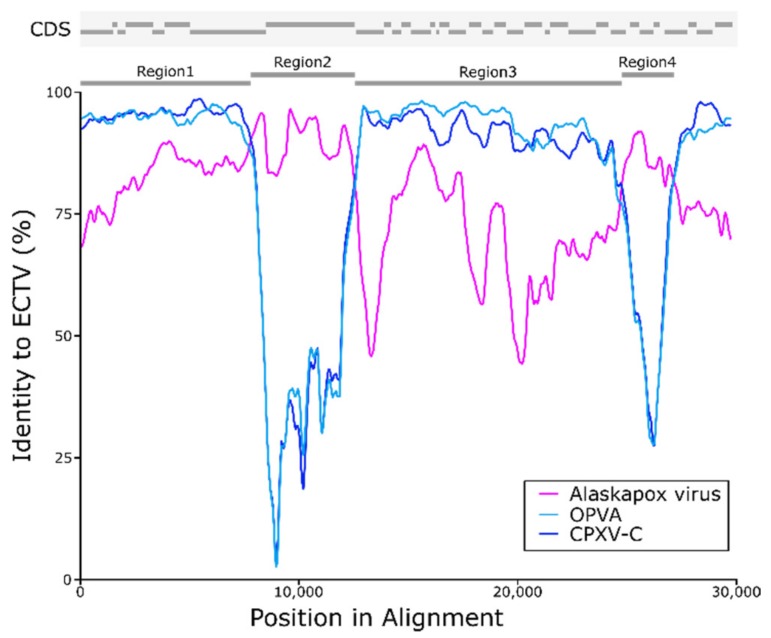
Potential recombination between Ectromelia virus (ECTV) and the Alaskapox virus (AKPV) isolate. Similarity plot displaying the sequence identity of AKPV, Orthopoxvirus Abatino (OPVA) and Cowpox virus (CPXV-C) to ECTV (Moscow strain) in the putative recombination region. Across most positions examined, OPVA and CPXV-C have higher similarity to ECTV than AKPV. However, the AKPV sequence has higher sequence identity than ECTV in two regions that can be seen as the pink AKPV line crossing the blue OPVA and CPXV lines. Above the graph, there is a schematic showing locations of annotated coding sequences (CDS), putative recombinant regions 2 and 4, and control regions 1 and 3.

References

    1. Haller S.L., Peng C., McFadden G., Rothenburg S. Poxviruses and the evolution of host range and virulence. Infect. Genet. Evol. 2014;21:15–40. doi: 10.1016/j.meegid.2013.10.014. - DOI - PMC - PubMed
    1. Reynolds M.G., Guagliardo S.A.J., Nakazawa Y.J., Doty J.B., Mauldin M.R. Understanding orthopoxvirus host range and evolution: From the enigmatic to the usual suspects. Curr. Opin. Virol. 2018;28:108–115. doi: 10.1016/j.coviro.2017.11.012. - DOI - PubMed
    1. Essbauer S., Pfeffer M., Meyer H. Zoonotic poxviruses. Vet. Microbiol. 2010;140:229–236. doi: 10.1016/j.vetmic.2009.08.026. - DOI - PMC - PubMed
    1. Vorou R.M., Papavassiliou V.G., Pierroutsakos I.N. Cowpox virus infection: An emerging health threat. Curr. Opin. Infect. Dis. 2008;21:153–156. doi: 10.1097/QCO.0b013e3282f44c74. - DOI - PubMed
    1. Nitsche A., Pauli G. Sporadic human cases of cowpox in Germany. Eurosurveillance. 2007;12:pii=3178. doi: 10.2807/esw.12.16.03178-en. - DOI - PubMed

Publication types

LinkOut - more resources