


Glycemic Variability and Hypoglycemic Excursions With Continuous Glucose Monitoring Compared to Intermittently Scanned Continuous Glucose Monitoring in Adults With Highest Risk Type 1 Diabetes
- PMID: 31375042
- PMCID: PMC7576953
- DOI: 10.1177/1932296819867688
Glycemic Variability and Hypoglycemic Excursions With Continuous Glucose Monitoring Compared to Intermittently Scanned Continuous Glucose Monitoring in Adults With Highest Risk Type 1 Diabetes
Abstract
Background: The I-HART CGM study has shown that real-time continuous glucose monitoring (rtCGM) has greater beneficial impact on hypoglycemia than intermittently scanned continuous glucose monitoring (iscCGM) in adults with type 1 diabetes at high risk (Gold score ≥4 or recent severe hypoglycemia using insulin injections). In this subanalysis, we present the impact of rtCGM and iscCGM on glycemic variability (GV).
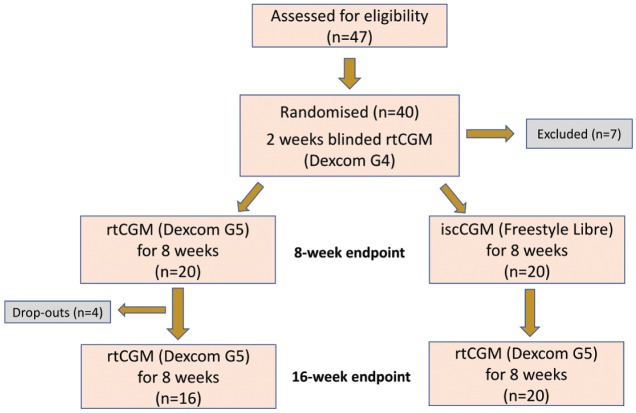
Methods: Forty participants were recruited to this parallel group study. Following two weeks of blinded rtCGM (DexcomG4), participants were randomized to rtCGM (Dexcom G5; n = 20) or iscCGM (Freestyle Libre; n = 20) for eight weeks. An open-extension phase enabled participants on rtCGM to continue for a further eight weeks and those on iscCGM to switch to rtCGM over this period. Glycemic variability measures at baseline, 8- and 16-week endpoints were compared between groups.
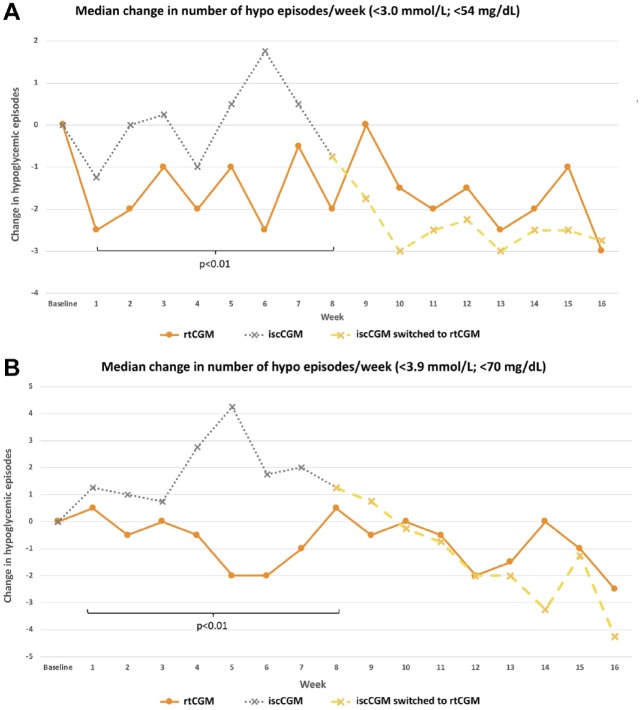
Results: At the eight-week endpoint, between-group differences demonstrated significant reduction in several GV measures with rtCGM compared to iscCGM (GRADE%hypoglycemia, index of glycemic control [IGC], and average daily risk range [ADRR]; P < .05). Intermittently scanned continuous glucose monitoring reduced mean average glucose and glycemic variability percentage and GRADE%hyperglycemia compared with rtCGM (P < .05). At 16 weeks, the iscCGM group switching to rtCGM showed significant improvement in GRADE%hypoglycemia, personal glycemic status, IGC, and ADRR.
Conclusion: Our data suggest most, but not all, GV measures improve with rtCGM compared with iscCGM, particularly those measures associated with the risk of hypoglycemia. Selecting appropriate glucose monitoring technology to address GV in this high-risk cohort is important to minimize the risk of glucose extremes and severe hypoglycemia.
Clinical trial registration: ClinicalTrials.gov NCT03028220.
Keywords: continuous glucose monitoring; glycemic variability; hypoglycemia episodes; intermittently scanned continuous glucose monitoring; type 1 diabetes.
Conflict of interest statement
Figures
Comment in
-
Unproven Glycemic Variability and Hypoglycemia Outcomes in I HART Study in High-Risk Adults with Type 1 Diabetes: Comment on Avari et al.J Diabetes Sci Technol. 2020 May;14(3):695-696. doi: 10.1177/1932296820904443. Epub 2020 Feb 13. J Diabetes Sci Technol. 2020. PMID: 32054302 Free PMC article. No abstract available.
References
-
- El-Laboudi AH, Godsland IF, Johnston DG, Oliver NS. Measures of glycemic variability in type 1 diabetes and the effect of real-time continuous glucose monitoring. Diabetes Technol Ther. 2016;18(12):806-812. - PubMed
