Review
. 2020 Feb:60:138-147.
doi: 10.1016/j.semcancer.2019.07.021. Epub 2019 Jul 31.

The pan-therapeutic resistance of disseminated tumor cells: Role of phenotypic plasticity and the metastatic microenvironment

Affiliations
Review

The pan-therapeutic resistance of disseminated tumor cells: Role of phenotypic plasticity and the metastatic microenvironment

Bo Ma et al. Semin Cancer Biol. 2020 Feb.

Abstract

Cancer metastasis is the leading cause of mortality in patients with solid tumors. The majority of these deaths are associated with metastatic disease that occurs after a period of clinical remission, anywhere from months to decades following removal of the primary mass. This dormancy is prominent in cancers of the breast and prostate among others, leaving the survivors uncertain about their longer-term prognosis. The most daunting aspect of this dormancy and re-emergence is that the micrometastases in particular, and even large lethal outgrowths are often show resistance to agents to which they have not been exposed. This suggests that in addition to specific mutations that target single agents, there also exist adaptive mechanisms that provide this pan-resistance. Potential molecular underpinnings of which are the topic of this review.

Keywords: Disseminated tumor cells; Dormancy; Epithelial-mesenchymal plasticity; Metastasis; Metastatic microenvironment; Therapeutic resistance.


Conflict of interest statement

Declaration of Competing Interest There are no conflicts of interest to declare.

Figures

Fig.1.
Fig.1.
Metastatic cascade post-extravastion. After extravasation, the MME modulates tumor cell plasticity, dormancy and emergence. Successful colonization by DTCs and entrance into a dormant state involves a cancer-associated mesenchymal to epithelial reverting transition (cMErT) and establishing heterotypic E-cadherin connections with the resident cells of the metastatic organ. After a period of time, dormant cells may be stimulated by inflammatory signals to outgrow and undergo a second cancer-associated epithelial to mesenchymal transition (cEMT). The inflammatory signals are produced following homeostatic disruption (either systemically or locally). They may act to stimulate outgrowth of dormant cells directly or indirectly by activating innate immune or stromal cells in the MME which then produce mitogenic signals. Made with Affinity Designer 1.7.0.
Fig. 2.
Fig. 2.
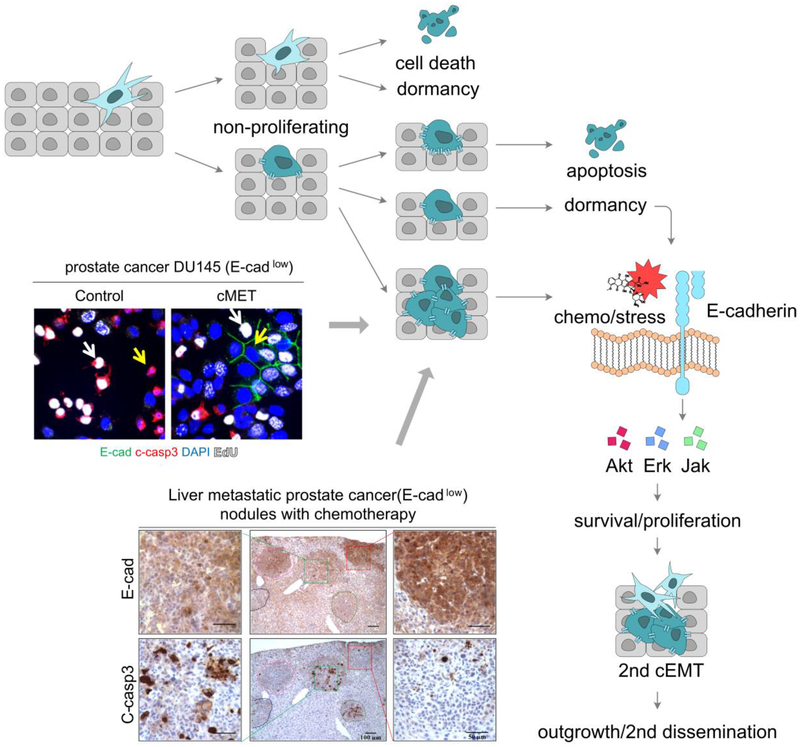
E-cadherin mediates micrometastases dormancy and chemoresistance. (A) An overview schematic depicting entry into dormancy and acquisition of chemoresistance. (B) E-cadherin promotes cell survival independent of cell arrest or proliferation. E-cadherin, green; cleaved caspase-3, red; EdU, white; DAPI, blue. White arrow shows proliferating cells; yellow arrow shows nonproliferating cells. (C) E-cadherin protects tumor cells in the MME from chemotherapy. Representative images of DU145 prostate cancer cells and cleaved caspase-3 on sister sections of the liver. Same tumor on the sister sections is lined by same color. (B&C) Adapted from [58]. Made with Affinity Designer 1.7.0.
Fig.3.
Fig.3.
Mechanisms of resistance conferred by the MME. (A) Chemotherapeutic resistance observed in dormant cells may be conferred by the MME through E-cadherin re-expression, interactions with endothelial cells (ECs), tumor cells integrin binding to extracellular matrix (ECM), and signals, such as IL-6 and IGFs from bone marrow, contribute chemoresistance. Immune recognition and efficacy of immunotherapy is limited through downregulation of immune target molecules (e.g. PD-L1 and MHC I) and possibly some immunosuppressive effects of ECs, macrophages, myeloid derived suppressor cells (MDSCs) and regulatory T cells (Tregs) which suppress the cytotoxic activity or induce apoptosis of anti-tumor T cells and NK cells. (B) Chemotherapeutic resistance observed in outgrowing metastases may be conferred through creation of dense ECM with survival signals from matricellular molecules, tenascin C in particular, and factors produced by activated stromal cells or innate immune cells. Despite upregulated expression of MHC I and PD-L1 on the tumor cells, efficacy of immunotherapy is inhibited through immunosuppressive effects of macrophages, MDSCs and regulatory T cells. Macrophages produced numerous immunosuppressive molecules, while MDCs produce inflammatory mediators which lead to apoptosis of T and NK cells. MDSCs and Tregs express immune checkpoint proteins PD-L1 and CTLA-4, respectively, which suppress effector T cells. Insulin like growth factos (IGFs); Von Willebrand factor (vWf); Indoleamine 2,3-dioxygenase (IDO); cancer –associated fibroblasts (CAFs). Made with Affinity Designer 1.7.0.

References

    1. Mieog JS, van der Hage JA, and van de Velde CJ (2007) Neoadjuvant chemotherapy for operable breast cancer. The British journal of surgery 94, 1189–1200 - PubMed
    1. Redden MH, and Fuhrman GM (2013) Neoadjuvant chemotherapy in the treatment of breast cancer. The Surgical clinics of North America 93, 493–499 - PubMed
    1. Mougalian SS, Hernandez M, Lei X, Lynch S, Kuerer HM, Symmans WF, Theriault RL, Fornage BD, Hsu L, Buchholz TA, Sahin AA, Hunt KK, Yang WT, Hortobagyi GN, and Valero V (2016) Ten-Year Outcomes of Patients With Breast Cancer With Cytologically Confirmed Axillary Lymph Node Metastases and Pathologic Complete Response After Primary Systemic Chemotherapy. JAMA oncology 2, 508–516 - PMC - PubMed
    1. Gonzalez-Angulo AM, Morales-Vasquez F, and Hortobagyi GN (2007) Overview of resistance to systemic therapy in patients with breast cancer. Advances in experimental medicine and biology 608, 1–22 - PubMed
    1. Jones SE (2008) Metastatic breast cancer: the treatment challenge. Clinical breast cancer 8, 224–233 - PubMed

Publication types