


The Ig superfamily protein PTGFRN coordinates survival signaling in glioblastoma multiforme
- PMID: 31377205
- PMCID: PMC6705426
- DOI: 10.1016/j.canlet.2019.07.018
The Ig superfamily protein PTGFRN coordinates survival signaling in glioblastoma multiforme
Abstract
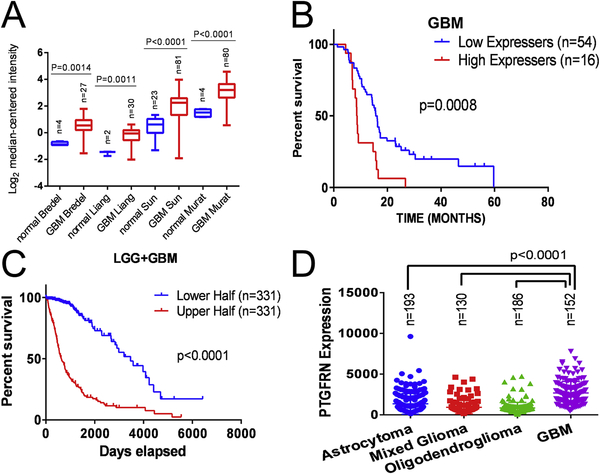
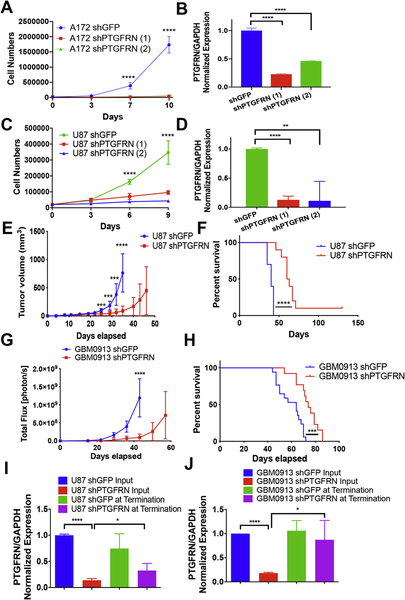
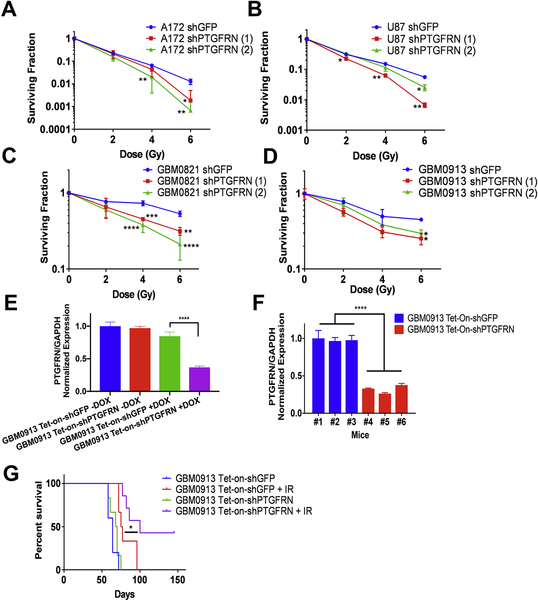
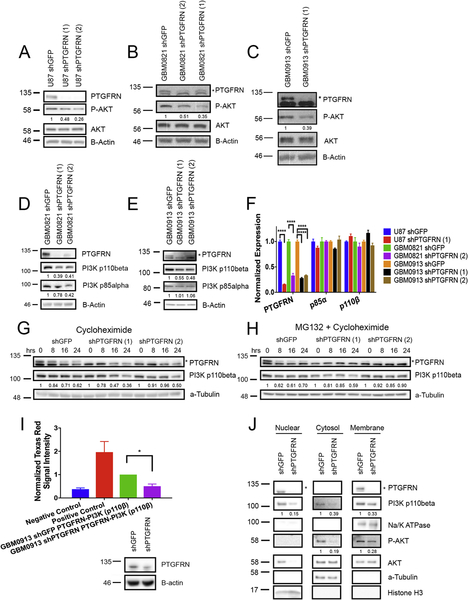
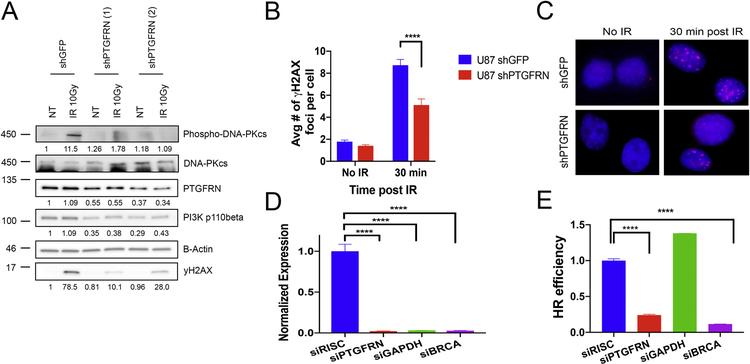
Glioblastoma multiforme (GBM) is the most malignant primary brain tumor with a median survival of approximately 14 months. Despite aggressive treatment of surgical resection, chemotherapy and radiation therapy, only 3-5% of GBM patients survive more than 3 years. Contributing to this poor therapeutic response, it is believed that GBM contains both intrinsic and acquired mechanisms of resistance, including resistance to radiation therapy. In order to define novel mediators of radiation resistance, we conducted a functional knockdown screen, and identified the immunoglobulin superfamily protein, PTGFRN. In GBM, PTGFRN is found to be overexpressed and to correlate with poor survival. Reducing PTGFRN expression radiosensitizes GBM cells and potently decreases the rate of cell proliferation and tumor growth. Further, PTGFRN inhibition results in significant reduction of PI3K p110β and phosphorylated AKT, due to instability of p110β. Additionally, PTGFRN inhibition decreases nuclear p110β leading to decreased DNA damage sensing and DNA damage repair. Therefore overexpression of PTGFRN in glioblastoma promotes AKT-driven survival signaling and tumor growth, as well as increased DNA repair signaling. These findings suggest PTGFRN is a potential signaling hub for aggressiveness in GBM.
Keywords: AKT; Glioblastoma multiforme; PI3K p110β; PTGFRN; Radiation.
Copyright © 2019 Elsevier B.V. All rights reserved.
Conflict of interest statement
Figures
References
-
- Krex D, Klink B, Hartmann C, von Deimling A, Pietsch T, Simon M, Sabel M, Steinbach JP, Heese O, Reifenberger G, Weller M, Schackert G, German Glioma N. Long-term survival with glioblastoma multiforme. Brain : a journal of neurology. 2007;130(Pt 10):2596–606. - PubMed
-
- Stupp R, Mason WP, van den Bent MJ, Weller M, Fisher B, Taphoorn MJ, Belanger K, Brandes AA, Marosi C, Bogdahn U, Curschmann J, Janzer RC, Ludwin SK, Gorlia T, Allgeier A, Lacombe D, Cairncross JG, Eisenhauer E, Mirimanoff RO, European Organisation for R, Treatment of Cancer Brain T, Radiotherapy G, National Cancer Institute of Canada Clinical Trials G. Radiotherapy plus concomitant and adjuvant temozolomide for glioblastoma. The New England journal of medicine. 2005;352(10):987–96. - PubMed
-
- Dunn GP, Rinne ML, Wykosky J, Genovese G, Quayle SN, Dunn IF, Agarwalla PK, Chheda MG, Campos B, Wang A, Brennan C, Ligon KL, Furnari F, Cavenee WK, Depinho RA, Chin L, Hahn WC. Emerging insights into the molecular and cellular basis of glioblastoma. Genes & development. 2012;26(8):756–84. - PMC - PubMed
-
- Wen PY, Kesari S. Malignant gliomas in adults. The New England journal of medicine. 2008;359(5):492–507. - PubMed
-
- Bao S, Wu Q, McLendon RE, Hao Y, Shi Q, Hjelmeland AB, Dewhirst MW, Bigner DD, Rich JN. Glioma stem cells promote radioresistance by preferential activation of the DNA damage response. Nature. 2006;444(7120):756–60. - PubMed
Publication types
MeSH terms
Substances
Grants and funding
LinkOut - more resources
Full Text Sources
Other Literature Sources
Medical
Molecular Biology Databases
Research Materials
