


Protocolized Post-Extubation Respiratory Support to prevent reintubation: protocol and statistical analysis plan for a clinical trial
- PMID: 31377713
- PMCID: PMC6687016
- DOI: 10.1136/bmjopen-2019-030476
Protocolized Post-Extubation Respiratory Support to prevent reintubation: protocol and statistical analysis plan for a clinical trial
Abstract
Introduction: Following extubation from invasive mechanical ventilation, nearly one in seven critically ill adults requires reintubation. Reintubation is independently associated with increased mortality. Postextubation respiratory support (non-invasive ventilation or high-flow nasal cannula applied at the time of extubation) has been reported in small-to-moderate-sized trials to reduce reintubation rates among hypercapnic patients, high-risk patients without hypercapnia and low-risk patients without hypercapnia. It is unknown whether protocolised provision of postextubation respiratory support to every patient undergoing extubation would reduce the overall reintubation rate, compared with usual care.
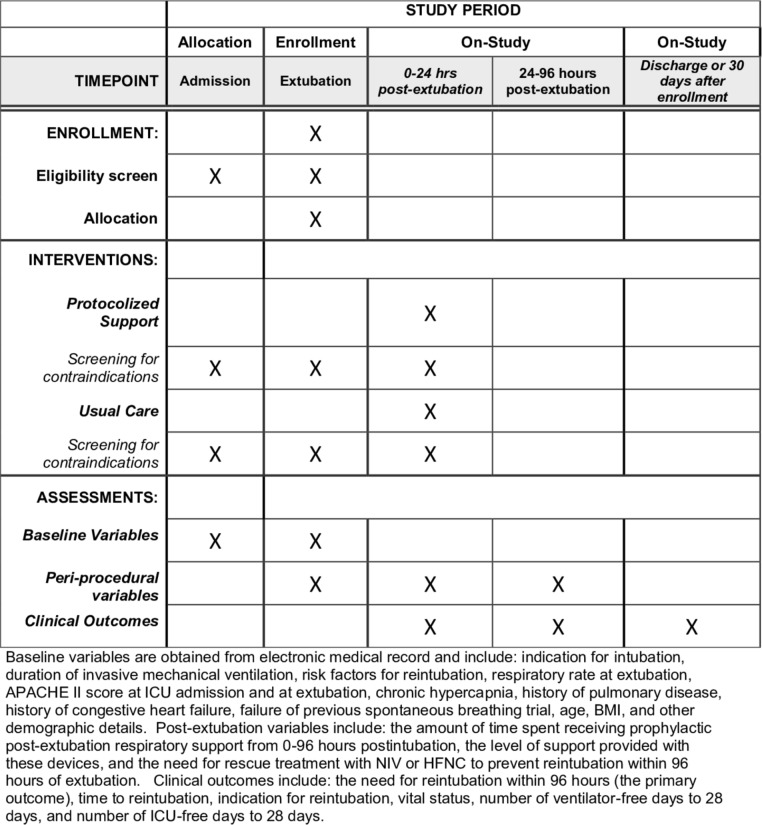
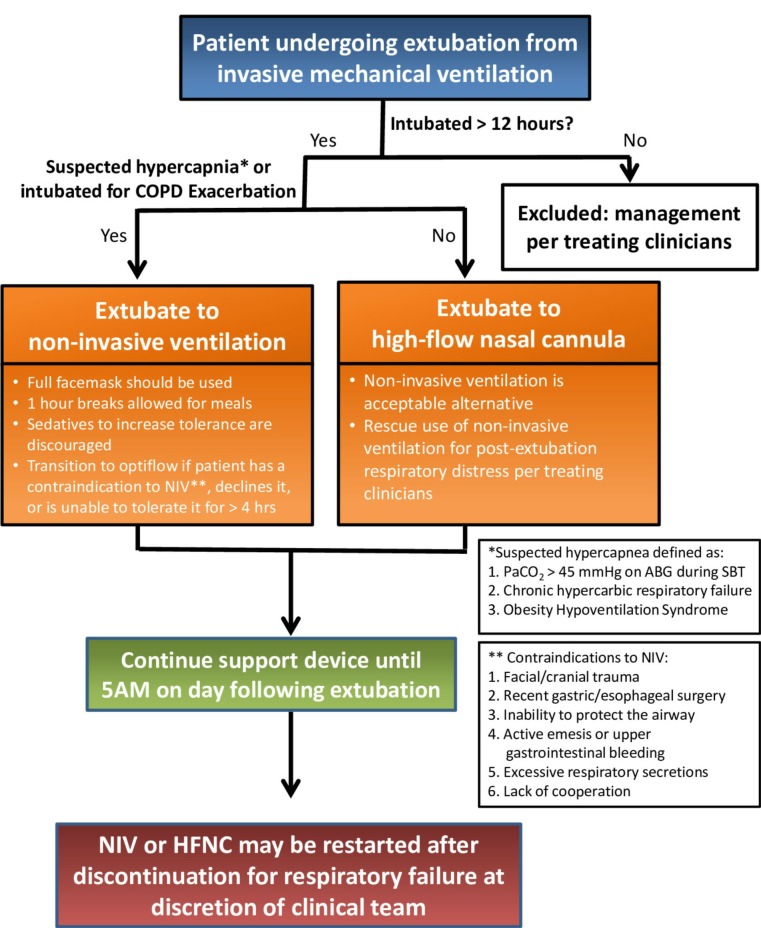
Methods and analysis: The Protocolized Post-Extubation Respiratory Support (PROPER) trial is a pragmatic, cluster cross-over trial being conducted between 1 October 2017 and 31 March 2019 in the medical intensive care unit of Vanderbilt University Medical Center. PROPER compares usual care versus protocolized post-extubation respiratory support (a respiratory therapist-driven protocol that advises the provision of non-invasive ventilation or high-flow nasal cannula based on patient characteristics). For the duration of the trial, the unit is divided into two clusters. One cluster receives protocolised support and the other receives usual care. Each cluster crosses over between treatment group assignments every 3 months. All adults undergoing extubation from invasive mechanical ventilation are enrolled except those who received less than 12 hours of mechanical ventilation, have 'Do Not Intubate' orders, or have been previously reintubated during the hospitalisation. The anticipated enrolment is approximately 630 patients. The primary outcome is reintubation within 96 hours of extubation.
Ethics and dissemination: The trial was approved by the Vanderbilt Institutional Review Board. The results will be submitted for publication in a peer-reviewed journal and presented at one or more scientific conferences.
Trial registration number: NCT03288311.
Keywords: respiratory physiology.
© Author(s) (or their employer(s)) 2019. Re-use permitted under CC BY-NC. No commercial re-use. See rights and permissions. Published by BMJ.
Conflict of interest statement
Competing interests: None declared.
Figures

References
-
- Girard TD, Kress JP, Fuchs BD, et al. . Efficacy and safety of a paired sedation and ventilator weaning protocol for mechanically ventilated patients in intensive care (Awakening and Breathing Controlled trial): a randomised controlled trial. Lancet 2008;371:126–34. 10.1016/S0140-6736(08)60105-1 - DOI - PubMed
-
- Ouellette DR, Patel S, Girard TD, et al. . Liberation from mechanical ventilation in critically ill adults: an official american college of chest physicians/american thoracic society clinical practice guideline: inspiratory pressure augmentation during spontaneous breathing trials, protocols minimizing sedation, and noninvasive ventilation immediately after extubation. Chest 2017;151 10.1016/j.chest.2016.10.036 - DOI - PubMed
Publication types
MeSH terms
Associated data
Grants and funding
LinkOut - more resources
Full Text Sources
Medical
