. 2019 Oct;181(2):683-700.
doi: 10.1104/pp.19.00707. Epub 2019 Aug 4.

Male Sterility in Maize after Transient Heat Stress during the Tetrad Stage of Pollen Development

Affiliations

Male Sterility in Maize after Transient Heat Stress during the Tetrad Stage of Pollen Development

Kevin Begcy et al. Plant Physiol. 2019 Oct.

Abstract

Shifts in the duration and intensity of ambient temperature impair plant development and reproduction, particularly male gametogenesis. Stress exposure causes meiotic defects or premature spore abortion in male reproductive organs, leading to male sterility. However, little is known about the mechanisms underlying stress and male sterility. To elucidate these mechanisms, we imposed a moderate transient heat stress on maize (Zea mays) plants at the tetrad stage of pollen development. After completion of pollen development at optimal conditions, stress responses were assessed in mature pollen. Transient heat stress resulted in reduced starch content, decreased enzymatic activity, and reduced pollen germination, resulting in sterility. A transcriptomic comparison pointed toward misregulation of starch, lipid, and energy biosynthesis-related genes. Metabolomic studies showed an increase of Suc and its monosaccharide components, as well as a reduction in pyruvate. Lipidomic analysis showed increased levels of unsaturated fatty acids and decreased levels of saturated fatty acids. In contrast, the majority of genes involved in developmental processes such as those required for auxin and unfolded protein responses, signaling, and cell wall biosynthesis remained unaltered. It is noteworthy that changes in the regulation of transcriptional and metabolic pathway genes, as well as heat stress proteins, remained altered even though pollen could recover during further development at optimal conditions. In conclusion, our findings demonstrate that a short moderate heat stress during the highly susceptible tetrad stage strongly affects basic metabolic pathways and thus generates germination-defective pollen, ultimately leading to severe yield losses in maize.


Figures

Figure 1.
Figure 1.
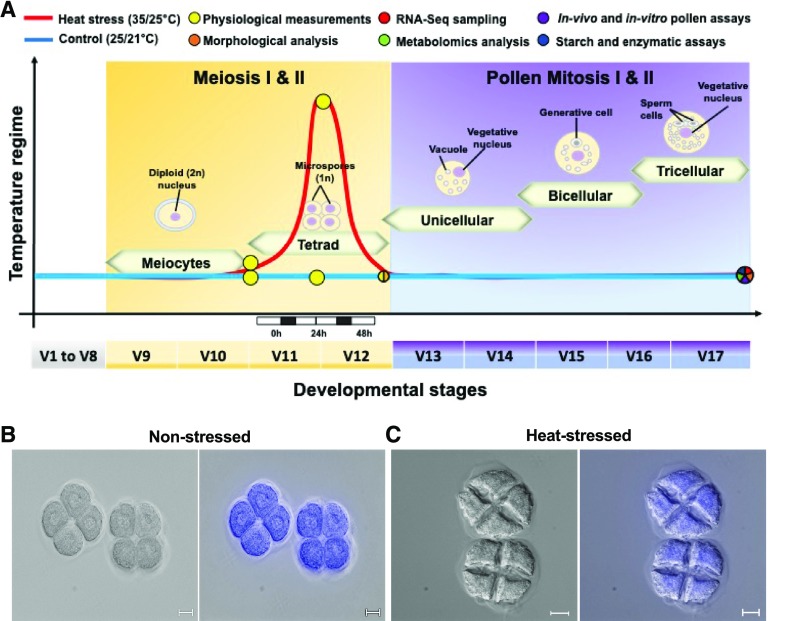
A short heat stress period applied at the tetrad stage affects pollen development in maize. A, Experimental setup and sampling scheme. Maize plants were grown in control conditions (25°C/21°C light/dark period) until they reached the tetrad stage of pollen development. Stages were identified according to Begcy and Dresselhaus (2017). At stage V11, plants were exposed to moderate heat stress (35°C/25°C light/dark period) for 48 h and afterward transferred back to control conditions until maturity. Red and blue lines indicate heat stress and control temperature regimes, respectively. Pie-chart colors and position indicate assay types and time points, respectively. B and C, Bright-field images (left) and merged bright-field and UV images (right) of DAPI-stained maize pollen at the tetrad stage of V12 nonstressed and heat-stressed plants, as indicated. Scale bars = 10 μm.
Figure 2.
Figure 2.
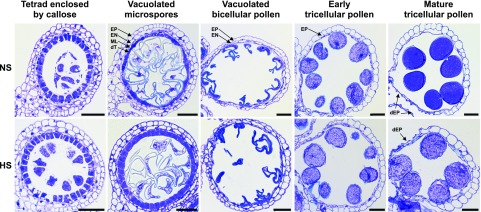
Disintegration of anther cell layers was slightly delayed after heat stress was applied at the tetrad stage. Anther sections were stained with toluidine blue. Note that large and highly vacuolated cells collapsed during the staining procedure. Top row, Representative images showing anther development in nonstressed (NS) plants at the stages indicated. Bottom row, Representative images showing anther developmental stages after a 48 h heat stress was applied at the tetrad stage (HS). Degeneration of the tapetum (dT) and middle layer (ML) of anthers were delayed after heat stress. At the bicellular stage, these cell layers were fully disintegrated in both samples. Degeneration of the endothecium (EN) was delayed in HS samples at the bicellular/tricellular stage. At maturity, only the epidermis cell layer (EP) is left and partly disintegrated (dEP) for pollen release in control plants. Pollen of heat-stressed plants shows less intense staining and the endothecium is less disintegrated. Scale bars = 50 µm.
Figure 3.
Figure 3.
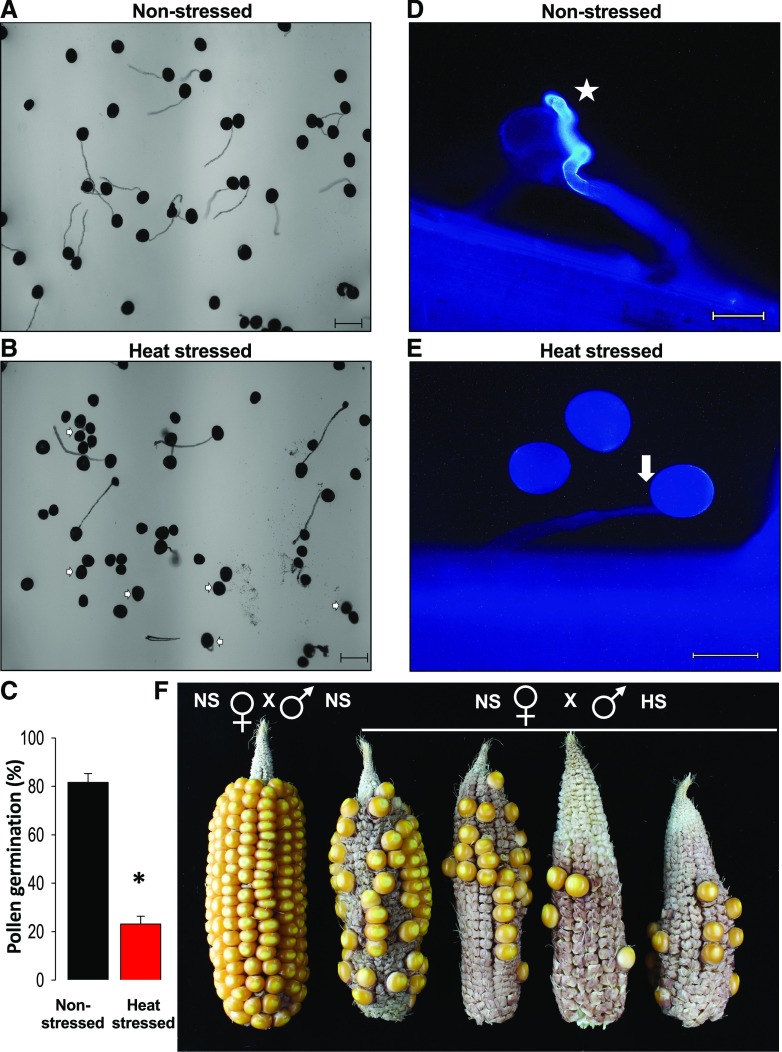
Heat stress applied during the tetrad stage of pollen development inhibits pollen germination in maize. A and B, In vitro germination assay of pollen isolated from nonstressed (A) and heat-stressed plants (B) show a reduced germination rate and burst of stressed pollen. Arrows indicate nongerminated pollen tubes. Scale bars = 100 μm. C, Percentage of in vitro germination rate of pollen harvested from nonstressed and heat-stressed plants. The asterisk indicates a significant difference at P < 0.001; one-tailed t test comparing heat-stressed samples to nonstressed samples. D and E, Aniline blue staining of nonstressed (D) and heat-stressed (E) pollen germinating on papilla hair cells show lack of pollen tubes and penetration after heat stress application. The star indicates a normal germinating pollen tube. Scale bars = 100 μm. F, Nonstressed cobs were pollinated with both nonstressed pollen (NS × NS) and heat-stressed pollen (NS × HS). Seed set is strongly reduced after using heat-stressed pollen. Data are presented as the mean ± sd. n = 400–500.
Figure 4.
Figure 4.
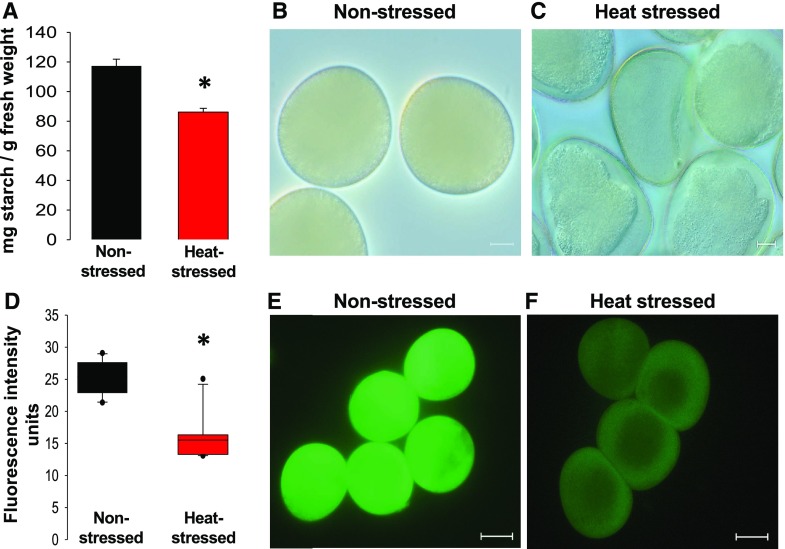
Transient moderate heat stress at the tetrad stage leads to reduced starch content and enzymatic activity in mature pollen. A, Total starch quantification of mature pollen subjected to heat stress at the tetrad stage and the nonstressed control pollen. B and C, Light microscopic images of nonstressed (B) and heat-stressed pollen (C). D, Quantification of enzymatic activity (D) in mature pollen stained with FDA in nonstressed (E) and heat-stressed pollen (F). Data are presented as the mean ± sd. Scale bars = 10 μm (B and C) and 20 μm (E and F).
Figure 5.
Figure 5.
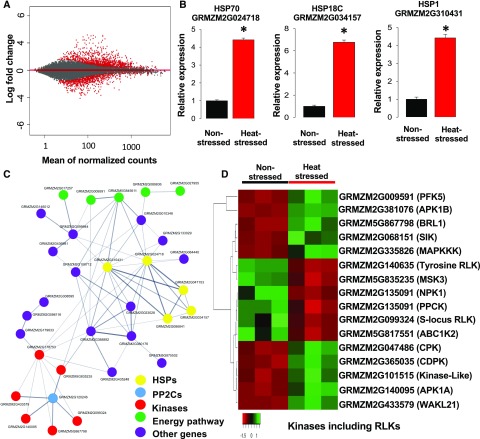
Differential gene expression analysis and data validation of mature pollen transiently heat stressed at the tetrad stage. A, Differential gene expression (the base 2 logarithm fold change) in mature maize pollen samples from plants exposed to heat stress relative to control (nonstressed) is plotted versus average gene expression level (i.e. logarithm of mean counts normalized for difference in library sizes). Red color indicates differentially expressed genes (DEG) exhibiting significant expression. B, RT-qPCR analysis shows that expression of HSP genes is still increased in mature pollen 2 weeks after application of heat stress at the tetrad stage. The asterisk indicates significant difference at P < 0.001; one-tailed t test comparing heat-stressed samples to nonstressed samples. n = 3 biological replicates, each with 3 technical replicates. C, Analysis of interactions of differentially expressed genes in response to heat stress. Well-known HSP markers for heat-stress responses are highlighted in yellow. A threshold of 0.7 of edge confidence was used. Thicker and thinner lines represent edge confidence of 0.9 and 0.7, respectively. A detailed list of the genes included in the gene interaction analysis can be found in Supplemental Table S4A. D, A number of genes encoding kinases, including RLKs, are differentially expressed in mature pollen after application of heat stress at the tetrad stage.
Figure 6.
Figure 6.
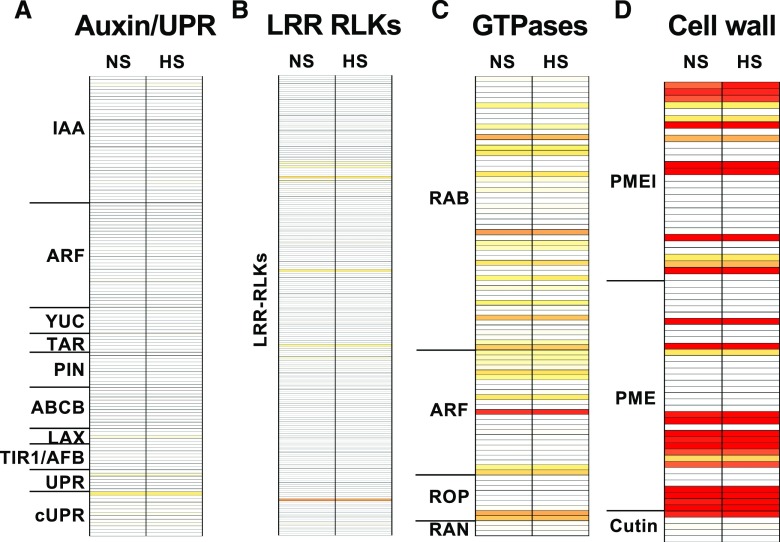
Expression of genes involved in auxin and UPRs, signaling as well as cell wall biosynthesis, is largely unaltered in mature pollen grains after application of moderate heat stress at the tetrad stage. A, Genes involved in auxin biosynthesis, transport, and response as well as UPRs. cUPR, canonical UPR genes, B and C, Genes encoding LRR RLKs and small GTPases as examples of genes involved in signaling. D, Examples of genes encoding cell wall modification enzymes (PMEs) and their inhibitors (PMEIs), as well as enzymes for cutin/suberin biosynthesis. White boxes indicate lack of gene expression, yellow boxes TPM values of 50, and dark red boxes TPM values >1,000; mixed colors indicate intermediate values. See the summary in Supplemental Table S5 for exact TPM values.
Figure 7.
Figure 7.
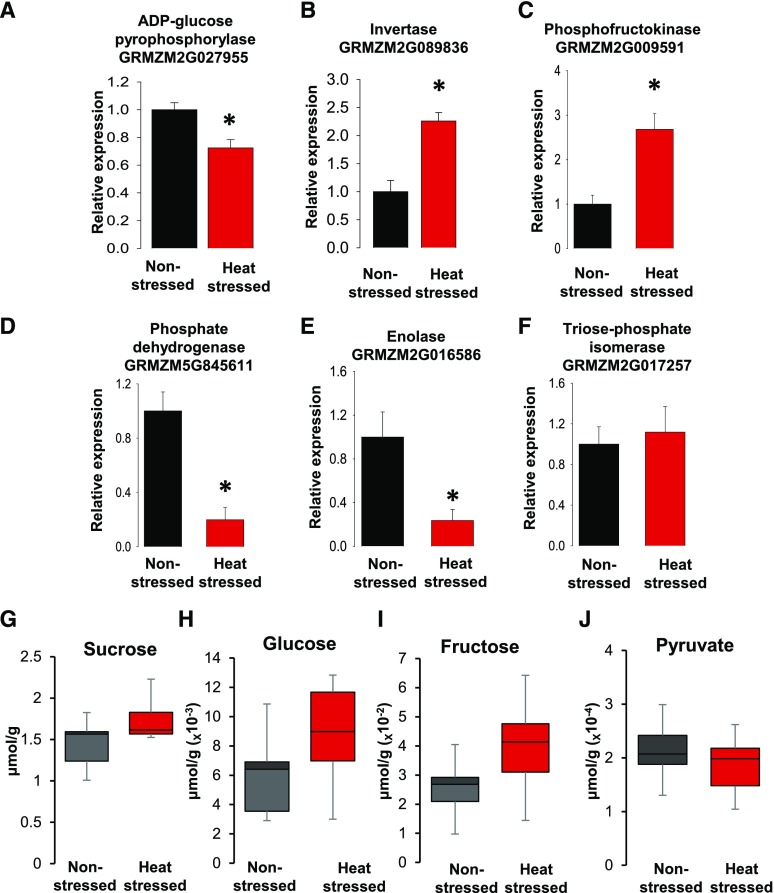
In contrast to Suc and pyruvate, hexose phosphate is increased after transient heat stress. A to E, Transcriptional expression levels of misregulated enzymes involved in energy production. The asterisk indicates significant difference at P < 0.001. F, Triose-phosphate isomerase served as a control. The one-tailed t test was used in comparing heat-stressed samples to nonstressed samples. n = 3 biological replicates, each with 3 technical replicates. G to J, Metabolite levels of Suc (G), Glc (H), Fru (I), and pyruvate (J). Data are normalized to peak areas; n = 8 control and n = 7 heat stressed. Black and red represent nonstressed and heat-stressed pollen, respectively. Data are presented as the mean ± sd.
Figure 8.
Figure 8.
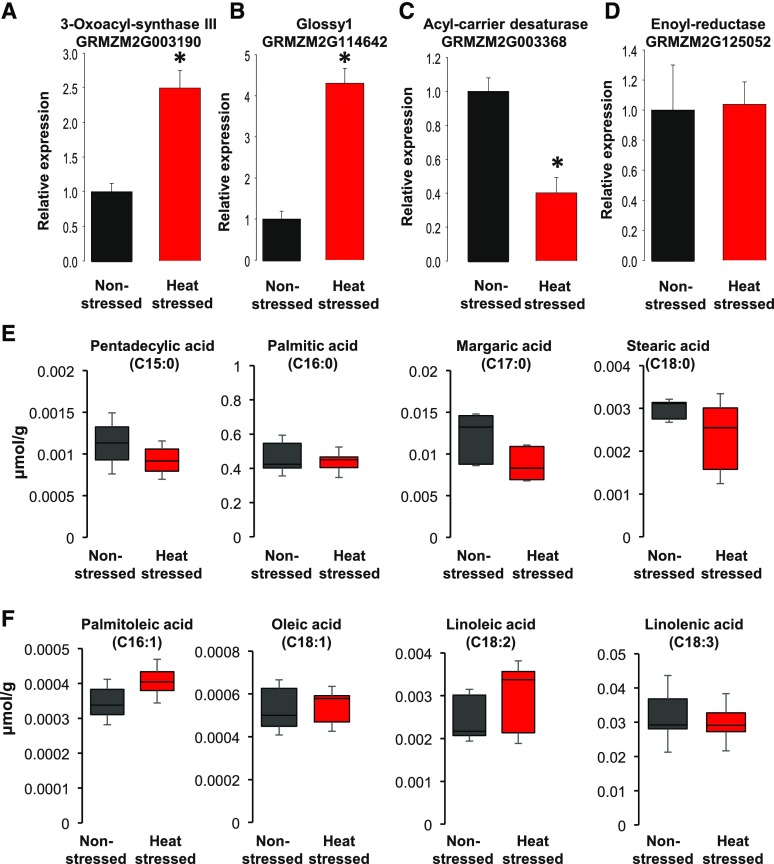
Heat stress during the tetrad stage of maize pollen development reduces levels of saturated fatty acids, while levels of unsaturated fatty acids are increased. A to C, Transcriptional expression of misregulated genes involved in lipid biosynthesis. D, Enoyl-reductase represents an unaltered gene. The asterisk indicates significant difference at P < 0.001; one-tailed t test comparing heat-stressed samples to nonstressed samples. n = 3 biological replicates, each with 3 technical replicates. E and F, Metabolite levels of saturated (E) and unsaturated (F) fatty acids. Data show normalized peak areas, n = 8 control and n = 7 heat stressed. Black and red represent nonstressed and heat-stressed pollen, respectively. Data are presented as the mean ± sd.
Figure 9.
Figure 9.
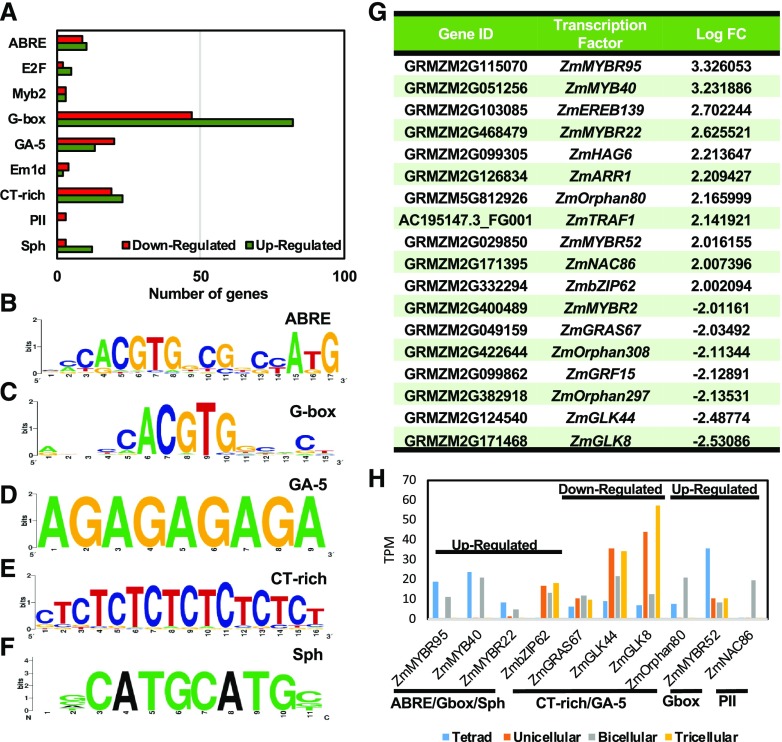
TF binding sites of DEGs in mature pollen in response to heat stress applied at the tetrad stage. A, Main TF binding sites presented in genes differentially expressed after heat stress. B to F, Consensus TF binding site sequences identified for ABRE (B), G-box (C), GA-5 (D), CT-rich (E), and Sph (F) motifs. G, TF classes differentially expressed as the result of heat stress. H, Gene expression during pollen development of TFs containing overrepresented binding sites of DEGs.
Figure 10.
Figure 10.
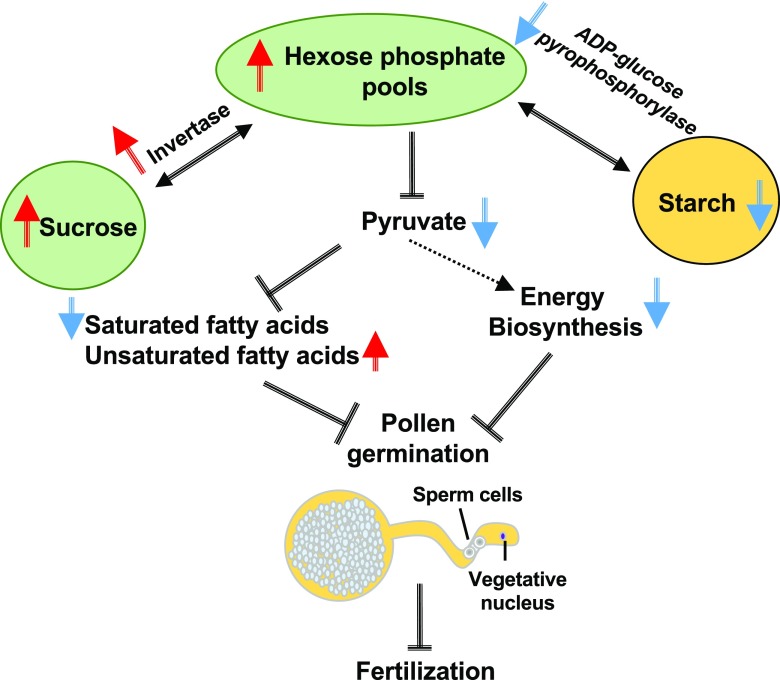
Proposed model incorporating the main pathways that are impacted when pollen is exposed to heat stress at the tetrad stage. Heat stress decreases starch concentration, but to compensate for the deficit of reserves, the activity of invertase increases, leading to high levels of hexose phosphate pools. Nevertheless, conversion of hexose pools into pyruvate is strongly affected, resulting in reduced energy production and fatty acids. Arrows and T-bars indicate induction and inhibition, respectively. Blue and red arrows represent downregulation and upregulation, respectively.

Comment in

References

    1. Albihlal WS, Obomighie I, Blein T, Persad R, Chernukhin I, Crespi M, Bechtold U, Mullineaux PM (2018) Arabidopsis HEAT SHOCK TRANSCRIPTION FACTORA1b regulates multiple developmental genes under benign and stress conditions. J Exp Bot 69: 2847–2862 - PMC - PubMed
    1. Alghabari F, Lukac M, Jones HE, Gooding MJ (2014) Effect of Rht alleles on the tolerance of wheat grain set to high temperature and drought stress during booting and anthesis. J Agron Crop Sci 200: 36–45
    1. Anders S, Huber W (2010) Differential expression analysis for sequence count data. Genome Biol 11: R106. - PMC - PubMed
    1. Barah P, Jayavelu ND, Mundy J, Bones AM (2013) Genome scale transcriptional response diversity among ten ecotypes of Arabidopsis thaliana during heat stress. Front Plant Sci 4: 532. - PMC - PubMed
    1. Barah P, Mahantesha Naika BN, Jayavelu ND, Sowdhamini R, Shameer K, Bones AM (2016) Transcriptional regulatory networks in Arabidopsis thaliana during single and combined stresses. Nucleic Acids Res 44: 3147–3164 - PMC - PubMed

Publication types