


Epidemiology of the U.S. opioid crisis: the importance of the vector
- PMID: 31378974
- PMCID: PMC6984757
- DOI: 10.1111/nyas.14209
Epidemiology of the U.S. opioid crisis: the importance of the vector
Abstract
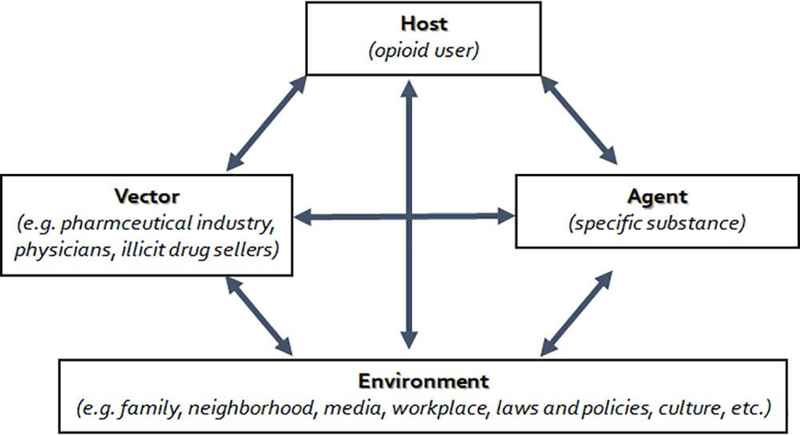
The roots of the remarkably lethal U.S. opioid crisis are complex and inextricably entangled with healthcare, especially in its treatment of another serious health problem: pain. Failures of the healthcare system-including lack of both training in pain management and caution in using an addictive class of medications-precipitated the rise in opioid misuse and addiction over the past two decades, but a wider range of social and economic forces has helped perpetuate the crisis and altered its character. The classic epidemiologic host-agent-environment triad can be augmented for the purpose of elucidating the current opioid crisis by addition of the "vector" to emphasize the importance of purveyors of opioids (licit and illicit), leading to our proposing an expanded host-agent-vector-environment model. Interventions addressing multiple components are needed, including solutions that account for behaviors of all vectors associated with the crisis. For prescription opioids, the vectors include clinicians and pharmaceutical-related companies involved in marketing, prescribing, distributing, and dispensing opioid medications; for illicit opioids, they include drug manufacturing and distribution networks. Attending to the vectors of opioids, while simultaneously implementing a full range of public health, clinical, law enforcement, and other approaches to ending the opioid crisis, may help to improve public health outcomes.
Keywords: epidemiology; opioids; overdose.
Published 2019. This article is a U.S. Government work and is in the public domain in the USA.
Conflict of interest statement
Competing Interests
W.M.C. reports ownership of stock in General Electric, 3M, and Pfizer Inc. unrelated to the submitted work.
Figures
References
-
- Hedegaard H, Miniño AM & Warner M. NCHS Data Brief, no 329 Hyattsville, MD: National Center for Health Statistics; 2018. Drug overdose deaths in the United States, 1999–2017. Data available at: https://www.cdc.gov/nchs/data/databriefs/db329_tables-508.pdf#1 Accessed March 4, 2019.
-
- Council on Economic Advisers. The Underestimated Cost of the Opioid Crisis. Available at: https://www.whitehouse.gov/sites/whitehouse.gov/files/images/The%20Under.... Accessed November 26, 2018.
MeSH terms
Substances
Grants and funding
LinkOut - more resources
Full Text Sources
Other Literature Sources
Medical
Miscellaneous
