


Predicting venous thromboembolism in multiple myeloma: development and validation of the IMPEDE VTE score
- PMID: 31379000
- PMCID: PMC7058359
- DOI: 10.1002/ajh.25603
Predicting venous thromboembolism in multiple myeloma: development and validation of the IMPEDE VTE score
Abstract
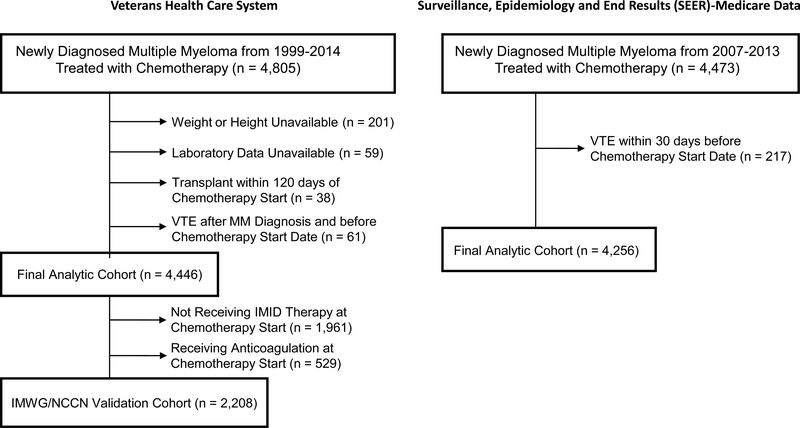
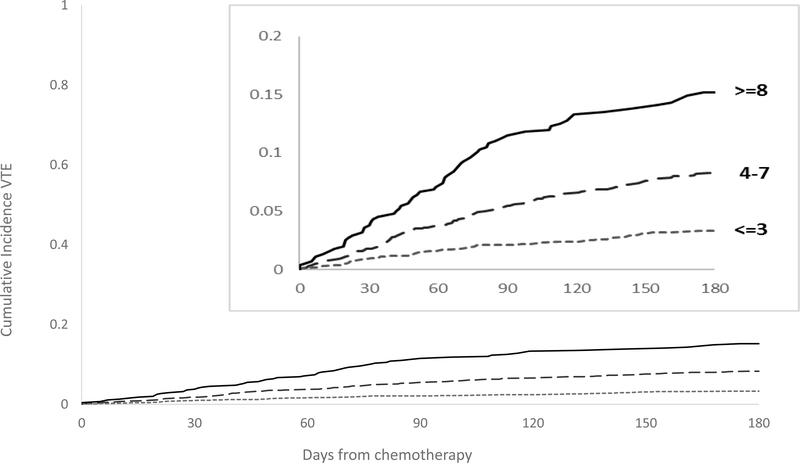
Venous thromboembolism (VTE) is a common cause of morbidity and mortality among patients with multiple myeloma (MM). The International Myeloma Working Group (IMWG) developed guidelines recommending primary thromboprophylaxis, in those identified at high-risk of VTE by the presence of risk factors. The National Comprehensive Cancer Network (NCCN) has adopted these guidelines; however, they lack validation. We sought to develop and validate a risk prediction score for VTE in MM and to evaluate the performance of the current IMWG/NCCN guidelines. Using 4446 patients within the Veterans Administration Central Cancer Registry, we used time-to-event analyses to develop a risk score for VTE in patients with newly diagnosed MM starting chemotherapy. We externally validated the score using the Surveillance, Epidemiology, End Results (SEER)-Medicare database (N = 4256). After identifying independent predictors of VTE, we combined the variables to develop the IMPEDE VTE score (Immunomodulatory agent; Body Mass Index ≥25 kg/m2 ; Pelvic, hip or femur fracture; Erythropoietin stimulating agent; Dexamethasone/Doxorubicin; Asian Ethnicity/Race; VTE history; Tunneled line/central venous catheter; Existing thromboprophylaxis). The score showed satisfactory discrimination in the derivation cohort, c-statistic = 0.66. Risk of VTE significantly increased as score increased (hazard ratio 1.20, P = <.0001). Within the external validation cohort, IMPEDE VTE had a c-statistic of 0.64. For comparison, when evaluating the performance of the IMWG/NCCN guidelines, the c-statistic was 0.55. In summary, the IMPEDE VTE score outperformed the current IMWG/NCCN guidelines and could be considered as the new standard risk stratification for VTE in MM.
© 2019 Wiley Periodicals, Inc.
Conflict of interest statement
Disclosure of Potential Conflicts of Interest:
K.M.S. was on the Bristol-Myers Squibb speaker bureau, served on an advisory board for Pfizer and Bayer, received travel expenses from AstraZeneca and received research funding from NHLBI. T-F. W. received travel expenses from Daiichi Sankyo. T.M.W. received research funding from Janssen. J.M. received research funding from Onyx, Celgene, Sanofi, and AbbVie. N.M.K. received consultancy fees from Janssen, Halozyme, Pfizer, Myriad Genetics, Agendia, and Celldex; research funding from Celldex; and travel expenses from Janssen, Halozyme, Pfizer, and Agendia. K.R.C. received consultancy fees from Roche. All other authors have no conflicts to disclose.
Figures
References
-
- Li W, Garcia D, Cornell RF, et al. Cardiovascular and Thrombotic Complications of Novel Multiple Myeloma Therapies: A Review. JAMA Oncol. 2017;3(7):980–988. - PubMed
-
- Carrier MLG G: Tay J: Wu C: Lee AY Rates of venous thromboembolism in multiple myeloma patients undergoing immunomodulatory therapy with thalidomide or lenalidomide: a systematic review and meta-analysis. Journal of thrombosis and haemostasis : JTH. 2011;9(4):653–663. - PubMed
Publication types
MeSH terms
Substances
Grants and funding
LinkOut - more resources
Full Text Sources
Medical