IRF1 and IRF2 regulate the non-canonical inflammasome
- PMID: 31379068
- PMCID: PMC6726896
- DOI: 10.15252/embr.201948891
IRF1 and IRF2 regulate the non-canonical inflammasome
Abstract
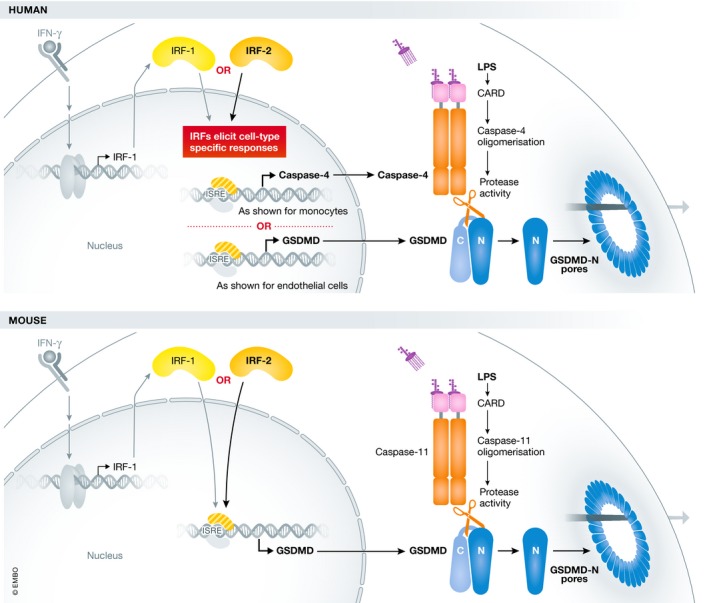
The non-canonical inflammasome mediates pyroptotic cell death in response to bacterial lipopolysaccharide (LPS) found in the cytosol. Understanding the mechanism and regulation of this system is of great interest, given its central role in mouse models of bacterial septic shock. In this issue of EMBO Reports, Benaoudia and colleagues sought to discover extra players in the human non-canonical inflammasome using a CRISPR library screen; the only strongly positive hit apart from the known components caspase-4 and gasdermin D was interferon regulatory factor-2 (IRF2) [1 ]. IRF2 was found to be a transcriptional activator of caspase-4, and in its absence, induction of IRF1 could substitute to maintain caspase-4 expression.
© 2019 The Authors.
Figures
Comment on
-
A genome-wide screen identifies IRF2 as a key regulator of caspase-4 in human cells.EMBO Rep. 2019 Sep;20(9):e48235. doi: 10.15252/embr.201948235. Epub 2019 Jul 29. EMBO Rep. 2019. PMID: 31353801 Free PMC article.
References
Publication types
MeSH terms
Substances
Grants and funding
LinkOut - more resources
Full Text Sources