. 2019 Jul 16:10:884.
doi: 10.3389/fphys.2019.00884. eCollection 2019.

Bitter Taste Receptors for Asthma Therapeutics

Affiliations

Bitter Taste Receptors for Asthma Therapeutics

Ajay P Nayak et al. Front Physiol. .

Abstract

Clinical management of asthma and chronic obstructive pulmonary disease (COPD) has primarily relied on the use of beta 2 adrenergic receptor agonists (bronchodilators) and corticosteroids, and more recently, monoclonal antibody therapies (biologics) targeting specific cytokines and their functions. Although these approaches provide relief from exacerbations, questions remain on their long-term efficacy and safety. Furthermore, current therapeutics do not address progressive airway remodeling (AR), a key pathological feature of severe obstructive lung disease. Strikingly, agonists of the bitter taste receptors (TAS2Rs) deliver robust bronchodilation, curtail allergen-induced inflammatory responses in the airways and regulate airway smooth muscle (ASM) cell proliferation and mitigate features of AR in vitro and in animal models. The scope of this review is to provide a comprehensive and systematic insight into our current understanding of TAS2Rs with an emphasis on the molecular events that ensue TAS2R activation in distinct airway cell types and expand on the pleiotropic effects of TAS2R targeting in mitigating various pathological features of obstructive lung diseases. Finally, we will discuss specific opportunities that could help the development of selective agonists for specific TAS2R subtypes in the treatment of asthma.

Keywords: SCC; TAS2R; airway smooth muscle; asthma; gustducin; relaxation.


Figures
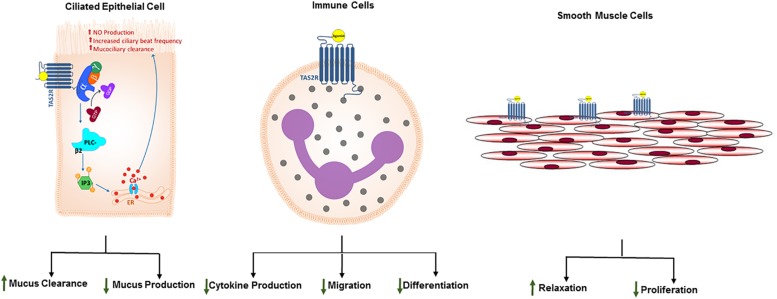
FIGURE 1
FIGURE 1
Expression of TAS2Rs and distinct functional outcomes of TAS2R agonism in airway cell types. Studies have demonstrated that different TAS2R subtypes are expressed on solitary chemosensory cells, ciliated epithelial cells, airway smooth muscle cells and immune cells. Proximal signaling events following TAS2R activation are invariant in taste cells and non-gustatory systems such as respiratory system. Moreover, these receptors have been evolutionarily engineered to adapt to the tissue environment. Consequently, TAS2R activation results in diverse functional outcomes depending on the cell type. While in taste cells, activation of TAS2Rs results in sensation of bitter taste, in epithelial cells and immune cells TAS2Rs play a crucial role in recognizing microbial products and mounting nuanced antimicrobial responses, specifically increased ciliary beat frequency, mucus clearance or antimicrobial nitric oxide generation. In ASM cells, TAS2Rs can be stimulated to induce ASM relaxation, bronchodilation, and inhibition of cellular proliferation. These functional outcomes of TAS2R activation in airway and immune cells prompt at potential therapeutic utility of the TAS2R agonism in obstructive lung diseases such as asthma.
FIGURE 2
FIGURE 2
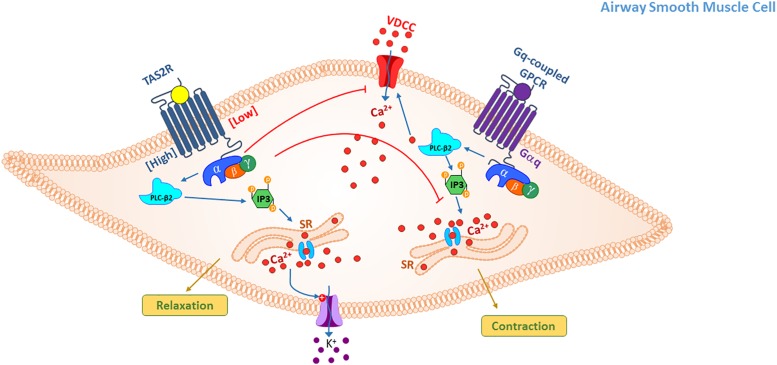
TAS2R signaling mediating relaxation in ASM cells. Activation of TAS2Rs on ASM cells results in relaxation, however, diversity in proximal signaling following receptor activation may occur with different agonists and agonist concentrations. Three basic mechanisms of action have been proposed: (1) elevation in intracellular Ca2+ from SR stores that in turn activate large conductance Ca2+ activated K+ (BKCa) channels, alter membrane potential (hyperpolarize) and relax the smooth muscle; (2) Gβγ subunit-mediated inhibition of voltage-dependent calcium channel that are activated upon stimulation of ASM cells with contractile agonist thereby inhibiting calcium elevation and contraction; (3) inhibition of Ca2+ release from IP3 stores by Gq-coupled GPCR agonists thereby attenuating agonist-induced calcium elevation and contraction.
FIGURE 3
FIGURE 3
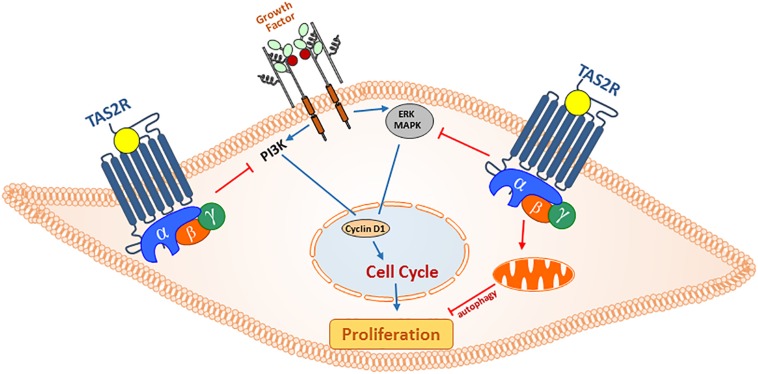
Anti-proliferative actions of TAS2R agonism in ASM cells. In asthma, secreted growth factors from infiltrating immune cells and resident epithelial cells can promote ASM cell hyperplasia through PI3 and MAP kinase pathways. Activation of TAS2Rs can regulate ASM cell proliferation by (1) exerting inhibitory action on cell cycle progression (ERK/MAPK and PI3K) and (2) promoting mitochondrial fragmentation and autophagy, and inhibiting cell survival.

References

    1. Adappa N., Howland T. J., Palmer J. N., Kennedy D. W., Doghramji L., Lysenko A., et al. (2013). Genetics of the taste receptor T2R38 correlates with chronic rhinosinusitis necessitating surgical intervention. Int. Forum Allergy Rhinol. 3 184–187. 10.1002/alr.21140 - DOI - PubMed
    1. Adler E., Hoon M. A., Mueller K. L., Chandrashekar J., Ryba N. J., Zuker C. S. (2000). A novel family of mammalian taste receptors. Cell 100 693–702. 10.1016/s0092-8674(00)80705-9 - DOI - PubMed
    1. An S. S., Robinett K. S., Deshpande D. A., Wang W. C., Liggett S. B. (2012a). Reply to: activation of BK channels may not be required for bitter tastant-induced bronchodilation. Nat. Med. 18 650–651. 10.1038/nm.2734 - DOI - PMC - PubMed
    1. An S. S., Wang W. C., Koziol-White C. J., Ahn K., Lee D. Y., Kurten R. C., et al. (2012b). TAS2R activation promotes airway smooth muscle relaxation despite beta(2)-adrenergic receptor tachyphylaxis. Am. J. Physiol. Lung Cell. Mol. Physiol. 303 L304–L311. 10.1152/ajplung.00126.2012 - DOI - PMC - PubMed
    1. Aoki M., Takao T., Takao K., Koike F., Suganuma N. (2014). Lower expressions of the human bitter taste receptor TAS2R in smokers: reverse transcriptase-polymerase chain reaction analysis. Tob. Induc. Dis. 12:12. 10.1186/1617-9625-12-12 - DOI - PMC - PubMed