


ADAMTS13: An Emerging Target in Stroke Therapy
- PMID: 31379722
- PMCID: PMC6650536
- DOI: 10.3389/fneur.2019.00772
ADAMTS13: An Emerging Target in Stroke Therapy
Abstract
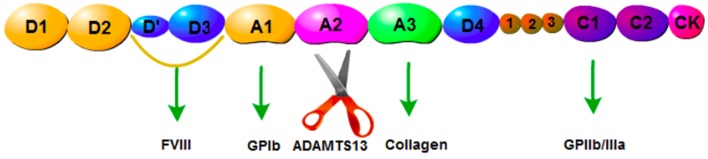
Thrombosis is the predominant underlying mechanism of acute ischemic stroke (AIS). Though thrombolysis with tPA has been proven to be effective in treating AIS within the time window, the majority of AIS patients fail to receive tPA due to various reasons. Current medical therapies for AIS have limited efficacy and pose a risk of intracerebral hemorrhage. ADAMTS13 (a disintegrin and metalloprotease with a thrombospondin type 1 motif, member 13) is a metalloprotease that effectively breaks down the von Willebrand Factor (VWF), a key factor in thrombus formation. Previous studies have proven that dysfunction of ADAMTS13 is associated with many diseases. Recently, ADAMTS13 has been reported to be closely related to stroke. In this review, we briefly described the structure of ADAMTS13 and its role in thrombosis, inflammation, as well as angiogenesis. We then focused on the relationship between ADAMTS13 and AIS, ranging from ischemic stroke occurrence, to AIS treatment and prognosis. Based on research findings from in vitro, animal, and clinical studies, we propose that ADAMTS13 is a potential biomarker to guide appropriate treatment for ischemic stroke and a promising therapeutic agent for tPA resistant thrombi.
Keywords: ADAMTS13; VWF; ischemic stroke; physiological function; structure.
Figures

References
-
- Powers WJ, Rabinstein AA, Ackerson T, Adeoye OM, Bambakidis NC, Becker K, et al. 2018 Guidelines for the early management of patients with acute ischemic stroke: A Guideline for Healthcare Professionals From the American Heart Association/American Stroke Association. Stroke. (2018) 49:e46–110. 10.1161/STR.0000000000000172 - DOI - PubMed
-
- Kernan WN, Ovbiagele B, Black HR, Bravata DM, Chimowitz MI, Ezekowitz MD, et al. Guidelines for the prevention of stroke in patients with stroke and transient ischemic attack: a guideline for healthcare professionals from the American Heart Association/American Stroke Association. Stroke. (2014) 45:2160–236. 10.1161/STROKEAHA.115.008661 - DOI - PubMed
Publication types
LinkOut - more resources
Full Text Sources
Other Literature Sources
Miscellaneous
