


Distribution, Function and Regulation of Type 6 Secretion Systems of Xanthomonadales
- PMID: 31379785
- PMCID: PMC6653060
- DOI: 10.3389/fmicb.2019.01635
Distribution, Function and Regulation of Type 6 Secretion Systems of Xanthomonadales
Abstract
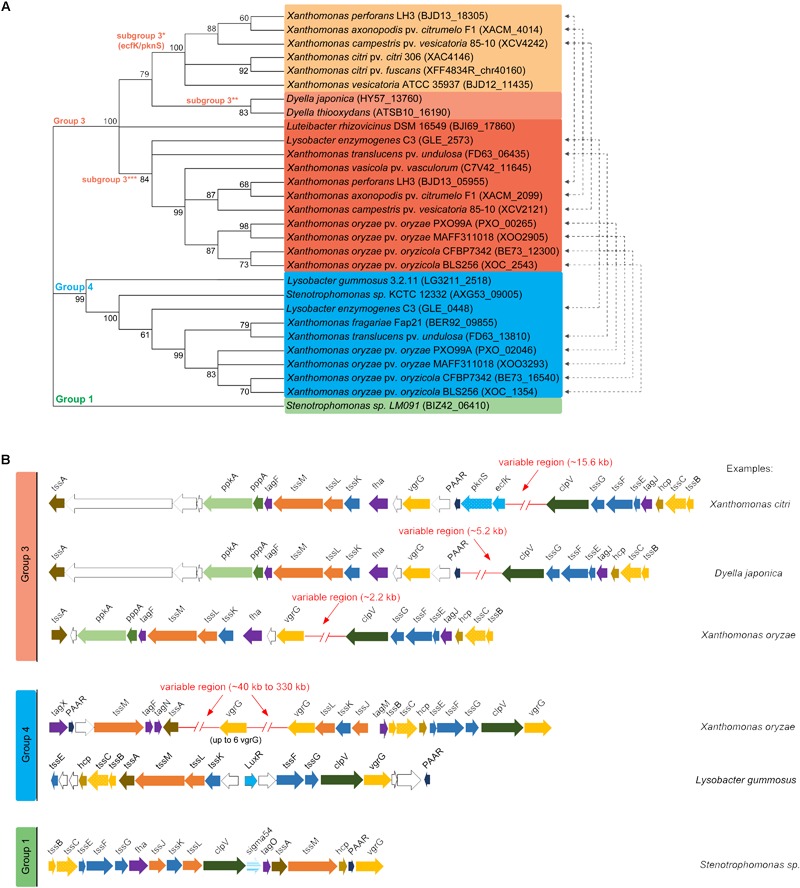
Members of the Xanthomonadales order include several plant pathogens of significant economic and agricultural impact, such as Xanthomonas spp. Type 6 secretion systems (T6SSs) are contractile nanomachines used by many bacterial species to inject protein effectors into target prokaryotic and eukaryotic cells and provide a competitive advantage for bacteria in different environments. Effectors with antibacterial properties include peptidoglycan hydrolases, lipases and phospholipases that break down structural components of the cell envelope, promoting target-cell lysis; and RNases, DNAses, and NADases that affect target-cell metabolism, arresting growth. Effectors with anti-eukaryotic properties are functionally more diverse. The T6SS of Xanthomonas citri is the only example experimentally characterized so far within the Xanthomonadales order and displays anti-eukaryotic function by providing resistance to predation by amoeba. This T6SS is regulated at the transcriptional level by a signaling cascade involving a Ser/Thr kinase and an extracytoplasmic function (ECF) sigma factor. In this review, we performed in silico analyses of 35 genomes of Xanthomonadales and showed that T6SSs are widely distributed and phylogenetically classified into three major groups. In silico predictions identified a series of proteins with known toxic domains as putative T6SS effectors, suggesting that the T6SSs of Xanthomonadales display both anti-prokaryotic and anti-eukaryotic properties depending on the phylogenetic group and bacterial species.
Keywords: T6SS; Xanthomonadales; Xanthomonas; amoeba predation; bacterial killing; effectors; toxins.
Figures
References
-
- Bayer-Santos E., Lidia dos Passos L., de Moraes Ceseti L., Ratagami C. Y., de Santana E. S., da Silva A. M., et al. (2018). Xanthomonas citri T6SS mediates resistance to Dictyostelium predation and is regulated by an ECF σ factor and cognate Ser/Thr kinase. Environ. Microbiol. 20 1562–1575. 10.1111/1462-2920.14085 - DOI - PubMed
Publication types
LinkOut - more resources
Full Text Sources
Molecular Biology Databases
Miscellaneous
