Review
. 2019 Jul 16:7:128.
doi: 10.3389/fcell.2019.00128. eCollection 2019.

Reprogramming the Epigenome With Vitamin C

Affiliations
Review

Reprogramming the Epigenome With Vitamin C

Taylor Lee Chong et al. Front Cell Dev Biol. .

Abstract

The erasure of epigenetic modifications across the genome of somatic cells is an essential requirement during their reprogramming into induced pluripotent stem cells (iPSCs). Vitamin C plays a pivotal role in remodeling the epigenome by enhancing the activity of Jumonji-C domain-containing histone demethylases (JHDMs) and the ten-eleven translocation (TET) proteins. By maintaining differentiation plasticity in culture, vitamin C also improves the quality of tissue specific stem cells derived from iPSCs that are highly sought after for use in regenerative medicine. The ability of vitamin C to potentiate the activity of histone and DNA demethylating enzymes also has clinical application in the treatment of cancer. Vitamin C deficiency has been widely reported in cancer patients and has recently been shown to accelerate cancer progression in disease models. Therapies involving high-dose vitamin C administration are currently gaining traction in the treatment of epigenetic dysregulation, by targeting aberrant histone and DNA methylation patterns associated with cancer progression.

Keywords: Jumonji C; TET; cancer; stem cell reprogramming; vitamin C.


Figures
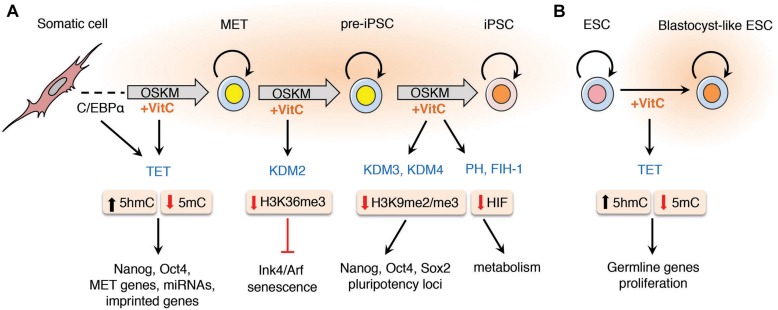
FIGURE 1
FIGURE 1
Vitamin C promotes somatic cell reprogramming by enhancing the activity of α-KGDDs. The addition of vitamin C to the culture medium of somatic cells during reprogramming enhances the activity of α-ketoglutarate dependent dioxygenases (α-KGDDs) including Jumonji-C domain-containing histone demethylases (JHDMs/KDMs), ten-eleven translocation (TET) proteins, prolyl hydroxylases (PH) and the asparaginyl hydroxylase FIH-1. (A) During somatic cell reprogramming it has been shown that transient C/EBPα expression up-regulates Tet2 expression that primes cells for mesenchymal-to-epithelial transition (MET). MET is an essential step required for the initiation of reprogramming that is dependent on TET-mediated DNA hydroxylation and demethylation of the enhancers and promoters of pluripotency genes (e.g., Nanog and Oct4) and for the expression of MET genes, miRNAs and to prevent hypermethylation and silencing of imprinted loci. The hypomethylation of histones by JHDMs such as KDM2 targets H3K36me3 for demethylation that suppresses the expression of senescence-inducing factors Ink4/Arf. Vitamin C also increases loss of H3K9me2/me3 by enhancing KDM3/4 activity to maintain expression at pluripotency loci during the final stages of reprogramming pre-iPSCs in to fully pluripotent iPSCs. Vitamin C may also reduce oxidative stress and increase the activity of hypoxia-inducible factor (HIF) prolyl hydroxylases and FIH-1 that promote the degradation of HIF that has also been shown to be important in the final stage of reprogramming. (B) Vitamin C treatment increases the proliferation of embryonic stem cells (ESCs) in culture and promotes demethylation of germline genes by enhancing TET activity to replicate the naïve “ground-state” of blastocyst-derived ESCs.
FIGURE 2
FIGURE 2
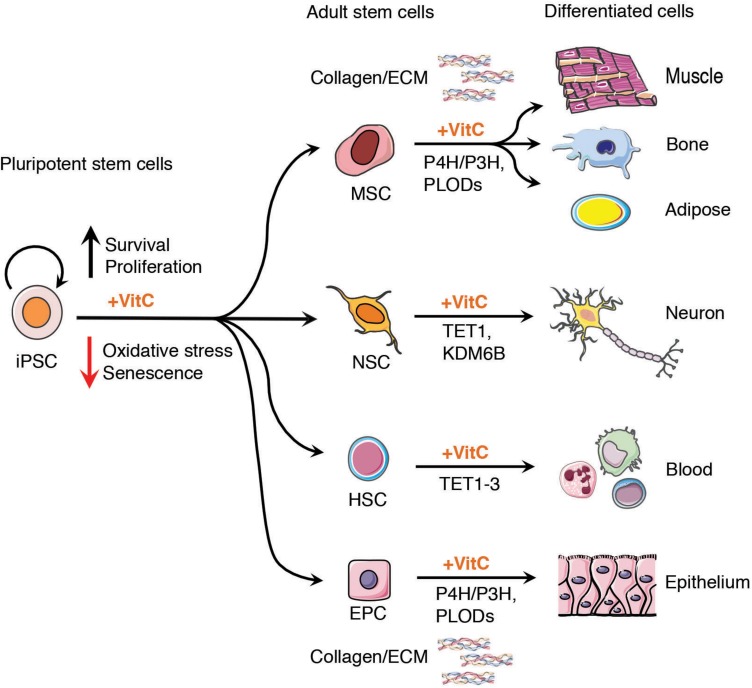
Vitamin C enhances stem cell therapeutic potential. Vitamin C maintains the proliferation and self-renewal capacity of tissue specific stem and progenitor cells derived from iPSCs in culture, including epithelial stem and progenitor cells (EPC), neural stem cells (NSC), mesenchymal stem cells (MSCs), and hematopoietic stem cells (HSCs). The addition of vitamin C to the culture medium of cells enhances the activity of α-ketoglutarate dependent dioxygenases (α-KGDDs) including Jumonji-C domain-containing histone demethylase (JHDM) such as KDM6B, ten-eleven translocation (TET1-3) proteins, prolyl Hydroxylases (P4H, P3H) and pro-collagen-lysine α-KG 5-dioxygenases (PLODs). Vitamin C may serve as a key adjuvant in preclinical models of iPSC-based regenerative medicine providing a renewable source of cells for tissue regeneration with potential to form epithelium, neurons, fat tissue (adipocytes) bone and heart muscle (cardiomyocytes), maintaining epigenetic plasticity to maximize progenitor cell differentiation capacity. The enhanced activity of collagen prolyl hydroxylases in the presence of vitamin C can also contribute to higher quality tissues for engraftment, highlighting an important non-epigenetic role of vitamin C in stem cell therapies.
FIGURE 3
FIGURE 3
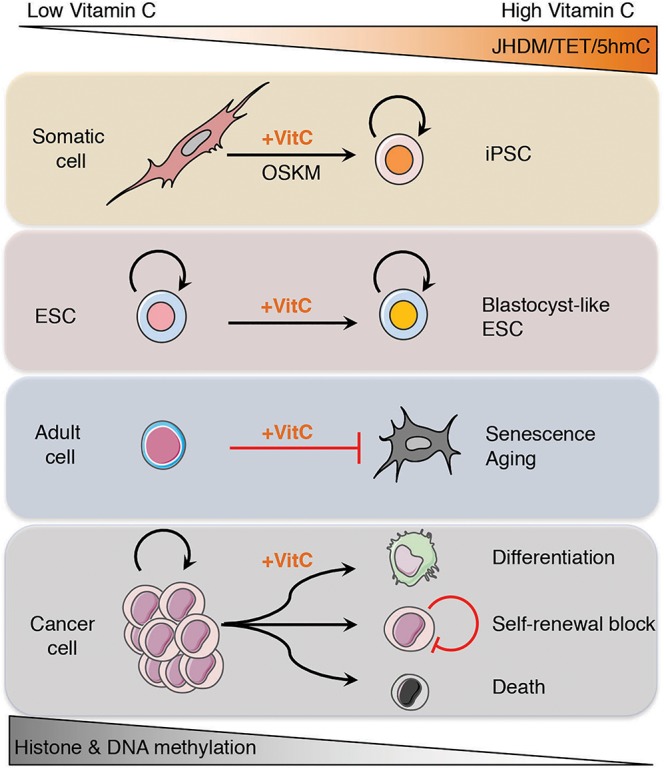
Vitamin C reprograms the epigenome to reverse commitment, prevent senescence and restore differentiation potential. Under growth conditions with low levels of vitamin C, the epigenome of cells becomes hypermethylated, most likely due to suppressed activity of α-ketoglutarate dependent dioxygenases (α-KGDDs) including Jumonji-C domain-containing histone demethylases (JHDMs) and ten-eleven translocation (TET) proteins. By increasing the levels of vitamin C, JHDM, and TET enzymatic activity is enhanced, leading to the loss of histone and DNA methylation, respectively, that promotes somatic cell reprograming, increased differential potential of ESCs toward a blastocyst-like state, protects adult cells from senescence and aging, and can drive the differentiation or death of cancer cells.

References

    1. Abdel-Wahab O., Mullally A., Hedvat C., Garcia-Manero G., Patel J., Wadleigh M., et al. (2009). Genetic characterization of TET1, TET2, and TET3 alterations in myeloid malignancies. Blood 114 144–147. 10.1182/blood-2009-03-210039 - DOI - PMC - PubMed
    1. Agathocleous M., Meacham C. E., Burgess R. J., Piskounova E., Zhao Z., Crane G. M., et al. (2017). Ascorbate regulates haematopoietic stem cell function and leukaemogenesis. Nature 549 476–481. 10.1038/nature23876 - DOI - PMC - PubMed
    1. Agus D. B., Gambhir S. S., Pardridge W. M., Spielholz C., Baselga J., Vera J. C., et al. (1997). Vitamin C crosses the blood-brain barrier in the oxidized form through the glucose transporters. J. Clin. Invest. 100 2842–2848. - PMC - PubMed
    1. Akalin A., Garrett-Bakelman F. E., Kormaksson M., Busuttil J., Zhang L., Khrebtukova I., et al. (2012). Base-pair resolution DNA methylation sequencing reveals profoundly divergent epigenetic landscapes in acute myeloid leukemia. PLoS Genet. 8:e1002781. 10.1371/journal.pgen.1002781 - DOI - PMC - PubMed
    1. Anthony H. M., Schorah C. J. (1982). Severe hypovitaminosis C in lung-cancer patients: the utilization of vitamin C in surgical repair and lymphocyte-related host resistance. Br. J. Cancer 46 354–367. - PMC - PubMed

LinkOut - more resources