. 2019 Jul 11:2019:9369853.
doi: 10.1155/2019/9369853. eCollection 2019.

Relationship between Endplate Defects, Modic Change, Disc Degeneration, and Facet Joint Degeneration in Patients with Low Back Pain

Affiliations

Relationship between Endplate Defects, Modic Change, Disc Degeneration, and Facet Joint Degeneration in Patients with Low Back Pain

Bin Lv et al. Biomed Res Int. .

Abstract

Purpose: The endplate defects (EDs), Modic changes (MCs), disc degeneration (DD), facet orientation (FO), and facet tropism (FT) were demonstrated to be related to the low back pain (LBP). The aim of this study was to investigate possible correlations between them.

Methods: 75 patients were reviewed to evaluate the degenerative change in vertebral bodies (EDs and MCs), intervertebral discs (DD), and facet joint degeneration (FO and FT). All patients were categorized into four groups based on the grade of EDs. Clinical outcomes were evaluated with the visual analog scale (VAS) and Oswestry disability index (ODI) before and after surgery.

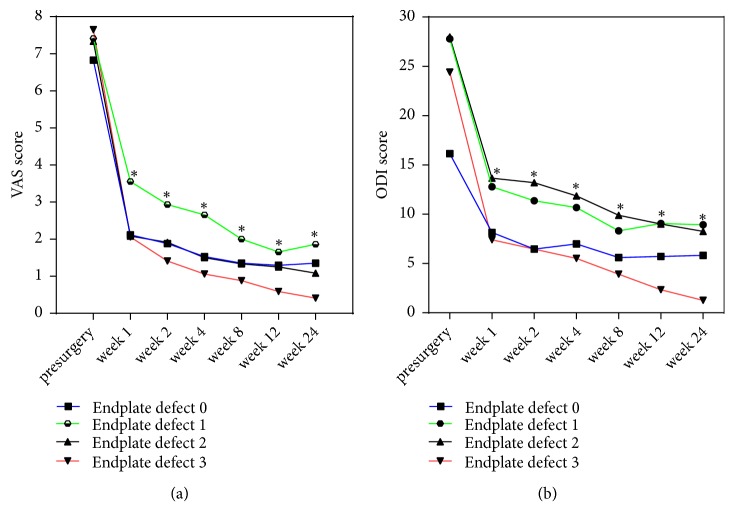
Results: There was no difference between the four groups in baseline characteristics except for gender and weight. FT is positively correlated with FO. The same rule exists between EDs, the size of MCs II, FO (left) and FO (right), and VAS and ODI. The grade of EDs is positively correlated with the grade of DD. L4-L5 can bear more load than other levels; thus, the grade of EDs is higher than that of other lumbar levels. The preoperative LBP was relieved in all groups in varying degrees. The change of pain and dysfunction is inversely proportional to the grade of EDs in the general trend.

Conclusion: The relationship between weight, gender, and disc degeneration provided a mechanism by which increasing weight can predispose to DD. Different grades of EDs had different effects on patients with LBP. There was a significant correlation between EDs, MCs II, DD, FT, and FO.


Figures
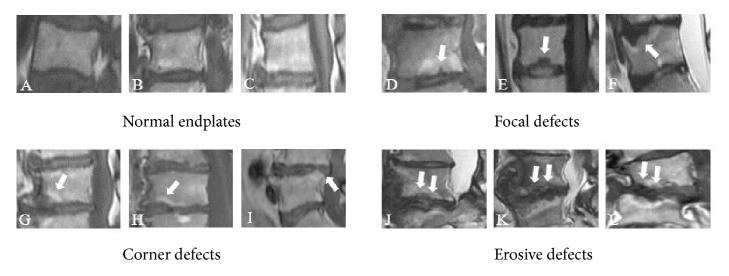
Figure 1
Figure 1
Morphological characteristics of three types of endplate defects. (A-C) Grade 0: normal endplates, no concave or defects. (D-F) Grade 1: endplate discontinuity or focal defects of the endplate (arrow). (G-I) Grade 2: defects located at the anterior or posterior corner of a vertebral body (arrow). (J-L) Grade 3: irregular and extensive disruptions of the endplate (arrow).
Figure 2
Figure 2
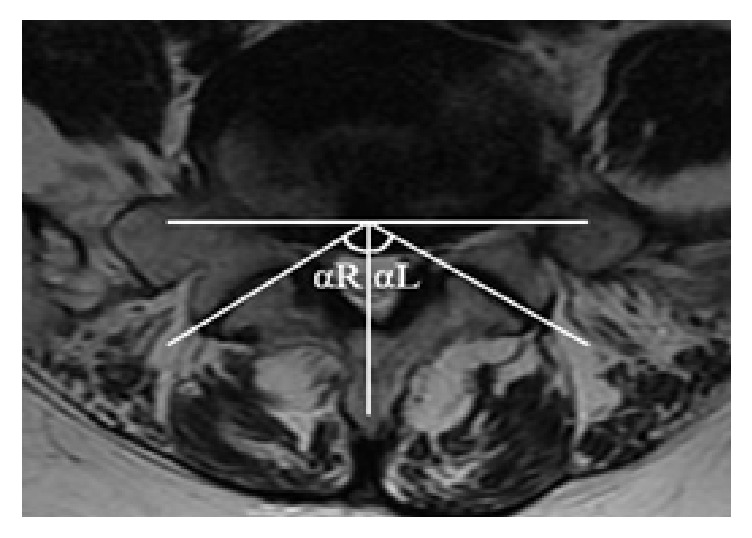
Evaluation of facet tropism and facet orientation. The facet joint angles relative to the sagittal plane were αL and αR. (a) Facet joint tropism = |αL − αR|. (b) Facet joint orientation = (αL +αR)/2.
Figure 3
Figure 3
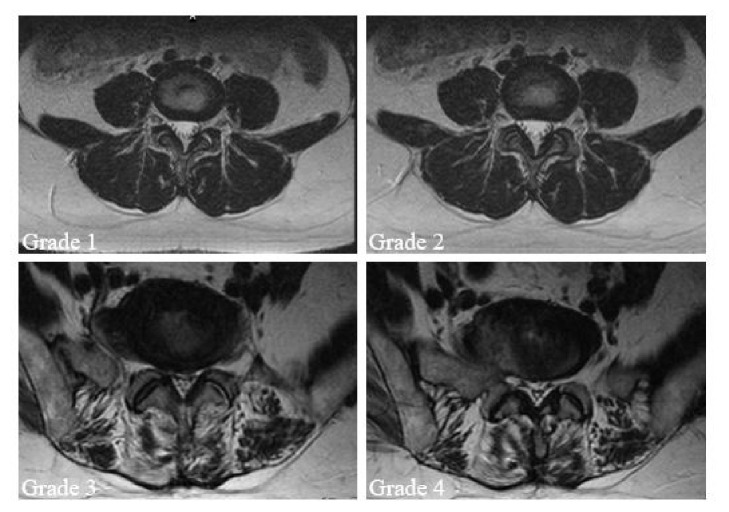
Facet osteoarthritis changes or degeneration was categorized into four grades using T2-weighted axial MRI. (a) Grade 1 was normal. (b) Grade 2 showed a narrow joint space and small osteophytes (mild osteoarthritis). (c) Grade 3 showed sclerosis or subchondral erosions (moderate osteoarthritis). (d) Grade 4 showed marked osteophyte (severe osteoarthritis).
Figure 4
Figure 4
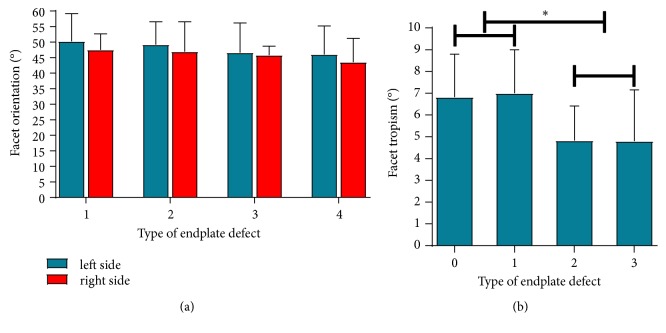
Distributions for facet orientation and facet tropism in four types of endplate defect. (a) Distributions for facet orientation in four types of endplate defect. (b) Distributions for facet tropism in four types of endplate defect. Note: P<0.05 between groups, the facet orientation was expressed as mean (SD), and facet tropism was expressed as mean (95%CI).
Figure 5
Figure 5
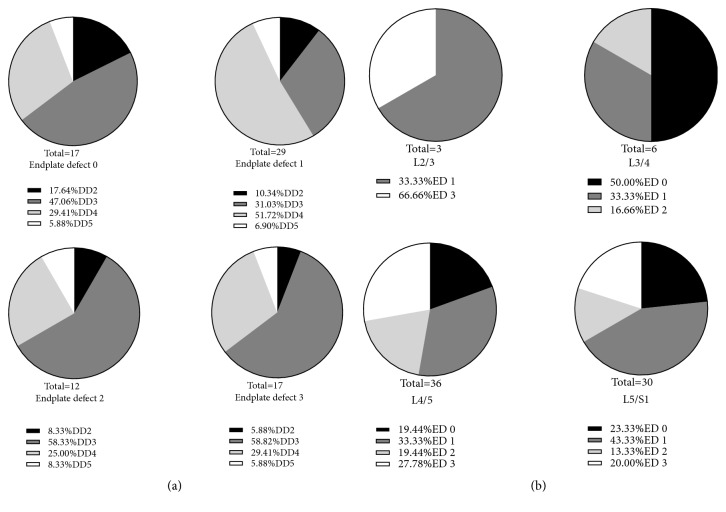
Endplate defects in association with Pfirrmann grades and intervertebral disc levels. (a) Comparison of distributions for DD on different grades of endplate defects. (b) Comparison of distributions for endplate defects on different levels. Abbreviations: ED: endplate defect; DD: disc degeneration.
Figure 6
Figure 6
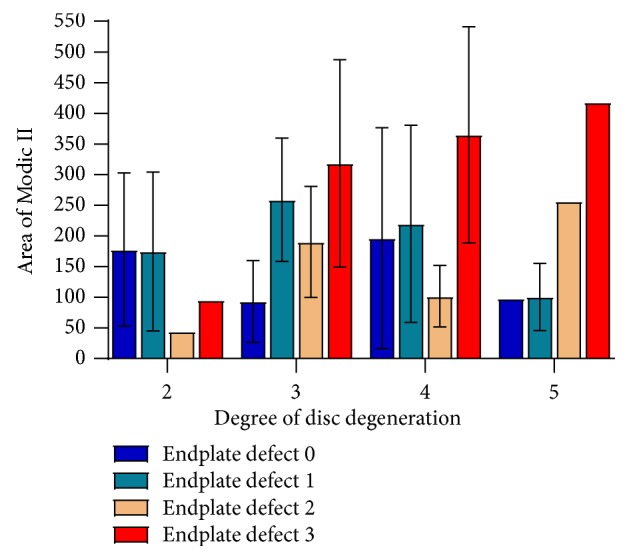
The relationship between the size of Modic II and the degree of DD at different types of endplate defects.
Figure 7
Figure 7
VAS scores (a) and ODI scores (b) before and after the operation. Abbreviations: VAS: visual analog scale; ODI: Oswestry disability index. Note: P<0.05 postsurgery vs presurgery in all groups.

References

    1. Freburger J. K., Holmes G. M., Agans R. P., et al. The rising prevalence of chronic low back pain. JAMA Internal Medicine. 2009;169(3):251–258. doi: 10.1001/archinternmed.2008.543. - DOI - PMC - PubMed
    1. Sears W. R., Sergides I. G., Kazemi N., Smith M., White G. J., Osburg B. Incidence and prevalence of surgery at segments adjacent to a previous posterior lumbar arthrodesis. The Spine Journal. 2011;11(1):11–20. doi: 10.1016/j.spinee.2010.09.026. - DOI - PubMed
    1. Moldavsky M., Neumann P., Klocke N., Hussain M., Bucklen B. S. In vitro analysis of circumferential joint replacement, including bilateral facet joint replacement with lateral lumber disc prosthesis: a parametric investigation of disc sizing. European Spine Journal. 2017;26(3):785–793. doi: 10.1007/s00586-016-4793-9. - DOI - PubMed
    1. Kim H.-J., Kang K.-T., Son J., Lee C.-K., Chang B.-S., Yeom J. S. The influence of facet joint orientation and tropism on the stress at the adjacent segment after lumbar fusion surgery: A biomechanical analysis. The Spine Journal. 2015;15(8):1841–1847. doi: 10.1016/j.spinee.2015.03.038. - DOI - PubMed
    1. Jiang X., Chen D. Magnetic resonance imaging analysis of work-related chronic low back pain: comparisons of different lumbar disc patterns. Journal of Pain Research. 2018;Volume 11:2687–2698. doi: 10.2147/JPR.S162988. - DOI - PMC - PubMed

MeSH terms

LinkOut - more resources