


Randomized Trial of Nicotine Inhaler for Pregnant Smokers
- PMID: 31380506
- PMCID: PMC6677278
- DOI: 10.1016/j.ajogmf.2019.03.006
Randomized Trial of Nicotine Inhaler for Pregnant Smokers
Abstract
Background: Smoking during pregnancy is a serious public health problem in need of better treatments. Nicotine replacement treatment (NRT) (patch or gum) has not been shown in randomized placebo-controlled trials to be efficacious for smoking cessation during pregnancy. However, the nicotine inhaler may have advantages over other NRTs as it replicates some of the sensory effects of smoking.
Objective: The purpose of the study was examine the efficacy and safety of the nicotine inhaler for smoking cessation during pregnancy. We hypothesized that the nicotine inhaler compared to placebo would increase quit rates and reduce smoking during treatment and at the end of pregnancy, result in a higher birth weight and gestational age in the offspring, and reduce the incidence of preterm birth and low birth weight infants.
Study design: We conducted a randomized, double-blind, placebo-controlled trial of the nicotine inhaler for smoking cessation during pregnancy. Pregnant women who smoked ≥5 cigarettes daily received behavioral counseling and random assignment to a 6-week treatment with nicotine or placebo inhaler, followed by a 6-week taper period. Throughout treatment, we assessed tobacco exposure biomarkers, cessation rates, and adverse events. We also obtained information on birth outcomes. The primary outcome was smoking cessation at 32-34 weeks gestation; secondary outcomes were smoking reduction, birth weight and gestational age, and the incidence of preterm birth or low birth weight infants. We compared treatment groups on these measures using t-tests, Fisher's exact tests, and multivariate linear and logistic regression.
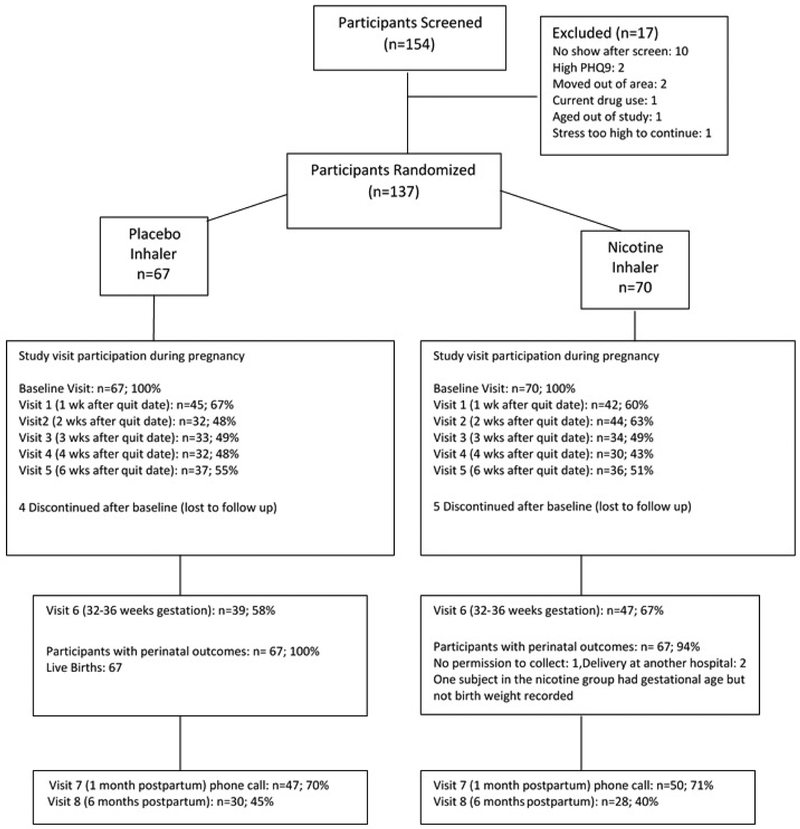
Results: Participants in the placebo (n=67) and nicotine (n=70) groups were comparable on baseline characteristics, though women in the placebo group reported a higher motivation to quit (p=0.016). Biochemically-validated smoking cessation rates were similar with nicotine and placebo (after 6 weeks of treatment: 4% (3/70) vs. 3% (2/67), respectively, p< 0.99, and at 32-34 weeks gestation: 10% (7/70) vs. 18% (12/67), respectively, p=0.220). Cigarettes per day (CPD) decreased over time in both groups (p< 0.001), with the nicotine inhaler group having a greater decrease than the placebo group two (p=0.022) and six weeks after the quit date (p=0.042), but not at 32-34 weeks gestation (p=0.108). Serum cotinine levels, birth weight, gestational age and reductions in carbon monoxide did not differ by group. However, the incidence of preterm delivery was higher in the placebo than the nicotine group: 15% (10/67) vs. 4% (3/67), respectively, p=0.030). The incidence of delivering a low birth weight infant was also higher in the placebo than the nicotine group: 15% (10/67) vs. 6% (4/67), respectively, p=0.035, but not after adjusting for preterm delivery p=0.268.
Conclusions: Although the nicotine inhaler group did not have a higher quit rate during pregnancy than the placebo group, the outcome of preterm delivery occurred less frequently in the nicotine group.
Trial registration: ClinicalTrials.gov NCT01656733.
Keywords: nicotine inhaler; pregnancy; preterm delivery; smoking cessation.
Figures
Comment in
-
Tobacco and nicotine exposure prevention in pregnancy: a priority to improve perinatal and maternal outcomes.Am J Obstet Gynecol MFM. 2019 Mar;1(1):19-23. doi: 10.1016/j.ajogmf.2019.03.005. Am J Obstet Gynecol MFM. 2019. PMID: 33319752 Free PMC article. No abstract available.
References
-
- Office of the Surgeon G, Office on S, Health. Reports of the Surgeon General. The Health Consequences of Smoking: A Report of the Surgeon General. Atlanta (GA): Centers for Disease Control and Prevention (US); 2004. - PubMed
-
- National Center for Chronic Disease P, Health Promotion Office on S, Health. Reports of the Surgeon General. The Health Consequences of Smoking-50 Years of Progress: A Report of the Surgeon General. Vol 9, Reproductive Outcomes. Atlanta (GA): Centers for Disease Control and Prevention (US); 2014.
-
- Curtin SC, Matthews TJ. Smoking Prevalence and Cessation Before and During Pregnancy: Data From the Birth Certificate, 2014. Natl Vital Stat Rep. 2016;65(1): 1–14. - PubMed
Publication types
MeSH terms
Substances
Associated data
Grants and funding
LinkOut - more resources
Full Text Sources
Medical