


Competency-Based Approaches to Community Health: A Randomized Controlled Trial to Reduce Childhood Obesity among Latino Preschool-Aged Children
- PMID: 31381365
- PMCID: PMC6862953
- DOI: 10.1089/chi.2019.0064
Competency-Based Approaches to Community Health: A Randomized Controlled Trial to Reduce Childhood Obesity among Latino Preschool-Aged Children
Abstract
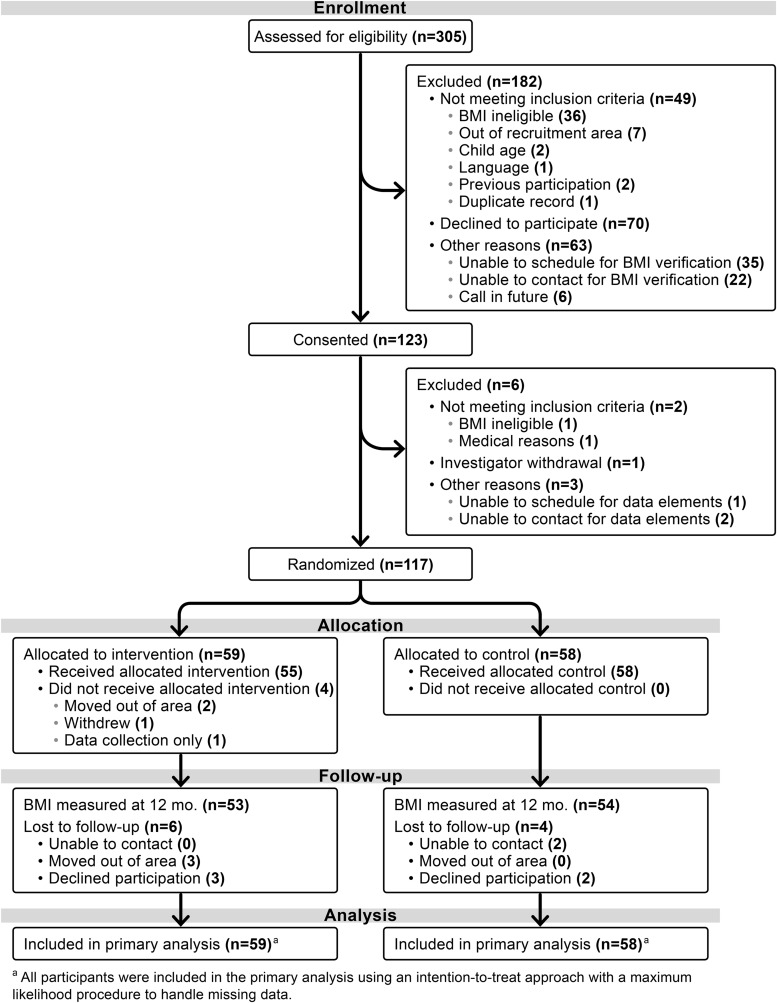
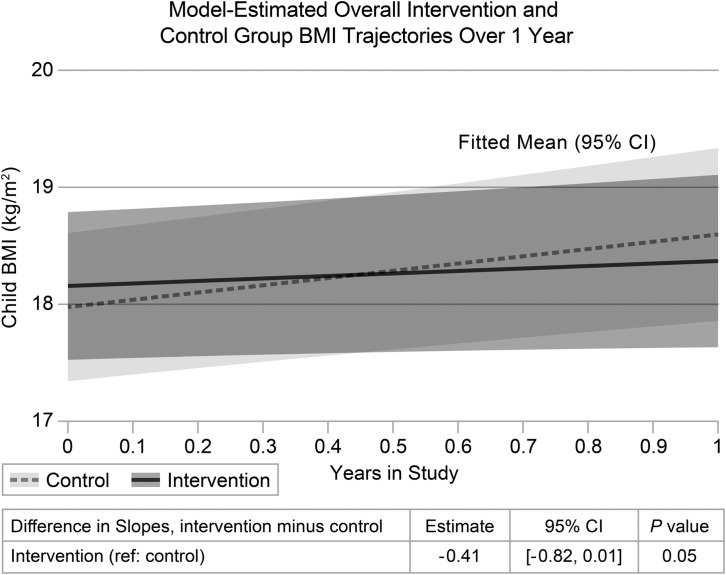
Background: Health behavior change interventions that target childhood obesity in minority populations have led to inconsistent and short-lived results. The purpose of this study was to test a novel intervention that was personalized and family-based in a Latino population to reduce childhood obesity. Methods: Competency-Based Approaches to Community Health (COACH) was a randomized controlled trial. Latino parent-child pairs were recruited from community settings in Nashville, TN. Child eligibility criteria included age 3-5 years and a BMI ≥50th percentile. The intervention included 15 weekly, 90-minute sessions followed by 3 months of twice-monthly health coaching calls. The control group was a twice-monthly school readiness curriculum for 3 months. Sessions were conducted by a health coach in local community centers, with groups of 8-11 parent-child pairs. The primary outcome was child BMI trajectory across 12 months, measured at four times. The intervention's effect was assessed by using a longitudinal, linear mixed-effects growth model, adjusting for child gender, baseline child and parent age, and baseline parent BMI and education. Results: Of the 305 parent-child pairs assessed for eligibility, 117 were randomized (59 intervention, 58 control). Child BMI was available for 91.5% at 1-year follow-up. Mean baseline child age was 4.2 [standard deviation (SD) = 0.8] years, and 53.8% of children were female. Mean baseline child BMI was 18.1 (SD = 2.6) kg/m2. After adjusting for covariates, the intervention's effect on linear child BMI growth was -0.41 kg/m2 per year (95% confidence interval -0.82 to 0.01; p = 0.05). Conclusions: Over 1-year follow-up, the intervention resulted in slower linear BMI growth for Latino preschool-aged children from poverty.
Keywords: Latino families; behavioral interventions; childhood obesity; qualitative research.
Conflict of interest statement
No competing financial interests exist.
Figures
References
-
- Hales CM, Carroll MD, Fryar CD, et al. Prevalence of obesity among adults and youth: United States, 2015-2016. NCHS Data Brief 2017:1–8 - PubMed
-
- Campbell MK. Biological, environmental, and social influences on childhood obesity. Pediatr Res 2016;79:205–211 - PubMed
-
- Singh GK, Kogan MD, Van Dyck PC, et al. Racial/ethnic, socioeconomic, and behavioral determinants of childhood and adolescent obesity in the United States: Analyzing independent and joint associations. Ann Epidemiol 2008;18:682–695 - PubMed
-
- Vargas CM, Stines EM, Granado HS. Health-equity issues related to childhood obesity: A scoping review. J Public Health Dent 2017;77(Suppl 1):S32–S42 - PubMed
Publication types
MeSH terms
Grants and funding
LinkOut - more resources
Full Text Sources
Medical
