


Transdiagnostic variations in impulsivity and compulsivity in obsessive-compulsive disorder and gambling disorder correlate with effective connectivity in cortical-striatal-thalamic-cortical circuits
- PMID: 31382045
- PMCID: PMC6721865
- DOI: 10.1016/j.neuroimage.2019.116070
Transdiagnostic variations in impulsivity and compulsivity in obsessive-compulsive disorder and gambling disorder correlate with effective connectivity in cortical-striatal-thalamic-cortical circuits
Abstract
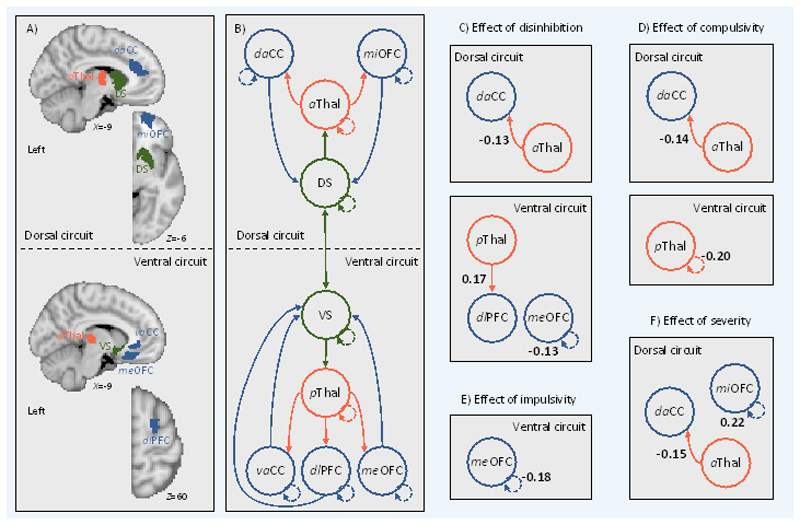
Individual differences in impulsivity and compulsivity is thought to underlie vulnerability to a broad range of disorders and are closely tied to cortical-striatal-thalamic-cortical function. However, whether impulsivity and compulsivity in clinical disorders is continuous with the healthy population and explains cortical-striatal-thalamic-cortical dysfunction across different disorders remains unclear. Here, we characterized the relationship between cortical-striatal-thalamic-cortical effective connectivity, estimated using dynamic causal modelling of resting-state functional magnetic resonance imaging data, and dimensional phenotypes of impulsivity and compulsivity in two symptomatically distinct but phenotypically related disorders, obsessive-compulsive disorder and gambling disorder. 487 online participants provided data for modelling of dimensional phenotypes. These data were combined with 34 obsessive-compulsive disorder patients, 22 gambling disorder patients, and 39 healthy controls, who underwent functional magnetic resonance imaging. Three core dimensions were identified: disinhibition, impulsivity, and compulsivity. Patients' scores on these dimensions were continuously distributed with the healthy participants, supporting a continuum model of psychopathology. Across all participants, higher disinhibition correlated with lower bottom-up connectivity in the dorsal circuit and greater bottom-up connectivity in the ventral circuit, and higher compulsivity correlated with lower bottom-up connectivity in the dorsal circuit. In patients, higher clinical severity was also linked to lower bottom-up connectivity in the dorsal circuit, but these findings were independent of phenotypic variation, demonstrating convergence towards behaviourally and clinically relevant changes in brain dynamics. Effective connectivity did not differ as a function of traditional diagnostic labels and only weak associations were observed for functional connectivity measures. Together, our results demonstrate that cortical-striatal-thalamic-cortical dysfunction across obsessive-compulsive disorder and gambling disorder may be better characterized by dimensional phenotypes than diagnostic comparisons, supporting investigation of quantitative liability phenotypes.
Keywords: Compulsivity; DCM; Disinhibition; GD; Impulsivity; OCD.
Copyright © 2019 Elsevier Inc. All rights reserved.
Conflict of interest statement
Competing interests: S.R.C consults for Cambridge Cognition, Shire, and Promentis. The remaining authors declare no competing financial interests.
Figures
References
-
- Bagozzi RP, Yi Y. Specification, evaluation, and interpretation of structural equation models. Journal of the Academy of Marketing Science. 2011;40(1):8–34. doi: 10.1007/s11747-011-0278-x. - DOI
-
- Benjamini Y, Hochberg Y. Controlling the False Discovery Rate: A Practical and Powerful Approach to Multiple Testing. Journal of the Royal Statistical Society. Series B (Methodological) 1995;57(1):289–300.
Publication types
MeSH terms
Grants and funding
LinkOut - more resources
Full Text Sources
Medical
