Review
. 2019 Sep 20;294(38):13852-13863.
doi: 10.1074/jbc.REV118.000828. Epub 2019 Aug 5.

Mitochondrial plasticity in cell fate regulation

Affiliations
Review

Mitochondrial plasticity in cell fate regulation

Amir Bahat et al. J Biol Chem. .

Abstract

Mitochondria are considered highly plastic organelles. This plasticity enables the mitochondria to undergo morphological and functional changes in response to cellular demands. Stem cells also need to remain functionally plastic (i.e. to have the ability to "decide" whether to remain quiescent or to undergo activation upon signaling cues to support tissue function and homeostasis). Mitochondrial plasticity is thought to enable this reshaping of stem cell functions, integrating signaling cues with stem cell outcomes. Indeed, recent evidence highlights the crucial role of maintaining mitochondrial plasticity for stem cell biology. For example, tricarboxylic acid (TCA) cycle metabolites generated and metabolized in the mitochondria serve as cofactors for epigenetic enzymes, thereby coupling mitochondrial metabolism and transcriptional regulation. Another layer of mitochondrial plasticity has emerged, pointing toward mitochondrial dynamics in regulating stem cell fate decisions. Imposing imbalanced mitochondrial dynamics by manipulating the expression levels of the key molecular regulators of this process influences cellular outcomes by changing the nuclear transcriptional program. Moreover, reactive oxygen species have also been shown to play an important role in regulating transcriptional profiles in stem cells. In this review, we focus on recent findings demonstrating that mitochondria are essential regulators of stem cell activation and fate decisions. We also discuss the suggested mechanisms and alternative routes for mitochondria-to-nucleus communications.

Keywords: ROS signaling; cell signaling; epigenetics; histone modification; metabolic cross-talk; metabolism; mitochondria; mitochondrial DNA (mtDNA); mitochondrial metabolism; molecular dynamics; nucleus; self-renewal; stem cells.


Conflict of interest statement

The authors declare that they have no conflicts of interest with the contents of this article.

Figures
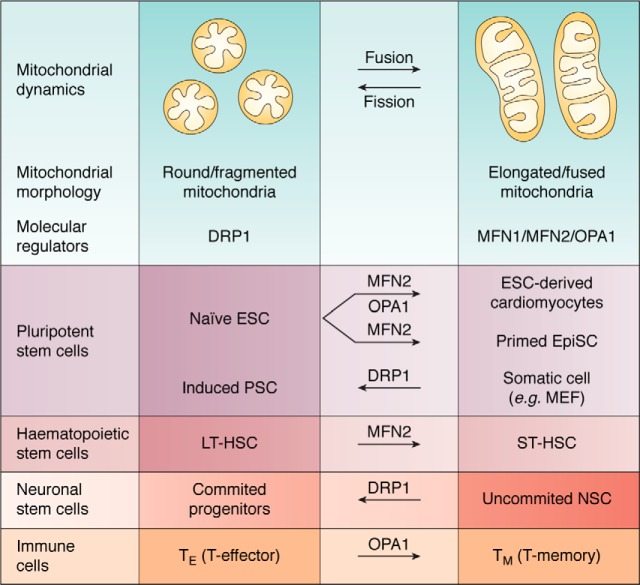
Figure 1.
Figure 1.
Mitochondria morphology and the molecular regulators of mitochondria dynamics in the regulation of transitioning between stem cells states and immune cells. The molecular regulators underlying fusion and fission events are depicted below the schematic representation of round/fragmented and elongated/fused mitochondria, respectively. Transitioning between the different stem cell states and immune cells was reported to be dependent upon the levels of these molecular regulators, according to the established mitochondria morphology characteristics with each state.
Figure 2.
Figure 2.
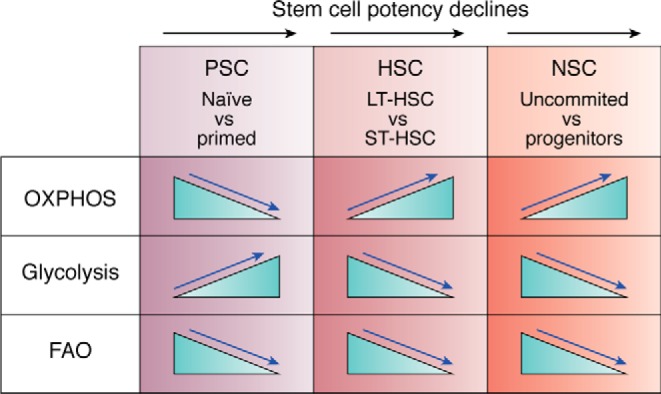
Metabolic requirements underlying the transition between the different stem cell states. The metabolic shifts underlying the transition between the different stem cell states are depicted above, as blue arrows point out the directionality of the metabolic shift, which was reported necessary for achieving the new stem cell state. The black arrow marks the decline in stem cell potency. Note that whereas the requirements for OXPHOS and glycolysis are diverse, the decrease in FAO levels is shared between the different stem cells.
Figure 3.
Figure 3.
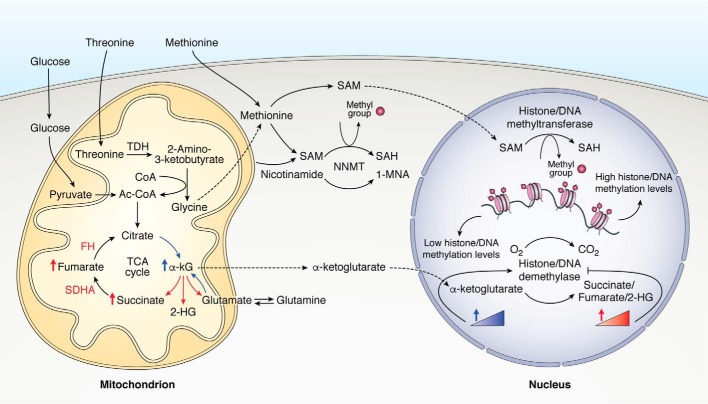
Metabolic control of DNA and histone methylation. Metabolites and amino acids implicated in the generation of SAM and in the regulation of histone/DNA demethylase activity in stem cells, generated or metabolized within the mitochondria, are depicted above. Note that enriched pathways depicted in blue will support, whereas those depicted in red will repress, histone/DNA demethylase activity. The activity of histone/DNA methyltransferase depends upon the abundance and availability of nuclear SAM levels. SAH, S-adenosylhomocysteine; FH, fumarate hydratase; SDHA, succinate dehydrogenase A; NNMT, nicotinamide N-methyltransferase; 1-MNA, 1-methylnicotinamide.
Figure 4.
Figure 4.
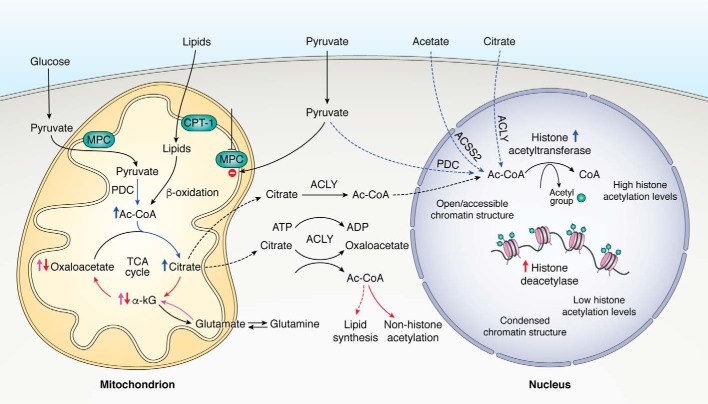
Metabolic control of histone acetylation levels. Metabolites and lipids implicated in the generation of Ac-CoA within the mitochondria and the nucleus of stem cells are depicted above. Note that enriched pathways depicted in blue will support the generation of cytosolic and nuclear pools of Ac-CoA and subsequent histone acetylation levels, whereas those depicted in red will repress the generation of cytosolic Ac-CoA and histone acetylation levels. Pathways shown in pink were reported to support bioenergetics of stem cells in response to the continuous citrate efflux. Blocking pyruvate entry into the mitochondria, allowing for nuclear-pyruvate accumulation together with active nuclear PDC, will support the generation of nuclear Ac-CoA pools. MPC, mitochondrial pyruvate carrier.

References

    1. Knoblich J. A. (2008) Mechanisms of asymmetric stem cell division. Cell 132, 583–597 10.1016/j.cell.2008.02.007 - DOI - PubMed
    1. Morrison S. J., and Spradling A. C. (2008) Stem cells and niches: mechanisms that promote stem cell maintenance throughout life. Cell 132, 598–611 10.1016/j.cell.2008.01.038 - DOI - PMC - PubMed
    1. Maryanovich M., Zahalka A. H., Pierce H., Pinho S., Nakahara F., Asada N., Wei Q., Wang X., Ciero P., Xu J., Leftin A., and Frenette P. S. (2018) Adrenergic nerve degeneration in bone marrow drives aging of the hematopoietic stem cell niche. Nat. Med. 24, 782–791 10.1038/s41591-018-0030-x - DOI - PMC - PubMed
    1. Ahola S., Langer T., and MacVicar T. (2019) Mitochondrial proteolysis and metabolic control. Cold Spring Harb. Perspect. Biol. 11, a033936 10.1101/cshperspect.a033936 - DOI - PMC - PubMed
    1. Mishra P., and Chan D. C. (2016) Metabolic regulation of mitochondrial dynamics. J. Cell Biol. 212, 379–387 10.1083/jcb.201511036 - DOI - PMC - PubMed

LinkOut - more resources