. 2019 Oct;96(4):505-514.
doi: 10.1124/mol.119.117358. Epub 2019 Aug 5.

Separation of Acute Desensitization and Long-Term Tolerance of µ-Opioid Receptors Is Determined by the Degree of C-Terminal Phosphorylation

Affiliations

Separation of Acute Desensitization and Long-Term Tolerance of µ-Opioid Receptors Is Determined by the Degree of C-Terminal Phosphorylation

Seksiri Arttamangkul et al. Mol Pharmacol. 2019 Oct.

Abstract

Phosphorylation of sites on the C terminus of the μ-opioid receptor (MOR) results in the induction of acute desensitization that is thought to be a precursor for the development of long-term tolerance. Alanine mutations of all 11 phosphorylation sites on the C terminus of MORs almost completely abolished desensitization and one measure of tolerance in locus coeruleus neurons when these phosphorylation-deficient MORs were virally expressed in MOR knockout rats. In the present work, we identified specific residues that underlie acute desensitization, receptor internalization, and tolerance and examined four MOR variants with different alanine or glutamate mutations in the C terminus. Alanine mutations in the sequence between amino acids 375 and 379 (STANT-3A) and the sequence between amino acids 363 and 394 having four additional alanine substitutions (STANT + 7A) reduced desensitization and two measures of long-term tolerance. After chronic morphine treatment, alanine mutations in the sequence between 354 and 357 (TSST-4A) blocked one measure of long-term tolerance (increased acute desensitization and slowed recovery from desensitization) but did not change a second (decreased sensitivity to morphine). With the expression of receptors having glutamate substitutions in the TSST sequence (TSST-4E), an increase in acute desensitization was present after chronic morphine treatment, but the sensitivity to morphine was not changed. The results show that all 11 phosphorylation sites contribute, in varying degrees, to acute desensitization and long-term tolerance. That acute desensitization and tolerance are not necessarily linked illustrates the complexity of events that are triggered by chronic treatment with morphine. SIGNIFICANCE STATEMENT: In this work, we showed that the degree of phosphorylation on the C terminus of the μ-opioid receptor alters acute desensitization and internalization, and in measures of long-term tolerance to morphine. The primary conclusion is that the degree of phosphorylation on the 11 possible sites of the C terminus has different roles for expression of the multiple adaptive mechanisms that follow acute and long-term agonist activation. Although the idea that acute desensitization and tolerance are intimately linked is generally supported, these results indicate that disruption of one phosphorylation cassette of the C terminus TSST (354-357) distinguishes the two processes.


Figures

Fig. 1.
Fig. 1.
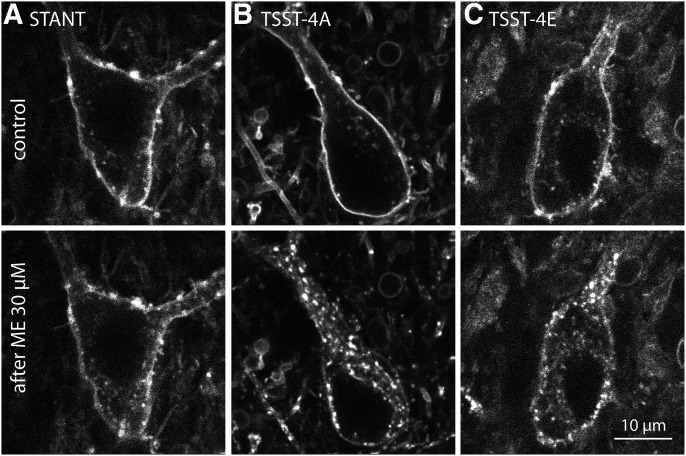
Receptor imaging before and after treatment with ME (30 µM, 10 min). An anti-GFP nanobody conjugated with Alexa594 was used to image the (A) STANT, (B) TSST-4A, and (C) TSST-4E receptors expressed in LC before (top) and after ME (30 µM, 10 min, bottom).
Fig. 2.
Fig. 2.
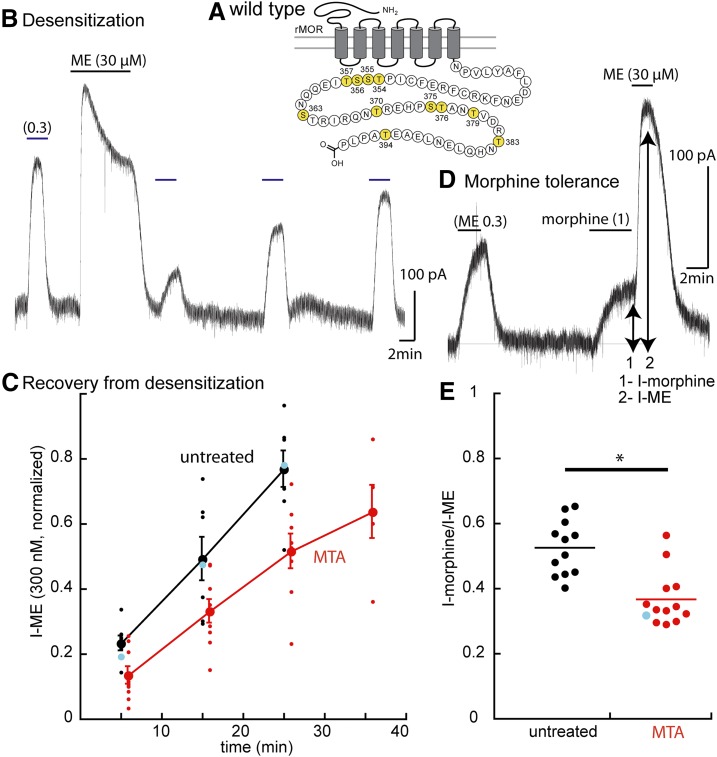
Protocols used to measure two forms of tolerance using experiments carried out in wild-type animals. (A) Snake plot illustrates the phosphorylation sites on the C terminus (yellow: T354, S355, S356, T357, S363, T370, S375, T376, T379, T383, and T394). (B) Protocol used to determine the acute desensitization and the recovery from desensitization. (C) Summary of results showing the time course of recovery from desensitization slices from untreated (black) and MTAs (red); blue dots indicate the results from the trace in (B). (D) Trace shows the current induced by morphine (1 µM, 1) relative to that induced by ME (30 µM, 2). (E) Summary of the results measuring the relative current induced by morphine (½) in slices from untreated animals (95% confidence interval, 0.518 ± 0.047) and MTAs (95% confidence level 0.37 ± 0.045), indicating that the morphine-induced current is smaller in slices from MTAs. Mann-Whitney U test P < 0.001. Blue dot indicates the results from the experiment in (D). *P < 0.05.
Fig. 3.
Fig. 3.
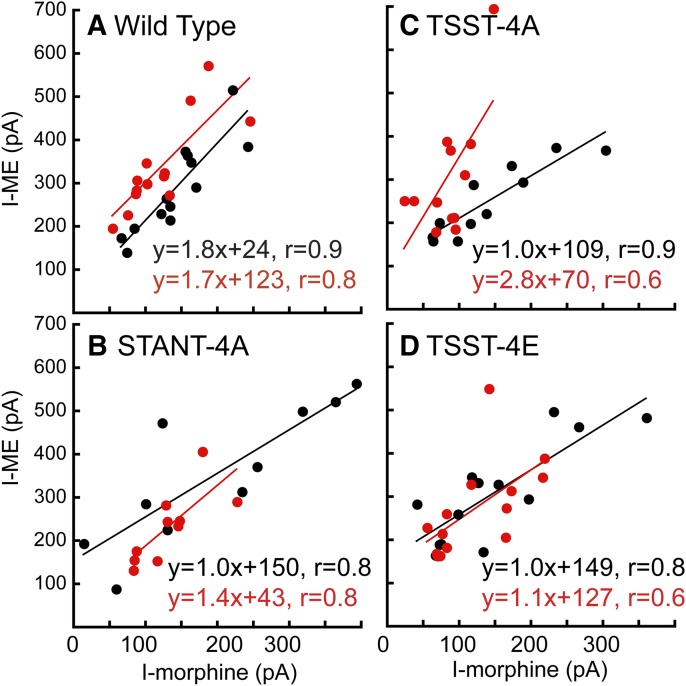
Summary of results comparing the current induced by morphine (1 µM) plotted against the current induced by ME (30 µM) in individual cells in slices from untreated (black) and morphine-treated (red) animals. (A) Cells in slices taken from wild-type animals. The current induced by morphine after treatment with morphine is smaller than that in untreated animals. (B) Cells taken from animals after expression of the STANT mutant. (C) Cells taken from animals after expression of the TSST-4A mutant. (D) Cells in slices taken from animals expressing the TSST-4E mutant.
Fig. 4.
Fig. 4.
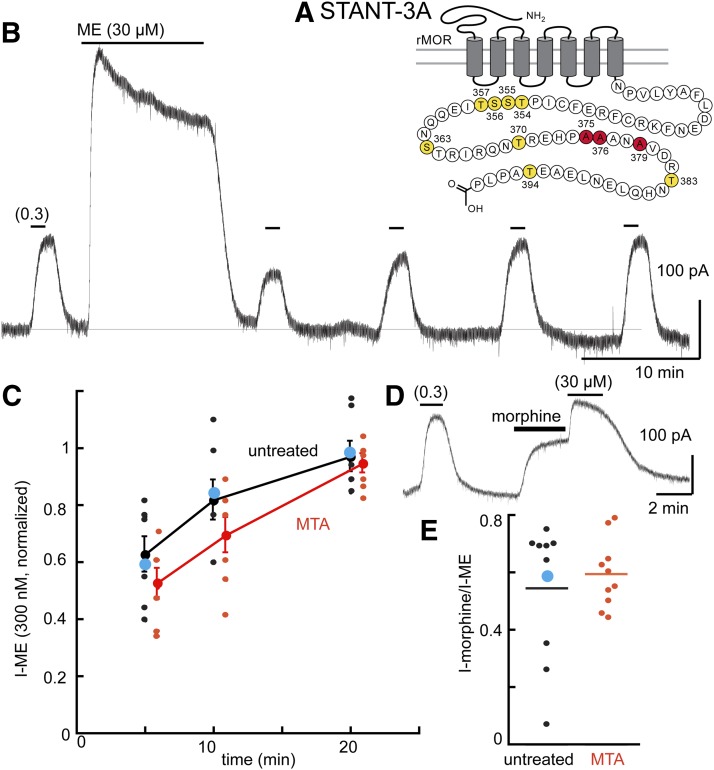
Desensitization is decreased, and tolerance is blocked in cells expressing the STANT mutant receptor. (A) Snake plot illustrates the sites in the STANT mutant having alanine mutations (red, S375. T376, T379). (B) An experiment taken from an MTA illustrating the desensitization and recovery from desensitization of ME (0.3 µM). (C) Summary of results showing the recovery from desensitization in slices from untreated and MTAs. Blue dot indicates the results taken from the trace in (B). (D) Trace illustrating the morphine (1 µM) current relative to the ME (30 µM) current. Blue dot indicates the result from the experiment illustrated in (D). (E) Summary of experiments plotting the current induced by morphine (1 µM) divided by that induced by ME (30 µM, I-morphine/I-ME), indicating that the relative morphine current was unchanged in slices from MTAs. Untreated 0.55 ± 0.23, MTA 0.59 ± 0.12 (95% confidence level).
Fig. 5.
Fig. 5.
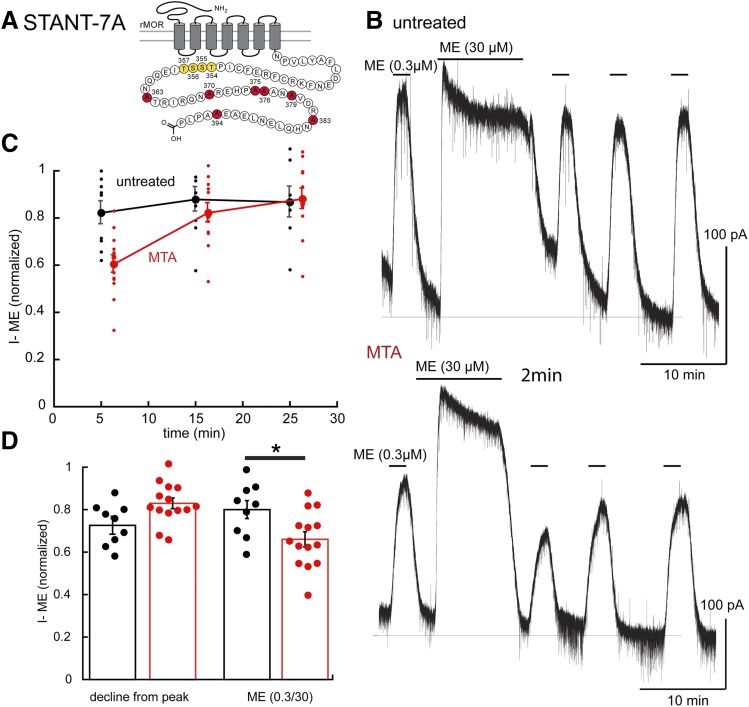
Transient desensitization is induced fafter chronic morphine treatment in the STANT-7A mutant receptors. (A) Snake plot indicates the site (red, S363, T370, S375, T376, T379, T383, and T394) with alanine mutations. (B) Illustrates the lack of ME induced desensitization in a slice from an untreated animal (top) and a morphine-treated (bottom) animal. (C) Summary of results showing the transient desensitization induced by chronic morphine treatment (MTAs, red). (D) Left: Decline from the peak current during ME (30 µM, 10 minutes) in slices from untreated (black) and morphine-treated (red) animals. Right shows the ME (0.3 µM) current relative to the peak ME (30 µM) current in slices from untreated and morphine treated animals. *P < 0.05.
Fig. 6.
Fig. 6.
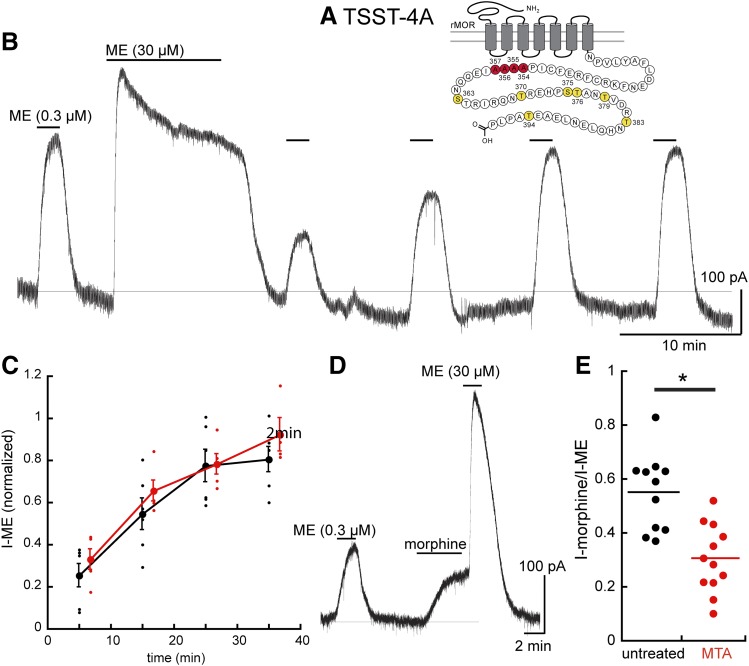
The TSST-4A mutant receptors distinguish tolerance measured by two assays, the increase in acute desensitization (blocked), and the decrease in sensitivity to morphine (present). (A) Snake plot illustrating the sites that were mutated to alanine (red, T354, S355, S356. T357). (B) An experiment illustrating the acute desensitization and recovery from desensitization. (C) Summarized results showing the recovery from desensitization in untreated (black) and MTAs (red). Acute desensitization is insensitive to chronic morphine treatment. (D) An experiment in a slice taken from an MTA illustrating the decreased amplitude of the current induced by morphine. (E) Dot plot shows the relative current induced by morphine (I-morphine/I-ME) in slices from untreated (black) and morphine-treated (red) animals, indicating that the relative morphine current was lower in slices taken from MTAs. Untreated 0.55 ± 0.14, MTAs 0.30 ± 0.13 (95% confidence level). *P < 0.05.
Fig. 7.
Fig. 7.
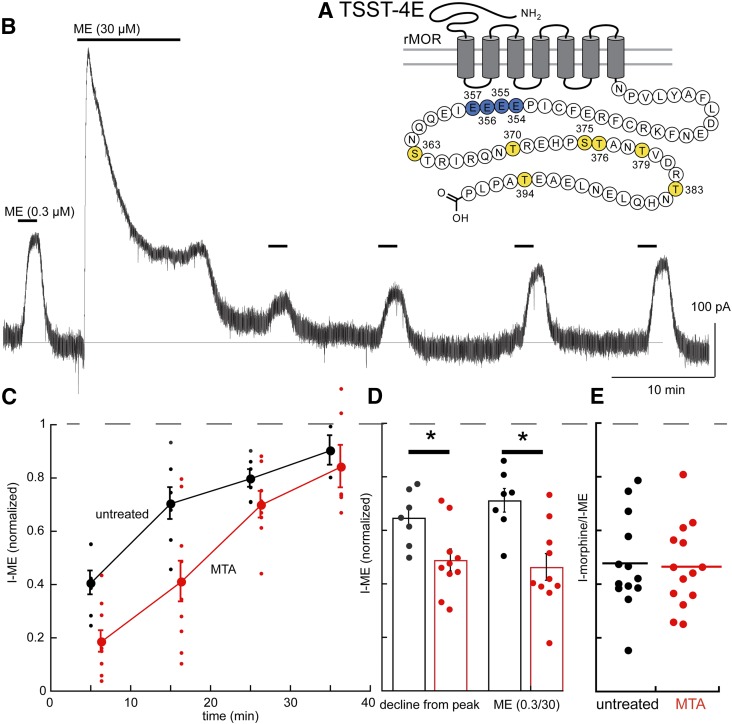
After chronic treatment with morphine, the TSST-4E mutant MOR separates induction of changes in acute desensitization (present) from the decrease in the sensitivity to morphine (blocked). (A) Snake plot shows the sites with glutamate substitutions (blue, T354, S355, S356. T357). (B) An example of acute ME-induced desensitization and recovery from desensitization in a slice from an MTA. (C) Summary of experiments showing recovery from desensitization in slices from untreated (black) and MTAs (red). (D) Summarized results showing the decline from the peak current induced by ME (30 µM, 10 minutes) and the amplitude of the ME (0.3 µM) current relative to the peak current induced by ME (30 µM) in slices from untreated and MTAs. (E) Dot plot of the relative current induced by morphine (1 µM) relative to the peak current induced by ME (30 µM, I-morphine/I-ME) showing that there was no change in the relative morphine current between slices from untreated and MTAs (untreated 0.48 ± 0.18, MTA 0.47 ± 0.16, 95% confidence level). *P < 0.05.

References

    1. Arttamangkul S, Heinz DA, Bunzow JR, Song X, Williams JT. (2018) Cellular tolerance at the µ-opioid receptor is phosphorylation dependent. eLife 7:e343989. - PMC - PubMed
    1. Birdsong WT, Arttamangkul S, Bunzow JR, Williams JT. (2015) Agonist binding and desensitization of the µ-opioid receptor is modulated by phosphorylation of the C-terminal tail domain. Mol Pharmacol 88:816–824. - PMC - PubMed
    1. Birdsong WT, Arttamangkul S, Clark MJ, Cheng K, Rice KC, Traynor JR, Williams JT. (2013) Increased agonist affinity at the μ-opioid receptor induced by prolonged agonist exposure. J Neurosci 33:4118–4127. - PMC - PubMed
    1. Chen YJ, Oldfield S, Butcher AJ, Tobin AB, Saxena K, Gurevich VV, Benovic JL, Henderson G, Kelly E. (2013) Identification of phosphorylation sites in the COOH-terminal tail of the μ-opioid receptor. J Neurochem 124:189–199. - PMC - PubMed
    1. Christie MJ, Williams JT, North RA. (1987) Cellular mechanisms of opioid tolerance: studies in single brain neurons. Mol Pharmacol 32:633–638. - PubMed

Publication types