. 2019 Aug 1;5(2):vez015.
doi: 10.1093/ve/vez015. eCollection 2019 Jul.

Cytomegalovirus distribution and evolution in hominines

Affiliations

Cytomegalovirus distribution and evolution in hominines

Sripriya Murthy et al. Virus Evol. .

Abstract

Herpesviruses are thought to have evolved in very close association with their hosts. This is notably the case for cytomegaloviruses (CMVs; genus Cytomegalovirus) infecting primates, which exhibit a strong signal of co-divergence with their hosts. Some herpesviruses are however known to have crossed species barriers. Based on a limited sampling of CMV diversity in the hominine (African great ape and human) lineage, we hypothesized that chimpanzees and gorillas might have mutually exchanged CMVs in the past. Here, we performed a comprehensive molecular screening of all 9 African great ape species/subspecies, using 675 fecal samples collected from wild animals. We identified CMVs in eight species/subspecies, notably generating the first CMV sequences from bonobos. We used this extended dataset to test competing hypotheses with various degrees of co-divergence/number of host switches while simultaneously estimating the dates of these events in a Bayesian framework. The model best supported by the data involved the transmission of a gorilla CMV to the panine (chimpanzee and bonobo) lineage and the transmission of a panine CMV to the gorilla lineage prior to the divergence of chimpanzees and bonobos, more than 800,000 years ago. Panine CMVs then co-diverged with their hosts. These results add to a growing body of evidence suggesting that viruses with a double-stranded DNA genome (including other herpesviruses, adenoviruses, and papillomaviruses) often jumped between hominine lineages over the last few million years.

Keywords: codivergence; cytomegalovirus; dsDNA virus; hominine; host switch.


Figures
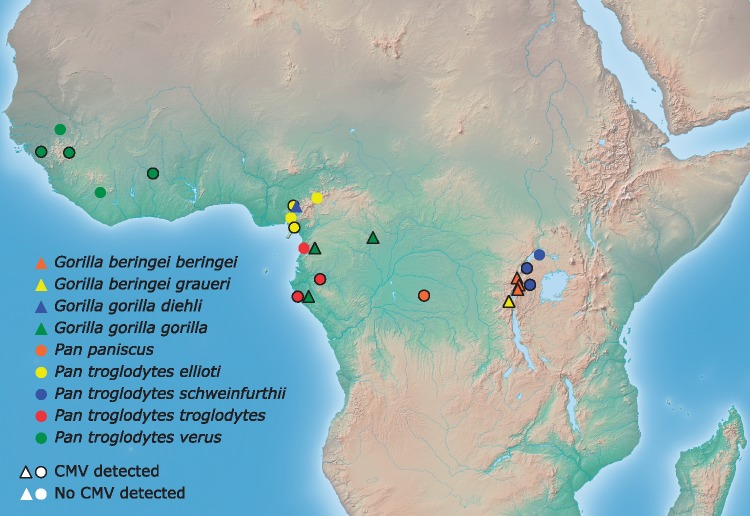
Figure 1.
Figure 1.
African great ape sampling site locations. The twenty sites represented on this map are (ordered from North to South within African great ape subspecies): G.b.b., Virunga National Park (DRC); Bwindi Impenetrable National Park* (Uganda), Volcanoes National Park (Rwanda); G.b.g., Kahuzi Biega National Park (DRC); G.g.d., Takamanda National Park (Cameroon); G.g.g., Dzanga-Sangha Special Reserve (Central African Republic), Campo Ma’an National Park* (Cameroon), Loango National Park* (Gabon); P.p., Salonga National Park (DRC); P.t.e., Gashaka Gumti National Park (Nigeria), Mbe Mountains Community Forest (Nigeria), Korup National Park (Cameroon), Mount Cameroon National Park (Cameroon); P.t.s., Budongo Forest (Uganda), Kibale National Park (Uganda), Bwindi Impenetrable National Park* (Uganda); P.t.t., Campo Ma’an National Park* (Cameroon), Lope National Park (Gabon), Loango National Park* (Gabon); P.t.v., Kayan (Senegal), Sangaredi (Guinea), Sobeya (Guinea), Comoe-GEPRENAF (Côte d’Ivoire), East Nimba (Liberia). DRC: Democratic Republic of the Congo; * samples were obtained from two African great apes species at this site.
Figure 2.
Figure 2.
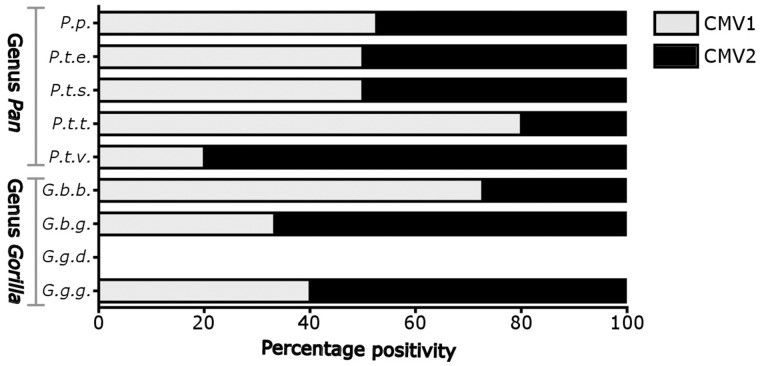
CMV1 and CMV2 in stools of great ape subspecies. Fecal samples (n = 675) from animals belonging to nine great ape subspecies, P.p. (n = 33), P.t.e. (n = 63), P.t.s. (n = 75), P.t.t. (n = 52), P.t.v. (n = 167), G.b.b. (n = 97), G.b.g. (n = 79), G.g.d. (n = 56), and G.g.g. (n = 53), were analyzed with generic nested PCR1 for the presence of CMVs. The positive samples were sequenced to determine the presence of CMV1 and CMV2. The figure represents percentage positivity of CMV1 (gray) and CMV2 (black). P.p., Pan paniscus; P.t.e., Pan troglodytes ellioti; P.t.s., Pan troglodytes schweinfurthii; P.t.t., Pan troglodytes troglodytes; P.t.v., Pan troglodytes verus; G.b.b., Gorilla beringei beringei; G.b.g., Gorilla beringei graueri; G.g.d., Gorilla gorilla diehli; and G.g.g., Gorilla gorilla gorilla.
Figure 3.
Figure 3.
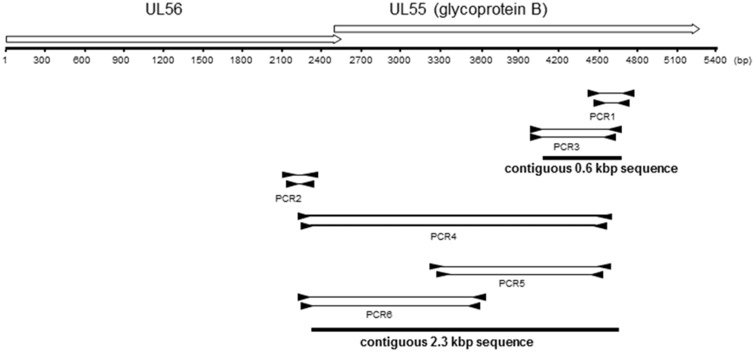
Map of targeted open reading frames (ORFs) and diagram of PCR strategy. Nested primers (black triangles) were used to amplify parts of the UL55 or UL56 ORFs. The amplified fragments are represented by thin solid lines between the primer binding sites. Fragments were sequenced and assembled to final contiguous sequences of 0.6 and 2.3 kbp. At the top of the figure, the genomic locus spanning ORFs UL55 and UL56 is depicted with open arrows. The arrowhead indicates the direction of transcription. The start of the ruler corresponds with the first base of the ORF UL56.
Figure 4.
Figure 4.
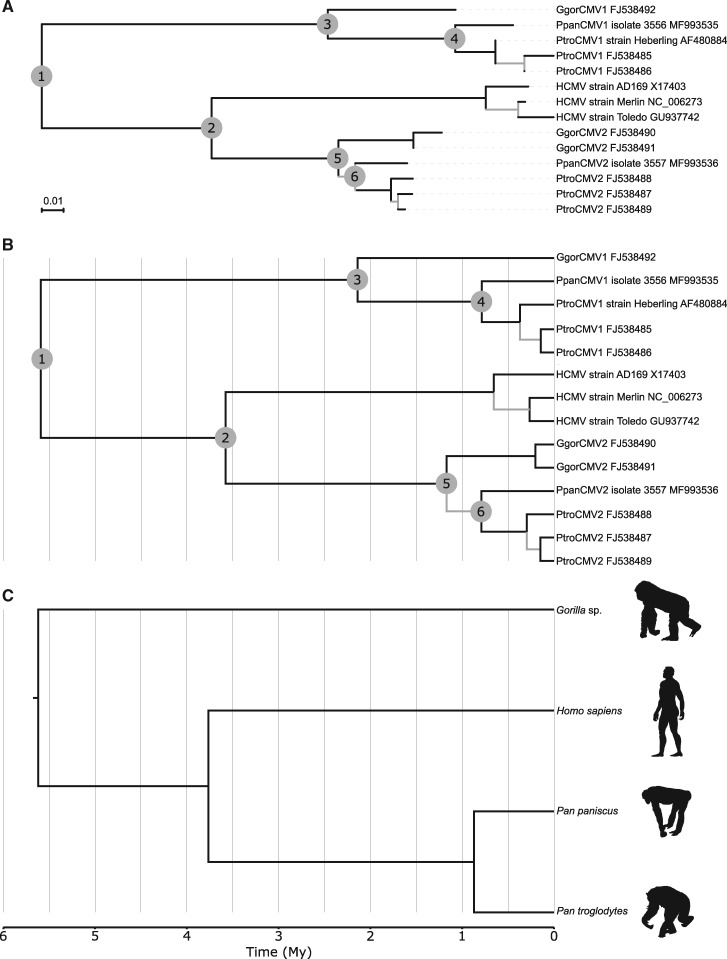
Host and CMV phylogenetic trees. (A) ML CMV tree. The scale is in aa substitution per site. (B) Bayesian CMV timetree. (C) Host timetree derived from the divergence dates published by Prado-Martinez et al. (2013) based on genomic analyses. For (A) and (B): branches supported by SH-like aLRT < 0.90 or posterior probability < 0.95 are gray; numbered nodes are discussed in the text. (B) and (C) have been drawn to the same scale that is, node depths are immediately comparable.
Figure 5.
Figure 5.
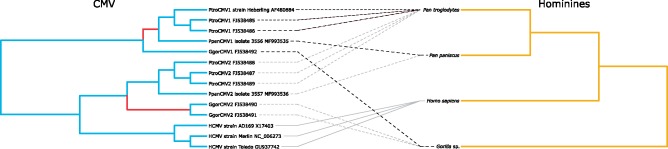
Tanglegram of host and CMV phylogenetic trees. Associations corresponding to the parallel co-divergence in CMV1 and CMV2 according to the co-divergence model are represented with black- and gray-dashed lines, respectively. Branches likely to harbor a transmission event according to the transmission model appear in red in the CMV phylogenetic tree.

References

    1. Altschul S. F. et al. (1990) ‘Basic Local Alignment Search Tool’, Journal of Molecular Biology, 215: 403–10. - PubMed
    1. Anisimova M. et al. (2011) ‘Survey of Branch Support Methods Demonstrates Accuracy, Power, and Robustness of Fast Likelihood-Based Approximation Schemes’, Systematic Biology, 60: 685–99. - PMC - PubMed
    1. Anoh A. E. et al. (2018) ‘Cytomegaloviruses in a Community of Wild Nonhuman Primates in Taï National Park, Côte D’Ivoire’, Viruses, 10: 11. - PMC - PubMed
    1. Argimon S. et al. (2016) ‘Microreact: Visualizing and Sharing Data for Genomic Epidemiology and Phylogeography’, Microbial Genomics, 2: e000093. - PMC - PubMed
    1. Aswad A., Katzourakis A. (2014) ‘The First Endogenous Herpesvirus, Identified in the Tarsier Genome, and Novel Sequences from Primate Rhadinoviruses and Lymphocryptoviruses’, PLoS Genetics, 10: e1004332. - PMC - PubMed