. 2019 Jul 27;4(3):134-141.
doi: 10.1016/j.synbio.2019.07.001. eCollection 2019 Sep.

Efficient biosynthesis of 2-keto-D-gluconic acid by fed-batch culture of metabolically engineered Gluconobacter japonicus

Affiliations

Efficient biosynthesis of 2-keto-D-gluconic acid by fed-batch culture of metabolically engineered Gluconobacter japonicus

Weizhu Zeng et al. Synth Syst Biotechnol. .

Erratum in

  • Erratum regarding previously published articles.
    [No authors listed] [No authors listed] Synth Syst Biotechnol. 2020 Oct 14;5(4):332. doi: 10.1016/j.synbio.2020.10.004. eCollection 2020 Dec. Synth Syst Biotechnol. 2020. PMID: 33102828 Free PMC article.

Abstract

2-keto-d-gluconic acid (2-KGA) is a key precursor for synthesising vitamin C and isovitamin C. However, phage contamination is as constant problem in industrial production of 2-KGA using Pseudomonas fluorescens. Gluconobacter holds promise for producing 2-KGA due to impressive resistance to hypertonicity and acids, and high utilisation of glucose. In this study, the 2-KGA synthesis pathway was regulated to enhance production of 2-KGA and reduce accumulation of the by-products 5-keto-d-gluconic acid (5-KGA) and d-gluconic acid (D-GA) in the 2-KGA producer Gluconobacter japonicus CGMCC 1.49. Knocking out the ga5dh-1 gene from a competitive pathway and overexpressing the ga2dh-A gene from the 2-KGA synthesis pathway via homologous recombination increased the titre of 2-KGA by 63.81% in shake flasks. Additionally, accumulation of 5-KGA was decreased by 63.52% with the resulting G. japonicasga5dh-1-ga2dh-A strain. Using an intermittent fed-batch mode in a 3 L fermenter, 2-KGA reached 235.3 g L-1 with a 91.1% glucose conversion rate. Scaling up in a 15 L fermenter led to stable 2-KGA titre with productivity of 2.99 g L-1 h-1, 11.99% higher than in the 3 L fermenter, and D-GA and 5-KGA by-products were completely converted to 2-KGA.

Keywords: 2-Keto-d-gluconic acid; Dehydrogenase; Fed-batch fermentation; Gluconobacter; Homologous recombination.


Figures
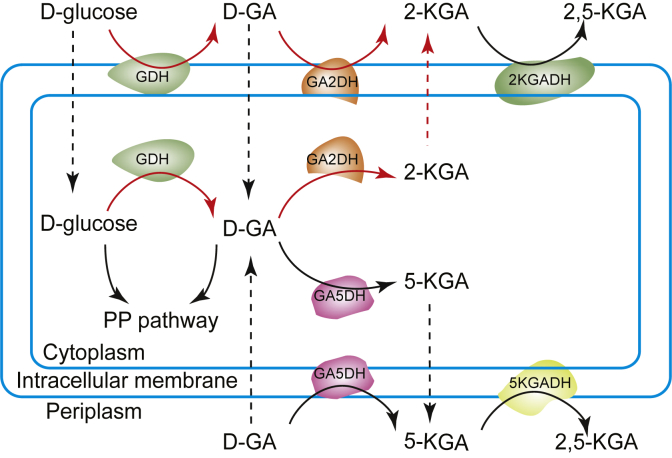
Fig. 1
Fig. 1
Pathways for 2-KGA synthesis from glucose in Gluconobacter. There exist two synthesis pathways for 2-KGA accumulation. One is catalysed by a membrane-bound dehydrogenase in the periplasm, in which glucose is directly oxidized to D-GA and further oxidised to 2-KGA and 2,5-KGA. The other is catalysed by an intracellular dehydrogenase, in which glucose transported into the cytoplasm is oxidised to D-GA, and further oxidised to 2-KGA or 5-KGA, or metabolised by the PP pathway. GDH, glucose dehydrogenase; GA2DH, gluconate-2-dehydrogenase; GA5DH, gluconate-5-dehydrogenase; 2KGADH, 2-keto-gluconate dehydrogenase; 5KGADH, 5-keto-gluconate dehydrogenase; PP, pentose phosphate.
Fig. 2
Fig. 2
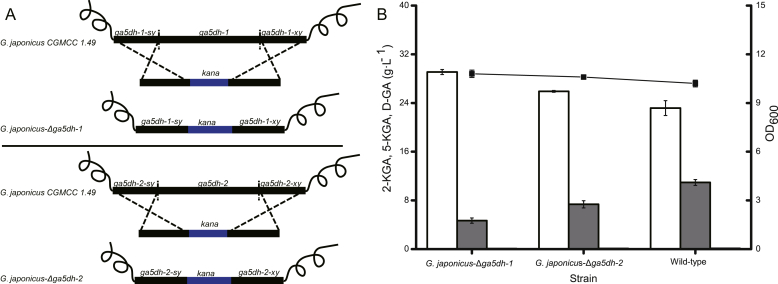
Effect of knocking out ga5dh on 2-KGA production. Compared with the wild-type strain, the 2-KGA titre of G. japonicusga5dh-1 and G. japonicusga5dh-1 strains was increased by 26.91% and 15.70%, respectively, and accumulation of the by-product 5-KGA was decreased by 58.51% and 32.82%, respectively. Almost no D-GA accumulation was detected in the fermentation broth. (A) Construction of G. japonicusga5dh-1 and G. japonicusga5dh-2 by knocking out the ga5dh-1 gene in the wild-type strain. (B) Comparison of the fermentation efficiency of strains. White columns = 2-KGA, grey columns = 5-KGA, black columns = D-GA. The line indicates the OD600 value.
Fig. 3
Fig. 3
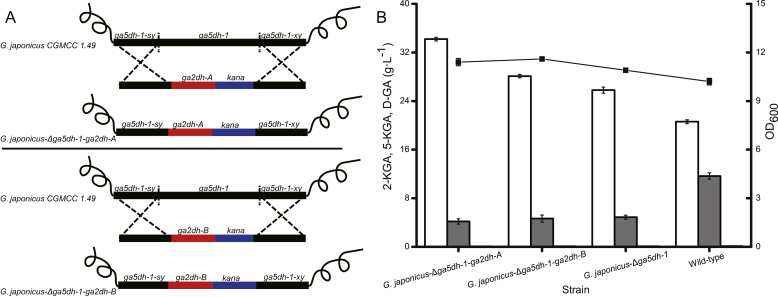
Effect of knocking out the ga5dh-1 and overexpressing the ga2dh on 2-KGA production. Compared with the wild-type strain, the 2-KGA titre of G. japonicusga5dh-1-ga2dh-A and G. japonicusga5dh-1-ga2dh-B was increased by 63.81% and 36.44%, respectively. Compared with G. japonicusga5dh-1, the 2-KGA titre was increased by 32.56% and 9.76%, respectively. (A) Construction of G. japonicusga5dh-1-ga2dh-A and G. japonicusga5dh-1-ga2dh-B from the wild-type strain. (B) Comparison of the fermentation efficiency of strains. White columns = 2-KGA, grey columns = 5-KGA, black columns = D-GA. The line indicates the OD600 value.
Fig. 4
Fig. 4
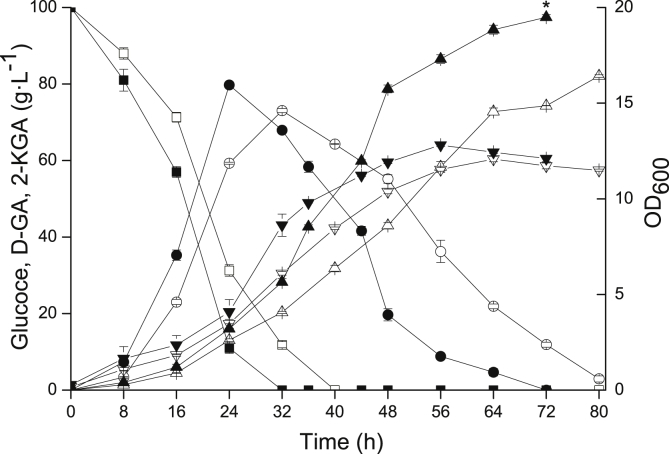
Batch culture of 2-KGA production using engineered and wild-type strains in a 3 L fermenter. Batch mode was employed in a 3 L fermenter with 100 g L−1 initial glucose concentration at 30 °C, 600 rpm, and 4.0 vvm. The growth rate of the engineered strain was faster than that of the wild-type strain. The 2-KGA production by G. japonicusga5dh-1-ga2dh-A was increased by 18.76%, the glucose conversion rate was increased by 15.80%, the productivity of the engineered strain was increased by 31.07%, and the fermentation period was 8 h shorter than that of the wild-type strain. The significant difference about highest 2-KGA titre of engineered strain compared to that of wild-type strain was analysed with T-test, p ≤ 0.01 was considered significant difference marked with a "*". Black = G. japonicusga5dh-1-ga2dh-A strain, white = Wild-type strain, squares = glucose, circles = D-GA, down triangles = OD600 values, up triangles = 2-KGA.
Fig. 5
Fig. 5
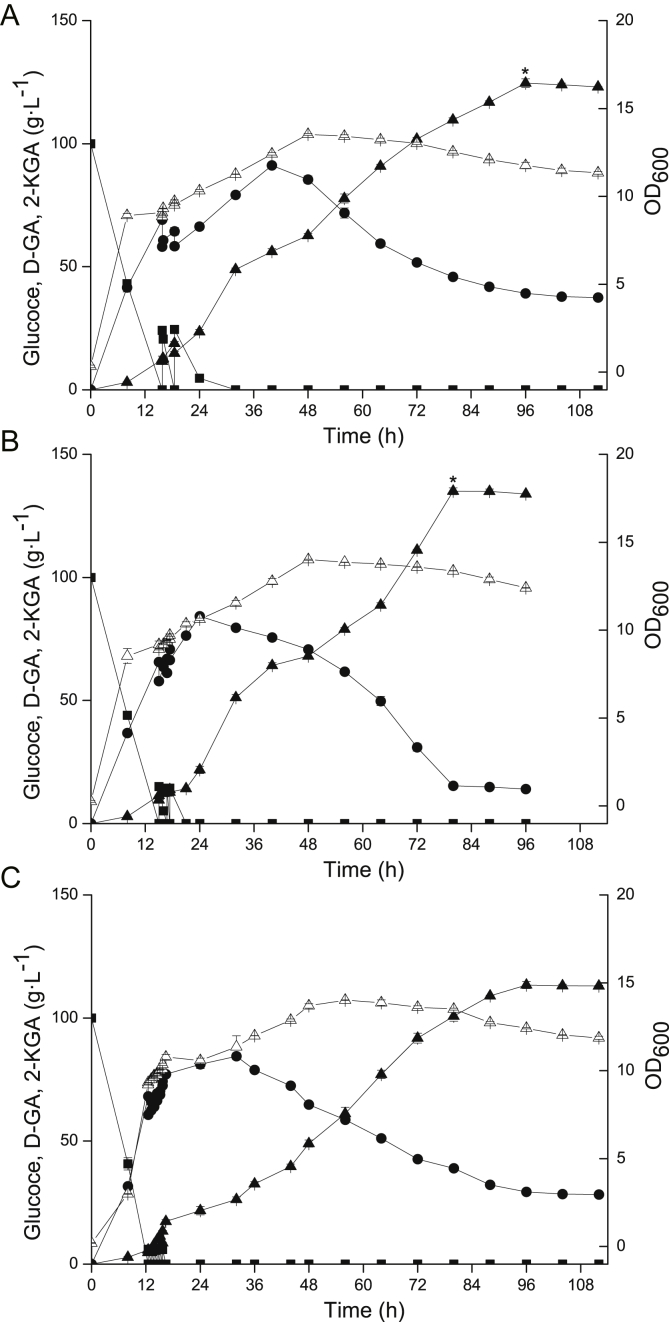
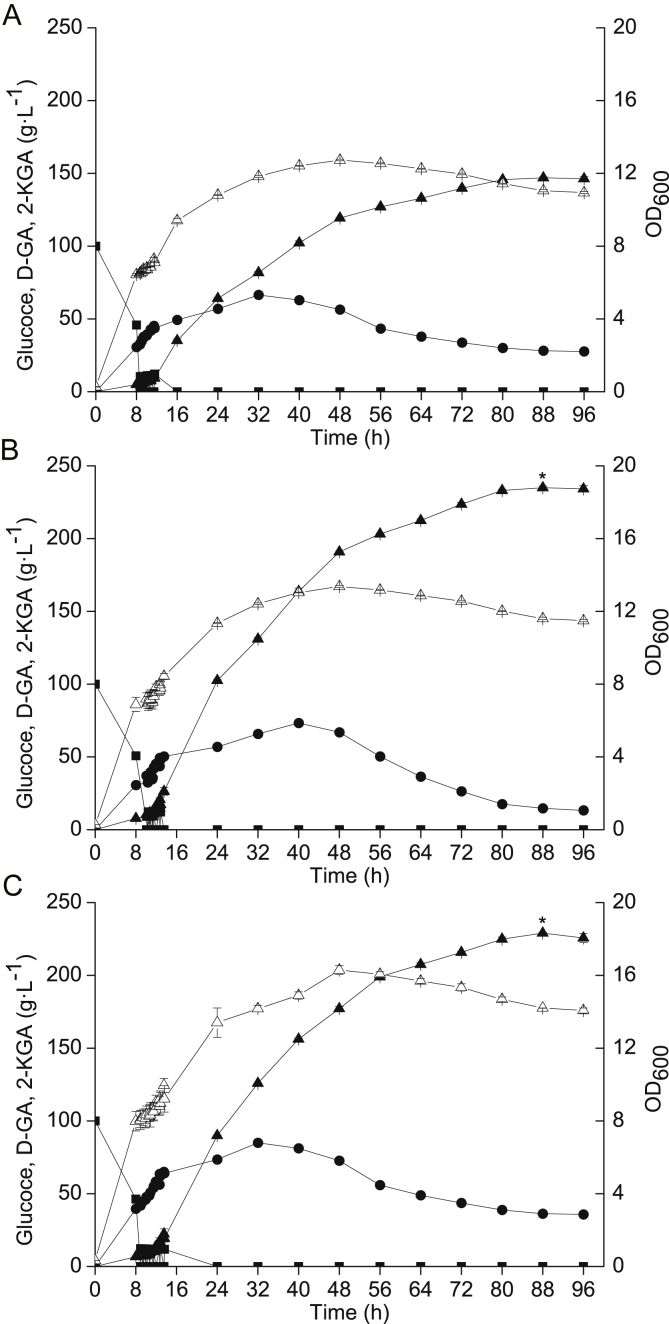
Effects of intermittent glucose addition on 2-KGA production. With an initial glucose concentration of 100 g L−1, 60 g L−1 glucose was intermittently fed several times when glucose was depleted. The titre of 2-KGA was 134.0 g L−1 with a 77.7% conversion efficiency with intermittent feeding three times, higher than with two feeds (123.2 g L−1 with a 71.4% conversion efficiency) and six feeds (113.5 g L−1 with a 65.8% conversion efficiency). The significant differences about highest 2-KGA titre of modes of two/three intermittent additions compared to that of mode of six intermittent additions were analysed with T-test, p ≤ 0.01 was considered significant difference marked with a "*". (A) Two additions of 30 g L−1 glucose each time. (B) Three additions of 20 g L−1 glucose each time. (C) Six additions of 10 g L−1 glucose each time. Squares = glucose, circles = D-GA, white triangles = OD600 values, black triangles = 2-KGA.
Fig. 6
Fig. 6
Effects of total glucose concentration on 2-KGA production. With an initial glucose concentration of 100 g L−1, different amounts of total glucose were fed intermittently (20 g L−1 each time). The titre of 2-KGA was 235.3 g L−1 with a 91.1% conversion efficiency after intermittently feeding seven times, higher than with six feeds (147.4 g L−1 with a 62.1% conversion efficiency) and eight feeds (229.0 g L−1 with an 81.7% conversion efficiency). The significant differences about highest 2-KGA titre of modes of seven/eight times additions compared to that of mode of six time additions were analysed with T-test, p ≤ 0.01 was considered significant difference marked with a "*". (A) Six additions totalling 120 g L−1 glucose. (B) Seven additions totalling 140 g L−1 glucose (C) Eight additions totalling 160 g L−1 glucose. Squares = glucose, circles = D-GA, white triangles = OD600 values, black triangles = 2-KGA.
Fig. 7
Fig. 7
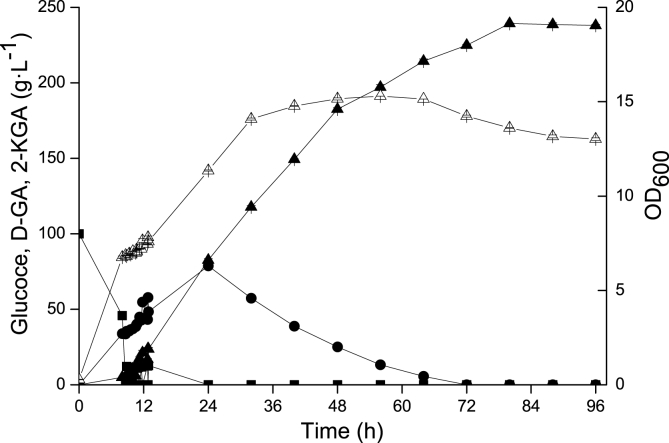
Time courses of 2-KGA production by intermittent fed-batch culturing in a 15 L fermenter. G. japonicusga5dh-1-ga2dh-A was cultivated in a 15 L fermenter at 30 °C, 600 rpm, 4 vvm and 0.05 MPa. The initial glucose concentration was 100 g L−1, and 140 g L−1 glucose was intermittently fed in seven steps. The by-product D-GA was completely converted into 2-KGA, maximum 2-KGA production reached 239.4 g/L, and the fermentation period was reduced to 80 h. Squares = glucose, circles = D-GA, white triangles = OD600 values, black triangles = 2-KGA.

References

    1. Stottmeister U. White biotechnology for green chemistry: fermentative 2-oxocarboxylic acids as novel building blocks for subsequent chemical syntheses. J Ind Microbiol Biotechnol. 2005;32(11–12):651–664. - PubMed
    1. Wang D. A membrane-bound gluconate dehydrogenase from 2-keto-D-gluconic acid industrial producing strain Pseudomonas plecoglossicida JUIM01: purification, characterization, and gene identification. Appl Biochem Biotechnol. 2019;188(4):897–913. - PubMed
    1. Pappenberger G., Hohmann H.P. Industrial production of L-ascorbic acid (vitamin C) and D-isoascorbic acid. Biotechnol Food Feed Additiv. 2014:143–188. - PubMed
    1. Zhuan W. Research progress on fermentation prcduction of 2-keto-D-gluconic acid. Food Sci (N Y) 2008;29(8):636–639.
    1. Wang D. Purification, characterization and gene identification of a membrane-bound glucose dehydrogenase from 2-keto-D-gluconic acid industrial updettas producing strain Pseudomonas plecoglossicida JUIM01. Int J Biol Macromol. 2018;118:534–541. - PubMed

LinkOut - more resources