Review
. 2019 Jan 30;5(1):48-61.
doi: 10.3934/microbiol.2019.1.48. eCollection 2019.

Asgard archaea: Diversity, function, and evolutionary implications in a range of microbiomes

Affiliations
Review

Asgard archaea: Diversity, function, and evolutionary implications in a range of microbiomes

Fraser MacLeod et al. AIMS Microbiol. .

Abstract

Elucidating the diversity of the Archaea has many important ecological and evolutionary implications. The Asgard superphylum of the archaea, described recently from metagenomic data, has reignited the decades-old debate surrounding the topology of the tree of life. This review synthesizes recent findings through publicly available genomes and literature to describe the current ecological and evolutionary significance of the Asgard superphylum. Asgard archaea have been found in a diverse range of microbiomes across the globe, primarily from sedimentary environments. Within these environments, positive correlations between specific members of the Asgard archaea and Candidate Division TA06 bacteria have been observed, opening up the possibility of symbiotic interactions between the groupings. Asgard archaeal genomes encode functionally diverse metabolic pathways, including the Wood-Ljungdahl pathway as a carbon-fixation strategy, putative nucleotide salvaging pathways, and novel mechanisms of phototrophy including new rhodopsins. Asgard archaea also appear to be active in nitrogen cycling. Asgard archaea encode genes involved in both dissimilatory nitrate reduction and denitrification, and for the potential to use atmospheric nitrogen or nitrite as nitrogen sources. Asgard archaea also may be involved in the transformation of sulfur compounds, indicating a putative role in sulfur cycling. To date, all Asgard archaeal genomes identified were described as obligately anaerobic. The Asgard archaea also appear to have important evolutionary implications. The presence of eukaryotic signature proteins and the affiliation of Asgard archaea in phylogenetic analyses appears to support two-domain topologies of the tree of life with eukaryotes emerging from within the domain of archaea, as opposed to the eukaryotes being a separate domain of life. Thus far, Heimdallarchaeota appears as the closest archaeal relative of eukaryotes.

Keywords: Asgard; archaea; ecology; eocyte; eukarya; evolution; genome; metabolism; microbiome; phylogeny.


Conflict of interest statement

Conflict of interest: All authors declare no conflicts of interest in this paper.

Figures
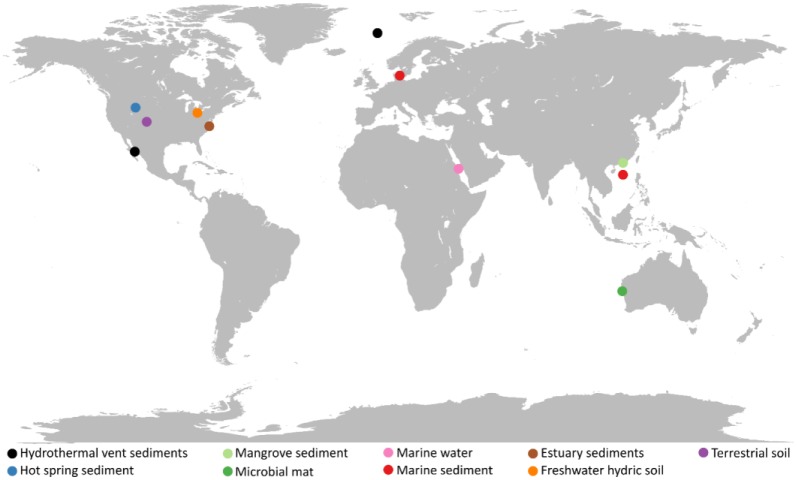
Figure 1.
Figure 1.. Global distribution of metagenomic-assembled sequences of Asgard archaea. Asgard metagenomic-assembled genomes from NCBI Assembly and MG-RAST databases were recorded for information related to location and environmental context of sampling (November 2018) (Table S1).
Figure 2.
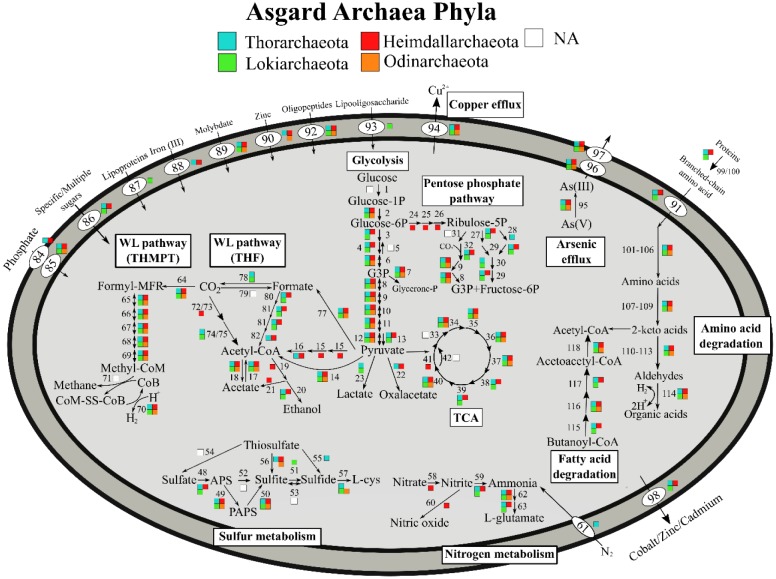
Figure 2.. Metabolic pathways of Asgard archaea indicating variation at the phyla level. Carbon metabolic pathways indicate a heterotrophic lifestyle for Asgard archaea. Asgard archaea also encoded genes related to sulfur and nitrogen cycling.
Figure 3.
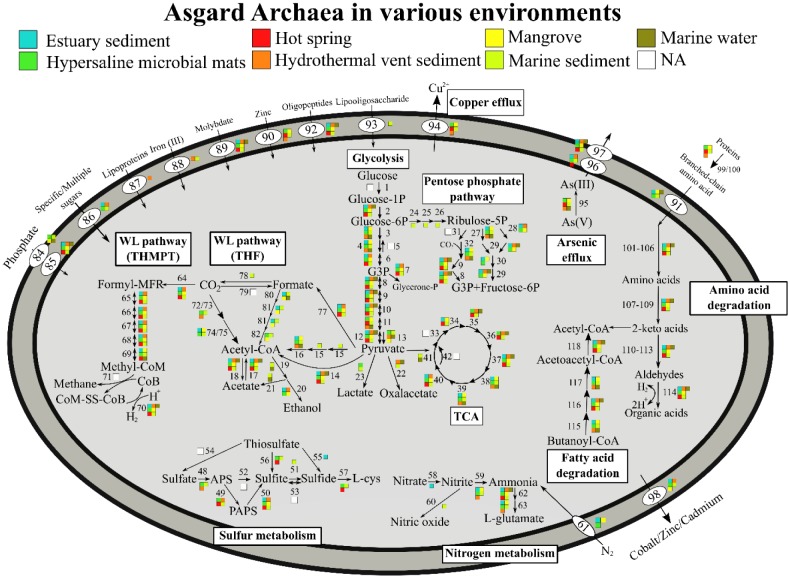
Figure 3.. Differences in metabolic capabilities of Asgard archaea from different environmental samples. No significant variation was observed for Asgard archaea sampled from different environments. This may be due to the similarities of the sedimentary environments from which Asgard archaea were sampled.
Figure 4.
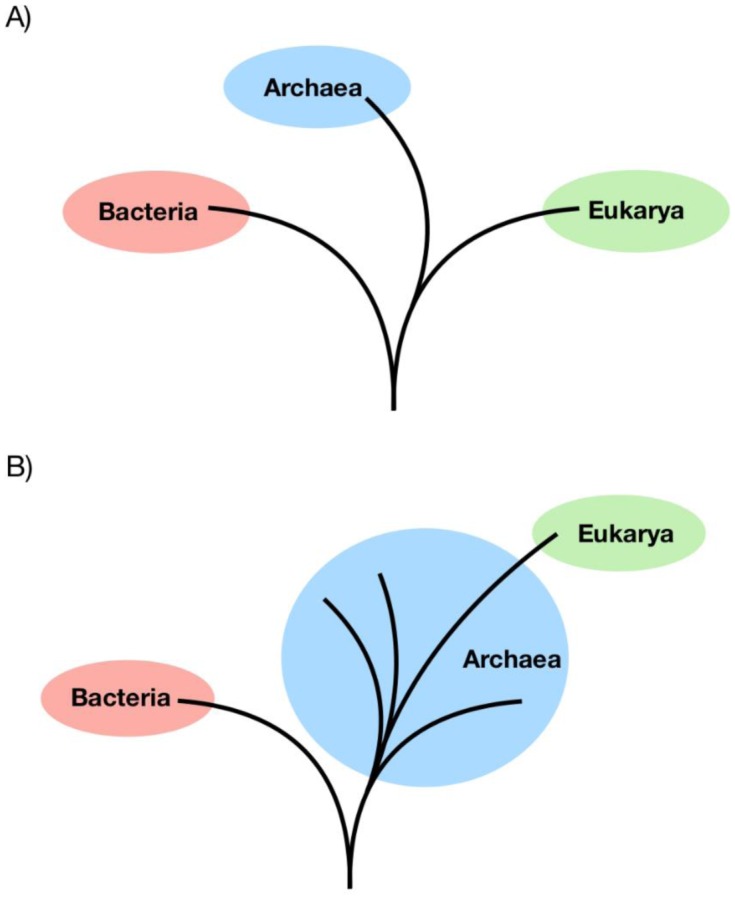
Figure 4.. Placement of eukaryotes within the tree of life. The two competing hypotheses: (A) the Woese three domain tree of life, whereby eukaryotes share a common ancestor to the exclusion of the bacteria, (B) the Eocyte hypothesis, whereby eukaryotes emerged from within the diversity of archaea.
Figure 5.
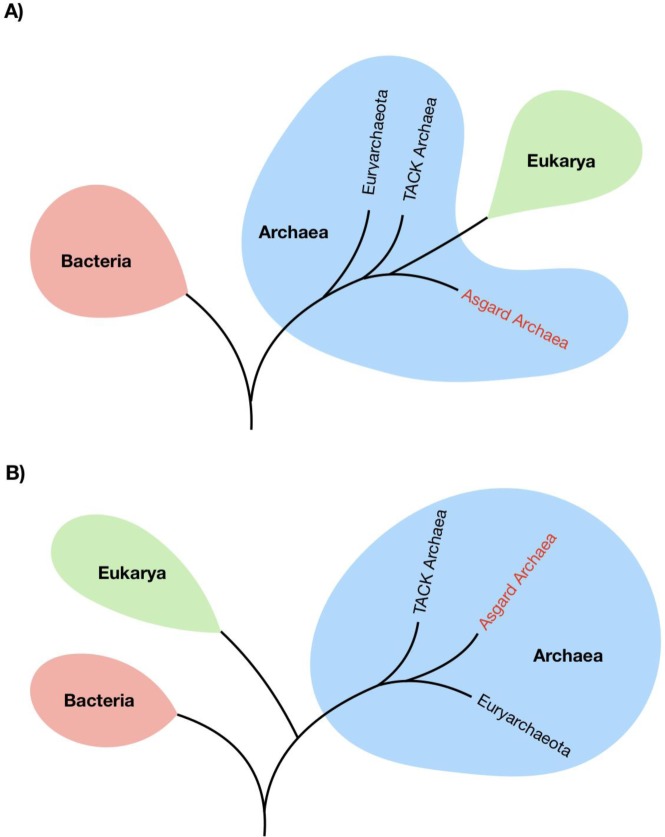
Figure 5.. Differing phylogenetic trees resulting from the inclusion of the Asgard superphylum. (A) The tree of life resulting from a range of phylogenetic analyses of conserved markers, ribosomal RNA genes and ribosomal proteins, placing Asgard archaea as the closest archaeal relatives of eukaryotes. (B) The tree produced from phylogenetic analyses of Asgard RNA polymerase genes supports the three-domain topology of the tree of life, with Asgard archaea as a sister group to Euryarchaeota.

References

    1. DeLong EF. Archaea in coastal marine environments. P Natl Acad Sci USA. 1992;89:5685–5689. - PMC - PubMed
    1. Karner MB, DeLong EF, Karl DM. Archaeal dominance in the mesopelagic zone of the Pacific Ocean. Nature. 2001;409:507. - PubMed
    1. Bintrim SB, Donohue TJ, Handelsman J, et al. Molecular phylogeny of Archaea from soil. P Natl Acad Sci USA. 1997;94:277–282. - PMC - PubMed
    1. Adam PS, Borrel G, Brochier-Armanet C, et al. The growing tree of Archaea: new perspectives on their diversity, evolution and ecology. ISME J. 2017;11:2407. - PMC - PubMed
    1. Spang A, Caceres EF, Ettema TJ. Genomic exploration of the diversity, ecology, and evolution of the archaeal domain of life. Science. 2017;357:eaaf3883. - PubMed