. 2019 Jun 25;5(2):158-175.
doi: 10.3934/microbiol.2019.2.158. eCollection 2019.

Antimicrobial activity of bacteriophage derived triple fusion protein against Staphylococcus aureus

Affiliations

Antimicrobial activity of bacteriophage derived triple fusion protein against Staphylococcus aureus

Natalia Y Kovalskaya et al. AIMS Microbiol. .

Abstract

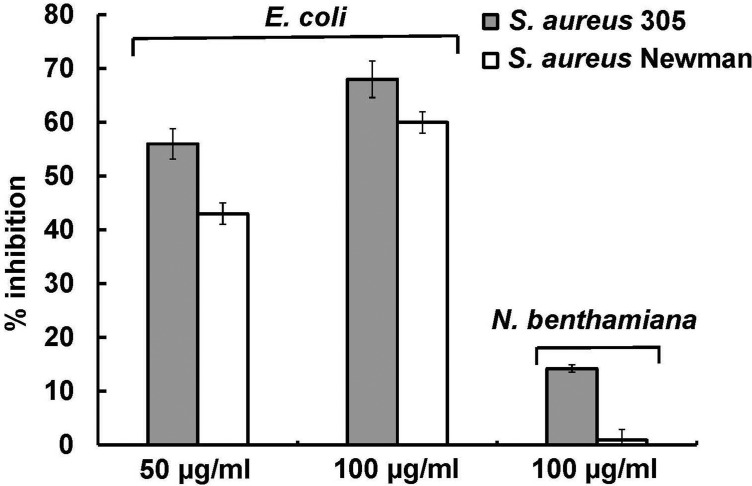
The increasing spread of antibiotic-resistant microorganisms has led to the necessity of developing alternative antimicrobial treatments. The use of peptidoglycan hydrolases is a promising approach to combat bacterial infections. In our study, we constructed a 2 kb-triple-acting fusion gene (TF) encoding the N-terminal amidase-5 domain of streptococcal LambdaSA2 prophage endolysin (D-glutamine-L-lysin endopeptidase), a mid-protein amidase-2 domain derived from the staphylococcal phage 2638A endolysin (N-acetylmuramoyl-L-alanine amidase) and the mature version (246 residues) of the Staphylococcus simulans Lysostaphin bacteriocin (glycyl-glycine endopeptidase) at the C-terminus. The TF gene was expressed in Nicotiana benthamiana plants using the non-replicating Cowpea mosaic virus (CPMV)-based vector pEAQ-HT and the replicating Alternanthera mosaic virus (AltMV)-based pGD5TGB1L8823-MCS-CP3 vector, and in Escherichia coli using pET expression vectors pET26b+ and pET28a+. The resulting poor expression of this fusion protein in plants prompted the construction of a TF gene codon-optimized for expression in tobacco plants, resulting in an improved codon adaptation index (CAI) from 0.79 (TF gene) to 0.93 (TFnt gene). Incorporation of the TFnt gene into the pEAQ-HT vector, followed by transient expression in N. benthamiana, led to accumulation of TFnt to an approximate level of 0.12 mg/g of fresh leaf weight. Antimicrobial activity of purified plant- and bacterial-produced TFnt proteins was assessed against two strains of Gram-positive Staphylococcus aureus 305 and Newman. The results showed that plant-produced TFnt protein was preferentially active against S. aureus 305, showing 14% of growth inhibition, while the bacterial-produced TFnt revealed significant antimicrobial activity against both strains, showing 68 (IC50 25 µg/ml) and 60% (IC50 71 µg/ml) growth inhibition against S. aureus 305 and Newman, respectively. Although the combination of codon optimization and transient expression using the non-replicating pEAQ-HT expression vector facilitated production of the TFnt protein in plants, the most functionally active antimicrobial protein was obtained using the prokaryotic expression system.

Keywords: CPMV-based vector; Nicotiana benthamiana; antimicrobials; codon optimization; endolysins; lysostaphin; transient expression.


Conflict of interest statement

Conflict of interest: All authors declare no conflicts of interest in this paper.

Figures
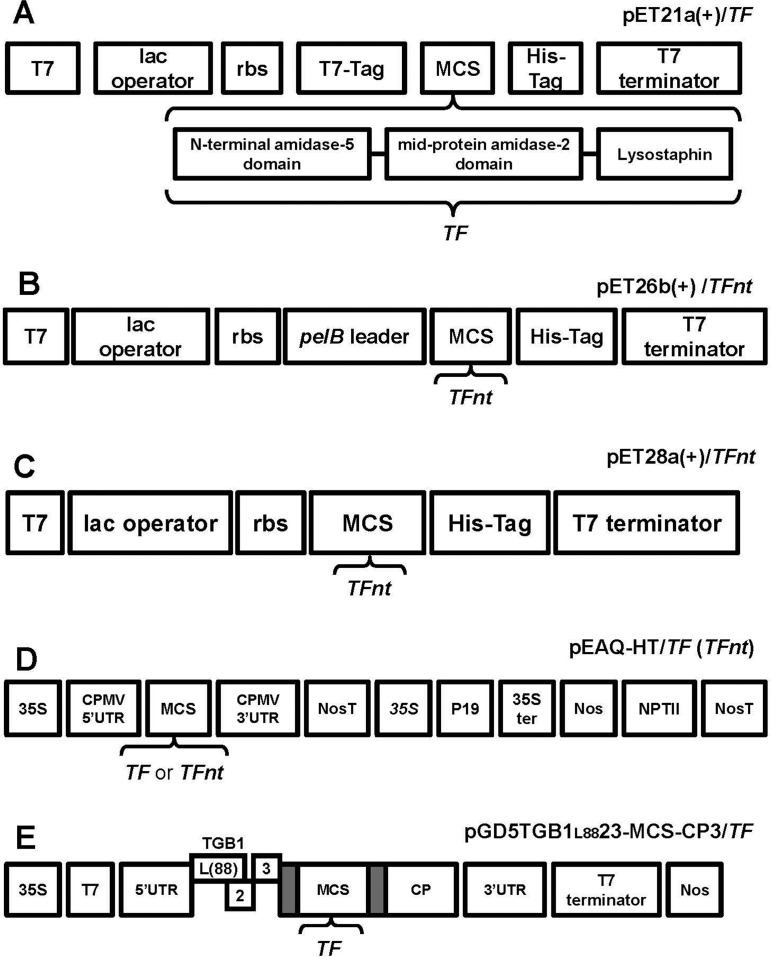
Figure 1.
Figure 1.. Schematic representation of vector constructions carrying TF and TFnt genes with major features labeled. A: The cloning/expression region of pET21a+/TF vector indicating the insertion of the TF gene consisting of N-terminal amidase-5 domain (D-glutamine-L-lysin endopeptidase activity) of LambdaSA2 prophage endolysin, a mid-protein amidase-2 domain of staphylococcal phage 2638A endolysin (amidase activity) and the mature S. simulans Lysostaphin (glycyl-glycine endopeptidase activity). pET21a+ carries an N-terminal T7-Tag sequence plus optional C-terminal His-Tag sequence. rbs—ribosomal binding site sequence; MCS—multiple cloning site. B: The cloning/expression region of pET26b+/TFnt vector indicating the insertion of the TFnt gene. pET26b+ carries an N-terminal pelB signal sequence for potential periplasmic localization of target gene. C: The cloning/expression region of pET28a+/TFnt vector indicating the insertion of the TFnt gene. D: The cloning/expression region of pEAQ-HT vector indicating the insertion of the TF and TFnt genes. 35S—Cauliflower mosaic virus 35S (35S) promoters; NosT—nopaline synthase transcriptional terminator; Nos—nopaline synthase promoter sequence; P19—gene coding the suppressor of gene silencing; NPTII—kanamycin resistance gene. E: The cloning/expression region of bipartite vector pGD5TGB1L8823-MCS-CP3 indicating the insertion of the TF gene. TGB1 (L(88))—‘triple gene block 1’ with Leucine at the position 88 (Lim et al., 2010); gray boxes - duplicated CP (coat protein) subgenomic promoters.
Figure 2.
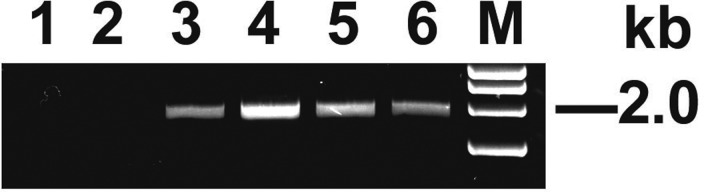
Figure 2.. RT-PCR analysis of total cellular RNA isolated from agroinfiltrated N. benthamiana leaves (5 dpi). Lanes: 1: ‘control-mock’ (healthy plant); 2: ‘empty-pEAQ-HT’; 3–6: ‘pEAQ-HT/TFnt’; ‘M’: DNA marker: Hyper Ladder 1kb (Bioline Taunton, MA).
Figure 3.
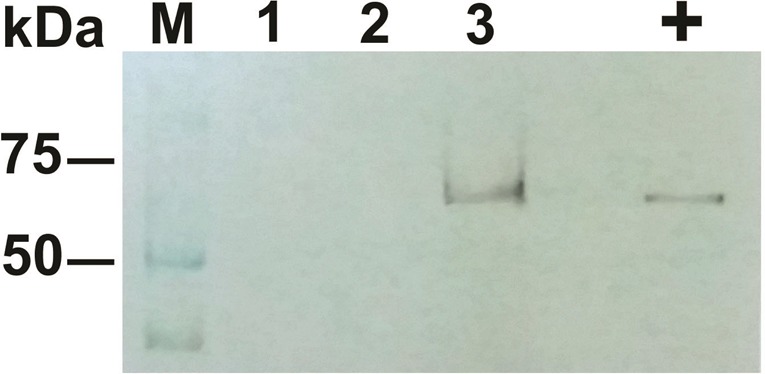
Figure 3.. Western blot analysis of TFnt produced in N. benthamiana on 6 dpi. The membrane was incubated with a 1:1000 dilution of polyclonal antibodies to Lysostaphin (AIC BIOTECH, Rockville MD, USA) followed by a 1:5000 dilution of goat anti-rabbit phosphatase-labeled antibodies (Kirkegaard & Perry Laboratories (KPL), Inc., Gaithersburg, MD) with subsequent membrane development by BCIP/NBT Membrane Phosphatase Substrate System (KPL). Lanes: M: Precision Plus Protein Kaleidoscope (Bio-Rad); 1: ‘control-mock’ (healthy plant); 2: ‘empty-pEAQ-HT’; 3: ‘pEAQ-HT/TFnt’; + - positive control (E. coli produced TFnt). The predicted TFnt MW = 72.9 kDa.
Figure 4.
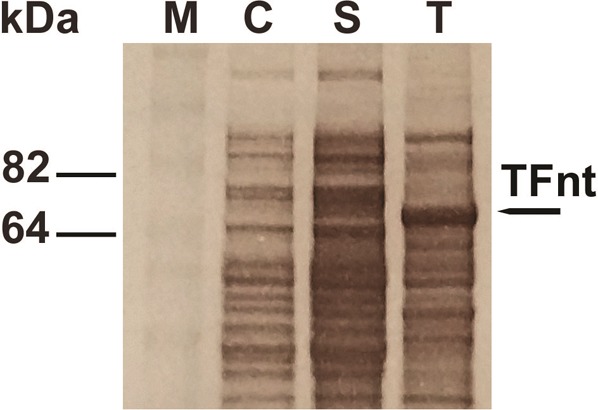
Figure 4.. SDS-PAGE analysis of protein fractions produced in E. coli BL21 (DE3) transformed with pET26b+/TFnt. Lanes: C: uninduced control (without addition of IPTG), S - soluble protein fraction; T: total protein fraction that contains TFnt localized in inclusion bodies. The latter fraction (T) has been used as positive control for Western blot analysis of TFnt protein. kDa = BenchMark Pre-Stained Protein Ladder (Novex, Life Technologies, CA, USA). The predicted TFnt MW = 72.9 kDa.
Figure 5.
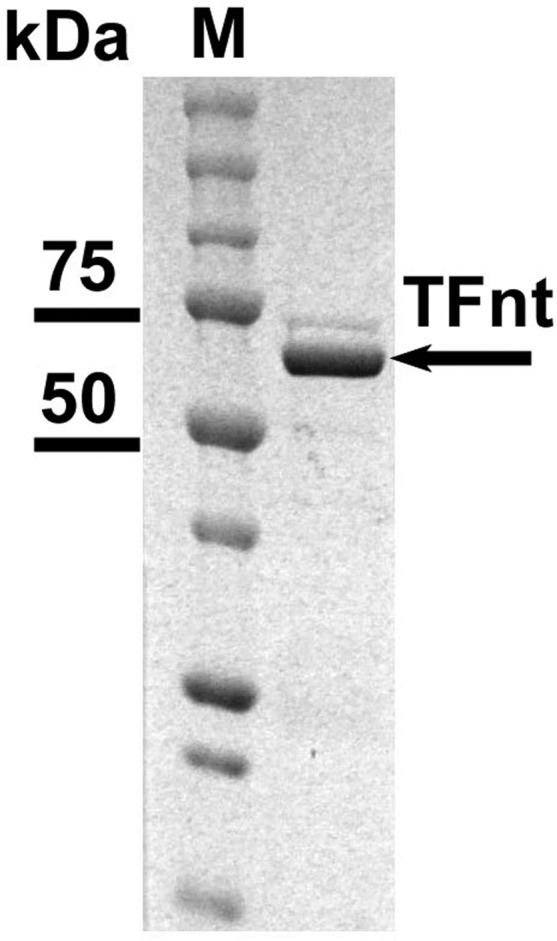
Figure 5.. SDS-PAGE analysis of Ni-NTA purified TFnt protein produced in E. coli BL21 (DE3) transformed with pET28a+/TFnt. M: Precision Plus Protein All Blue Prestained Protein Standards (Bio-Rad). The predicted TFnt MW = 72.9 kDa.
Figure 6.
Figure 6.. Antimicrobial activity of bacterial- and plant-produced TFnt protein against S. aureus 305 and Newman in a growth inhibition assay. % inhibition on the Y-axis refers to growth inhibition of S. aureus 305 and Newman. The TFnt concentration is indicated below the X-axis. Inhibition of S. aureus was statistically significant (p < 0.05) for all experimental groups except for inhibition of S. aureus Newman by plant-produced TFnt.
Figure 7.
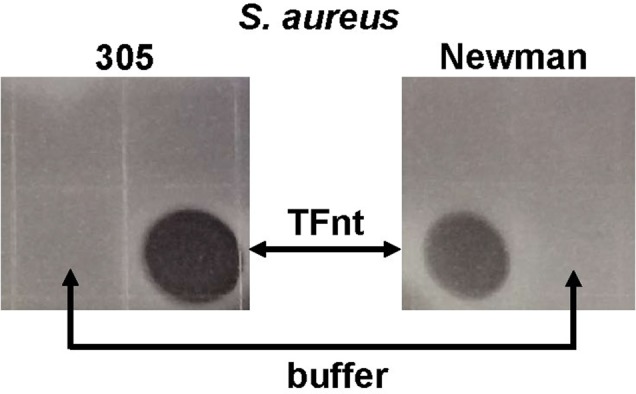
Figure 7.. Antimicrobial activity of bacterial produced TFnt protein (7 µg) against S. aureus 305 and Newman in plate lysis assay. Staphylococcus strains were applied to the plate as described in Materials and methods. Ten µl spots of samples were applied to the agar plate and the plate was incubated at room temperature. A photographic image of the plate was taken 16 hrs after application of the samples.

References

    1. Tong S, Davis J, Eichenberger E, et al. Staphylococcus aureus infections: epidemiology, pathophysiology, clinical manifestations, and management. Clin Microbiol Rev. 2015;28:603–661. - PMC - PubMed
    1. Kadariya J, Smith T, Thapaliya D. Staphylococcus aureus and staphylococcal food-borne disease: an ongoing challenge in public health. BioMed Res Int. 2014;2014:1–9. - PMC - PubMed
    1. Hennekinne J, Buyder M, Dragacci S. Staphylococcus aureus and its food poisoning toxins: characterization and outbreak investigation. FEMS Microbial Rev. 2012;36:815–836. - PubMed
    1. Altamirano F, Barr J. Phage therapy in the postantibiotic era. Clin Microbiol Rev. 2019;32:e00066–18. - PMC - PubMed
    1. Furfaro L, Payne M, Chang B. Bacteriophage therapy: clinical trials and regulatory hurdles. Front Cell Infect Microbiol. 2018;8:1–7. - PMC - PubMed