


U.K. Intensivists' Preferences for Patient Admission to ICU: Evidence From a Choice Experiment
- PMID: 31385883
- PMCID: PMC6798748
- DOI: 10.1097/CCM.0000000000003903
U.K. Intensivists' Preferences for Patient Admission to ICU: Evidence From a Choice Experiment
Abstract
Objectives: Deciding whether to admit a patient to the ICU requires considering several clinical and nonclinical factors. Studies have investigated factors associated with the decision but have not explored the relative importance of different factors, nor the interaction between factors on decision-making. We examined how ICU consultants prioritize specific factors when deciding whether to admit a patient to ICU.
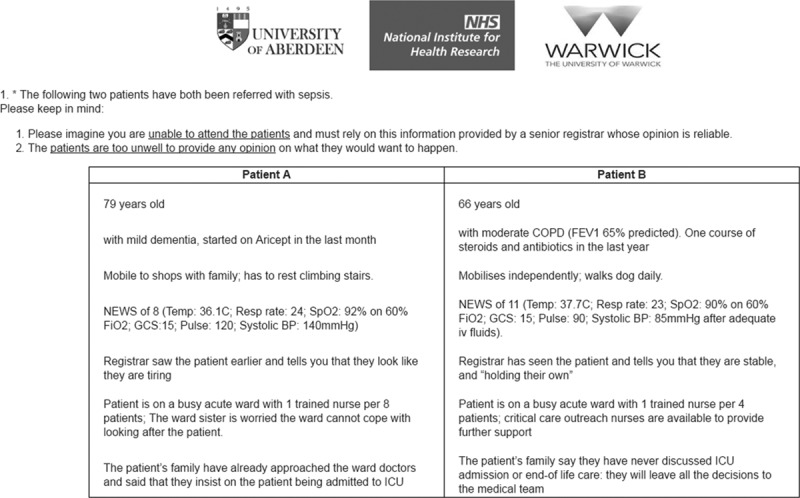
Design: Informed by a literature review and data from observation and interviews with ICU clinicians, we designed a choice experiment. Senior intensive care doctors (consultants) were presented with pairs of patient profiles and asked to prioritize one of the patients in each task for admission to ICU. A multinomial logit and a latent class logit model was used for the data analyses.
Setting: Online survey across U.K. intensive care.
Subjects: Intensive care consultants working in NHS hospitals.
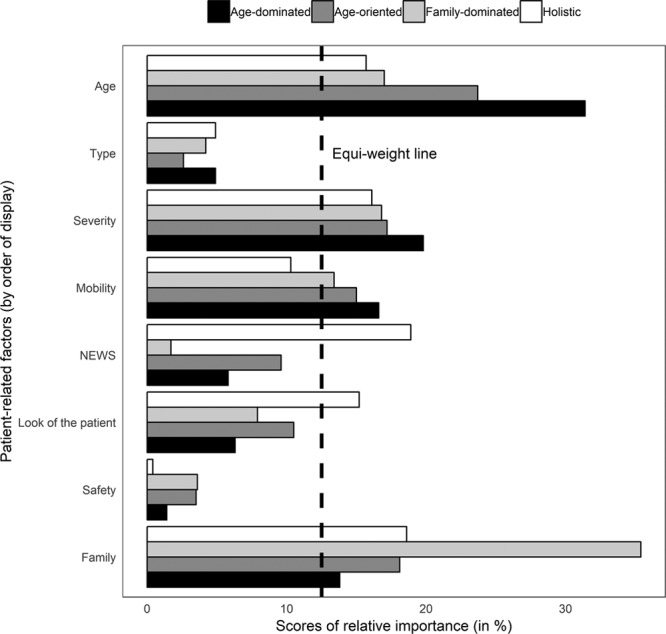
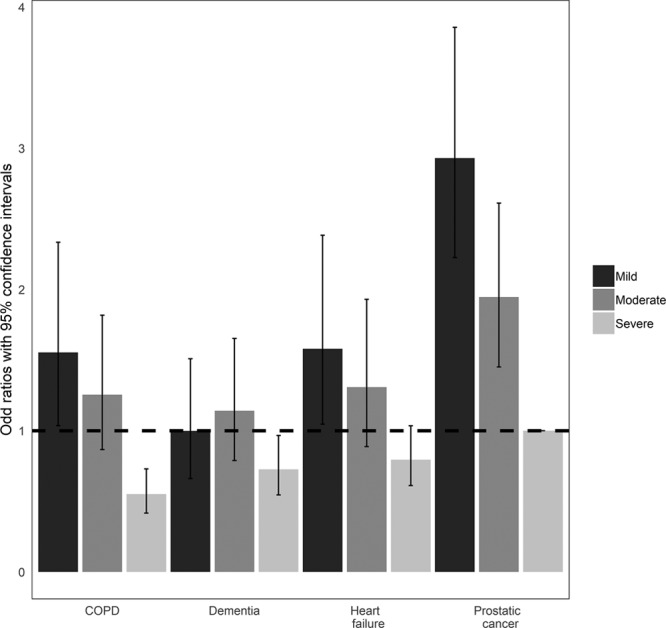
Measurements and main results: Of the factors investigated, patient's age had the largest impact at admission followed by the views of their family, and severity of their main comorbidity. Physiologic measures indicating severity of illness had less impact than the gestalt assessment by the ICU registrar. We identified four distinct decision-making patterns, defined by the relative importance given to different factors.
Conclusions: ICU consultants vary in the importance they give to different factors in deciding who to prioritize for ICU admission. Transparency regarding which factors have been considered in the decision-making process could reduce variability and potential inequity for patients.
Figures
References
-
- Wildman MJ, O’Dea J, Kostopoulou O, et al. Variation in intubation decisions for patients with chronic obstructive pulmonary disease in one critical care network. QJM 2003; 96:583–591 - PubMed
-
- Augier R, Hambleton IR, Harding H. Triage decisions and outcome among the critically ill at the University Hospital of the West Indies. West Indian Med J 2005; 54:181–186 - PubMed
-
- Iapichino G, Corbella D, Minelli C, et al. Reasons for refusal of admission to intensive care and impact on mortality. Intensive Care Med 2010; 36:1772–1779 - PubMed
-
- Louriz M, Abidi K, Akkaoui M, et al. Determinants and outcomes associated with decisions to deny or to delay intensive care unit admission in Morocco. Intensive Care Med 2012; 38:830–837 - PubMed
Publication types
MeSH terms
Grants and funding
LinkOut - more resources
Full Text Sources
