


Facilitating Screening and Brief Interventions in Primary Care: A Systematic Review and Meta-Analysis of the AUDIT as an Indicator of Alcohol Use Disorders
- PMID: 31386768
- PMCID: PMC6852009
- DOI: 10.1111/acer.14171
Facilitating Screening and Brief Interventions in Primary Care: A Systematic Review and Meta-Analysis of the AUDIT as an Indicator of Alcohol Use Disorders
Abstract
Background: The Alcohol Use Disorders Identification Test (AUDIT) was developed for use in primary health care settings to identify hazardous and harmful patterns of alcohol consumption, and is often used to screen for alcohol use disorders (AUDs). This study examined the AUDIT as a screening tool for AUDs.
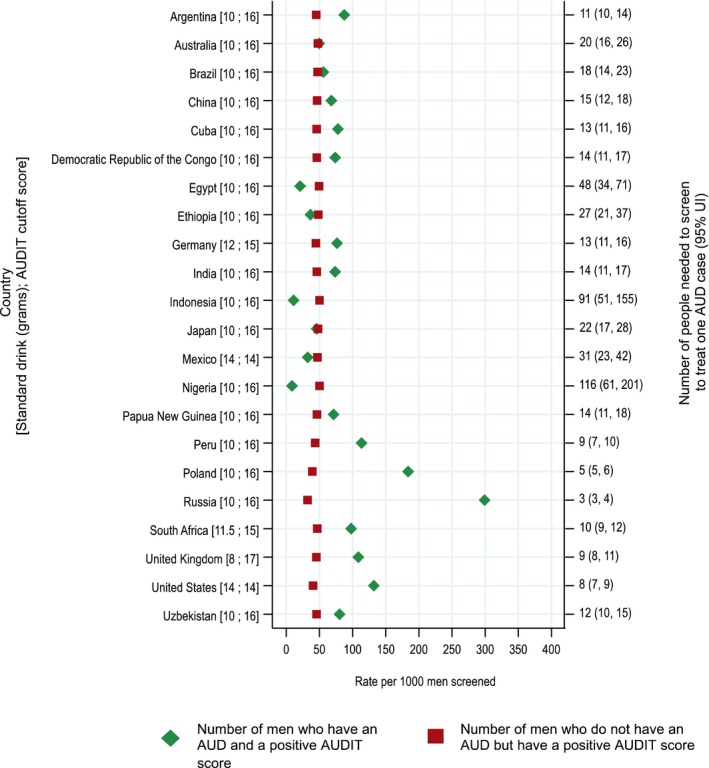
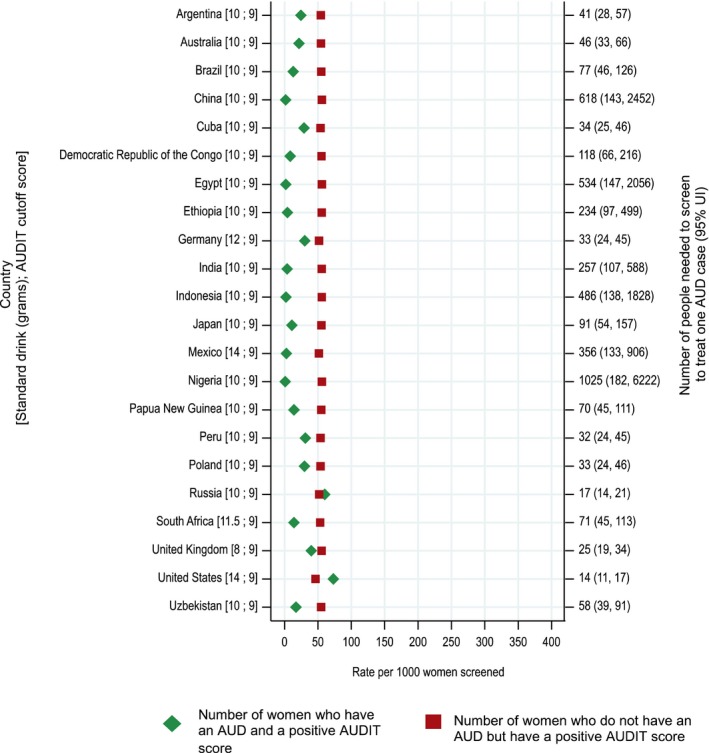
Methods: A systematic literature search was performed of electronic bibliographic databases (CINAHL, Embase, ERIC, MEDLINE, PsycINFO, Scopus, and Web of Science) without language or geographic restrictions for original quantitative studies published before September 1, 2018, that assess the AUDIT's ability to screen for AUDs. Random-effects meta-regression models were constructed by sex to assess the potential determinants of the AUDIT's specificity and sensitivity. From these models and ecological data from the Global Information System on Alcohol and Health, the true- and false-positive and true- and false-negative proportions were determined. The number of people needed to be screened to treat 1 individual with an AUD was estimated for all countries globally where AUD data exist, using a specificity of 0.95.
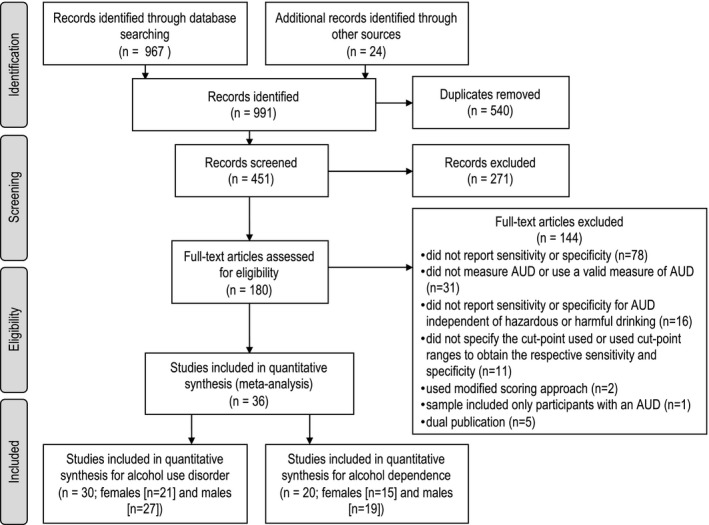
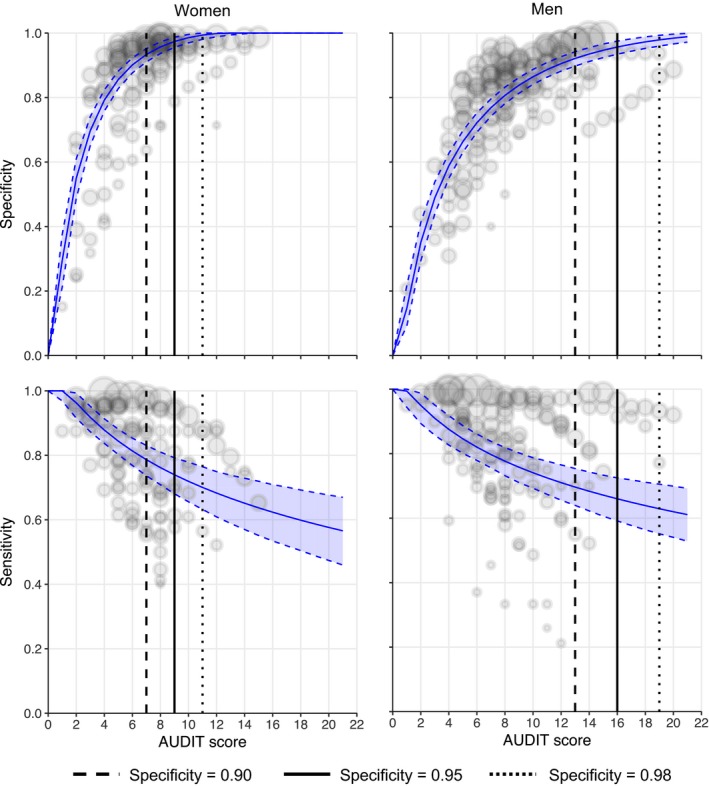
Results: A total of 36 studies met inclusion criteria for the meta-regression. The AUDIT score cut-point was significantly associated with sensitivity and specificity. Standard drink size was found to affect the sensitivity and specificity of the AUDIT for men, but not among women. The AUDIT performs less well in identifying women compared to men, and countries with a low prevalence of AUDs have higher false-positive rates compared to countries with a higher AUD prevalence.
Conclusions: The AUDIT does not perform well as a screening tool for identifying individuals with an AUD, especially in countries and among populations with a low AUD prevalence (e.g., among women), and thus should not be used for this purpose.
Keywords: Alcohol Use Disorders; Alcohol Use Disorders Identification Test; Classification Accuracy; Screening.
© 2019 The Authors. Alcoholism: Clinical & Experimental Research published by Wiley Periodicals, Inc. on behalf of Research Society on Alcoholism.
Conflict of interest statement
None to declare.
Figures
References
-
- American Psychiatric Association (2013) Diagnostic and Statistical Manual of Mental Disorders, Fifth Edition: DSM‐5 Author, Arlington, VA.
-
- Babor TF, Higgins‐Biddle JC, Saunders JB, Monteiro MG (2001) The Alcohol Use Disorders Identification Test: Guidelines for Use in Primary Care World Health Organization, Department of Mental Health and Substance Dependence, Geneva, Switzerland.
-
- Babor TF, Robaina K (2016) The Alcohol Use Disorders Identification Test (AUDIT): A review of graded severity algorithms and national adaptations. Int J Alcohol Drug Res 5:17–24.
-
- Bush K, Kivlahan DR, Mcdonell MB, Fihn SD, Bradley KA (1998) The AUDIT alcohol consumption questions (AUDIT‐C): an effective brief screening test for problem drinking. Arch Intern Med 158:1789–1795. - PubMed
Publication types
MeSH terms
Grants and funding
LinkOut - more resources
Full Text Sources
Medical
Miscellaneous
