. 2019 Aug 5;20(15):3818.
doi: 10.3390/ijms20153818.

Identification and Clinical Validation of a Novel 4 Gene-Signature with Prognostic Utility in Colorectal Cancer

Affiliations

Identification and Clinical Validation of a Novel 4 Gene-Signature with Prognostic Utility in Colorectal Cancer

Pankaj Ahluwalia et al. Int J Mol Sci. .

Abstract

Colorectal cancer (CRC) is a high burden disease with several genes involved in tumor progression. The aim of the present study was to identify, generate and clinically validate a novel gene signature to improve prediction of overall survival (OS) to effectively manage colorectal cancer. We explored The Cancer Genome Atlas (TCGA), COAD and READ datasets (597 samples) from The Protein Atlas (TPA) database to extract a total of 595 candidate genes. In parallel, we identified 29 genes with perturbations in > 6 cancers which are also affected in CRC. These genes were entered in cBioportal to generate a 17 gene panel with highest perturbations. For clinical validation, this gene panel was tested on the FFPE tissues of colorectal cancer patients (88 patients) using Nanostring analysis. Using multivariate analysis, a high prognostic score (composite 4 gene signature-DPP7/2, YWHAB, MCM4 and FBXO46) was found to be a significant predictor of poor prognosis in CRC patients (HR: 3.42, 95% CI: 1.71-7.94, p < 0.001 *) along with stage (HR: 4.56, 95% CI: 1.35-19.15, p = 0.01 *). The Kaplan-Meier analysis also segregated patients on the basis of prognostic score (log-rank test, p = 0.001 *). The external validation using GEO dataset (GSE38832, 122 patients) corroborated the prognostic score (HR: 2.7, 95% CI: 1.99-3.73, p < 0.001 *). Additionally, higher score was able to differentiate stage II and III patients (130 patients) on the basis of OS (HR: 2.5, 95% CI: 1.78-3.63, p < 0.001 *). Overall, our results identify a novel 4 gene prognostic signature that has clinical utility in colorectal cancer.

Keywords: biomarker; colorectal cancer; gene expression; prognostic; survival analysis; tumor.


Conflict of interest statement

The authors declare no conflict of interest.

Figures

Figure 1
Figure 1
Kaplan-Meier curve of (a) YWHAB, (b) DPP7/2, (c) MCM4, (d) FBXO46 from clinical dataset that were included in generation of prognostic score based on Cox proportion hazard model. The patients were divided into 2 groups, higher and lower based on median gene expression as a cut-off point.
Figure 2
Figure 2
The composite prognostic score differentiated CRC patients (n = 88) based on OS. The patients with higher score had poor prognosis compared to lower ones.
Figure 3
Figure 3
Kaplan-Meier curve of (a) YWHAB, (b) DPP7/2, (c) MCM4, (d) FBXO46 from the external dataset. The median gene expression was used as a cut-off point for higher and lower gene expression groups.
Figure 4
Figure 4
The external validation using independent dataset validated the four gene prognostic score.
Figure 5
Figure 5
The prognostic score differentiated CRC patients in stage II + III in combined internal and external datasets.
Figure 6
Figure 6
Differential expression of prognostic genes in cancerous tissue compared to normal. The expression of (a) YWHAB, (b) LRRC59, (c) MCM4, (d) DPP7/2, (e) FBXO46 was assessed using normal tissue expression data from TCGA and GTEx dataset (n = 349) and TCGA CRC tumor dataset (n = 275). Higher expression of these genes except DPP7/2 and FBXO46 were significantly associated with tumors in CRC patients.
Figure 7
Figure 7
A flowchart depicting gene extraction methodology for generation of 17 gene panel.
Figure 8
Figure 8
The 595 candidate gene-set was extracted from The Protein Atlas. The gene expression of 7 top-most altered genes (PI4K2B, PBXIP1, CHEK1, DLAT, FAM50A, KDM4B, DPP7/2) significantly differentiated patients on the basis of overall survival in cBioportal, with perturbations in 37% of CRC patients (n = 222).
Figure 9
Figure 9
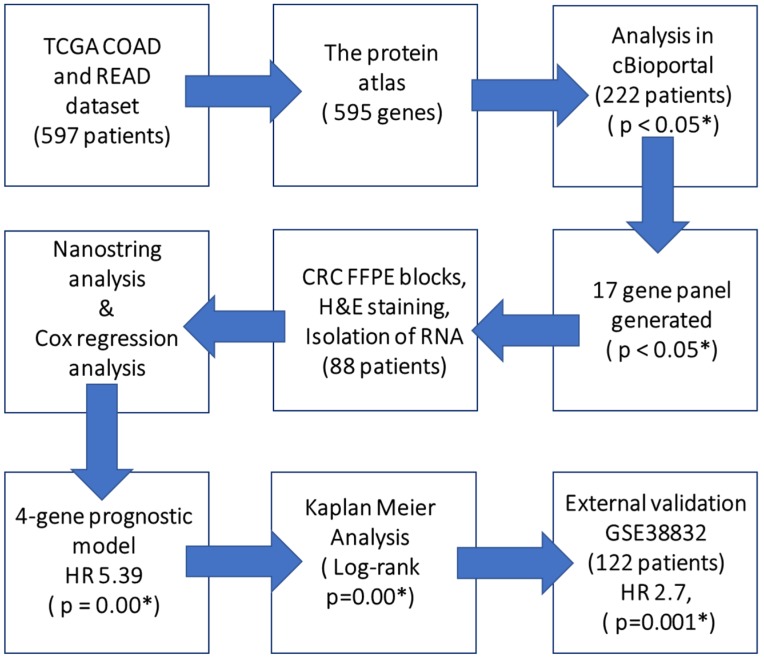
A flowchart depicting the process used to identify, generate and validate the prognostic signature in colorectal cancer.

References

    1. Siegel R.L., Miller K.D., Fedewa S.A., Ahnen D.J., Meester R.G.S., Barzi A., Jemal A. Colorectal cancer statistics, 2017. CA Cancer J. Clin. 2017;67:177–193. doi: 10.3322/caac.21395. - DOI - PubMed
    1. Siegel R.L., Miller K.D., Jemal A. Cancer statistics, 2019. CA Cancer J. Clin. 2019;69:7–34. doi: 10.3322/caac.21551. - DOI - PubMed
    1. Marcker Espersen M.L., Linnemann D., Christensen I.J., Alamili M., Troelsen J.T., Hogdall E. SOX9 expression predicts relapse of stage II colon cancer patients. Hum. Pathol. 2016;52:38–46. doi: 10.1016/j.humpath.2015.12.026. - DOI - PubMed
    1. Zuo S., Dai G., Ren X. Identification of a 6-gene signature predicting prognosis for colorectal cancer. Cancer Cell Int. 2019;19:6. doi: 10.1186/s12935-018-0724-7. - DOI - PMC - PubMed
    1. Lee U., Frankenberger C., Yun J., Bevilacqua E., Caldas C., Chin S.F., Rueda O.M., Reinitz J., Rosner M.R. A prognostic gene signature for metastasis-free survival of triple negative breast cancer patients. PLoS ONE. 2013;8:e82125. doi: 10.1371/journal.pone.0082125. - DOI - PMC - PubMed

MeSH terms

Substances