


Origins and Impact of Psychological Traits in Polycystic Ovary Syndrome
- PMID: 31387252
- PMCID: PMC6723772
- DOI: 10.3390/medsci7080086
Origins and Impact of Psychological Traits in Polycystic Ovary Syndrome
Abstract
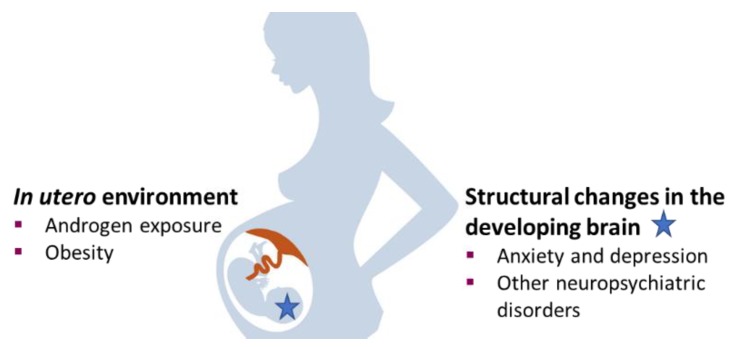
Women with polycystic ovary syndrome (PCOS) exhibit compromised psychiatric health. Independent of obesity, women with PCOS are more susceptible to have anxiety and depression diagnoses and other neuropsychiatric disorders. During pregnancy women with PCOS display high circulating androgen levels that may cause prenatal androgen exposure affecting the growing fetus and increasing the risk of mood disorders in offspring. Increasing evidence supports a non-genetic, maternal contribution to the development of PCOS and anxiety disorders in the next generation. Prenatal androgenized rodent models reflecting the anxiety-like phenotype of PCOS in the offspring, found evidence for the altered placenta and androgen receptor function in the amygdala, together with changes in the expression of genes associated with emotional regulation and steroid receptors in the amygdala and hippocampus. These findings defined a previously unknown mechanism that may be critical in understanding how maternal androgen excess can increase the risk of developing anxiety disorders in daughters and partly in sons of PCOS mothers. Maternal obesity is another common feature of PCOS causing an unfavorable intrauterine environment which may contribute to psychiatric problems in the offspring. Whether environmental factors such as prenatal androgen exposure and obesity increase the offspring's susceptibility to develop psychiatric ill-health will be discussed.
Keywords: PCOS; anxiety; behavior; developmental origin; obesity; prenatal androgen exposure.
Conflict of interest statement
The authors declare no conflict of interest.
Figures
References
-
- Dokras A., Stener-Victorin E., Yildiz B.O., Li R., Ottey S., Shah D., Epperson N., Teede H. Androgen Excess—Polycystic Ovary Syndrome Society: Position statement on depression, anxiety, quality of life, and eating disorders in polycystic ovary syndrome. Fertil. Steril. 2018;109:888–899. doi: 10.1016/j.fertnstert.2018.01.038. - DOI - PubMed
-
- Jedel E., Gustafson D., Waern M., Sverrisdottir Y.B., Landen M., Janson P.O., Labrie F., Ohlsson C., Stener-Victorin E. Sex steroids, insulin sensitivity and sympathetic nerve activity in relation to affective symptoms in women with polycystic ovary syndrome. Psychoneuroendocrinology. 2011;36:1470–1479. doi: 10.1016/j.psyneuen.2011.04.001. - DOI - PubMed
Publication types
Grants and funding
LinkOut - more resources
Full Text Sources
