


End of season influenza vaccine effectiveness in adults and children in the United Kingdom in 2017/18
- PMID: 31387673
- PMCID: PMC6685099
- DOI: 10.2807/1560-7917.ES.2019.24.31.1800488
End of season influenza vaccine effectiveness in adults and children in the United Kingdom in 2017/18
Abstract
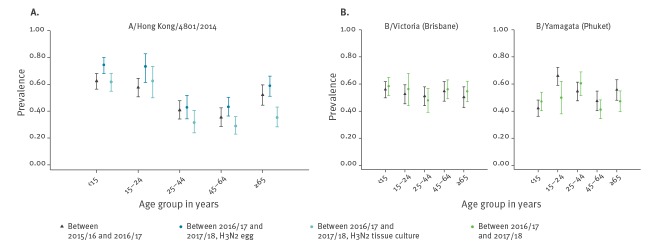
BackgroundIn the United Kingdom (UK), in recent influenza seasons, children are offered a quadrivalent live attenuated influenza vaccine (LAIV4), and eligible adults mainly trivalent inactivated vaccine (TIV).AimTo estimate the UK end-of-season 2017/18 adjusted vaccine effectiveness (aVE) and the seroprevalence in England of antibodies against influenza viruses cultured in eggs or tissue.MethodsThis observational study employed the test-negative case-control approach to estimate aVE in primary care. The population-based seroprevalence survey used residual age-stratified samples.ResultsInfluenza viruses A(H3N2) (particularly subgroup 3C.2a2) and B (mainly B/Yamagata/16/88-lineage, similar to the quadrivalent vaccine B-virus component but mismatched to TIV) dominated. All-age aVE was 15% (95% confidence interval (CI): -6.3 to 32) against all influenza; -16.4% (95% CI: -59.3 to 14.9) against A(H3N2); 24.7% (95% CI: 1.1 to 42.7) against B and 66.3% (95% CI: 33.4 to 82.9) against A(H1N1)pdm09. For 2-17 year olds, LAIV4 aVE was 26.9% (95% CI: -32.6 to 59.7) against all influenza; -75.5% (95% CI: -289.6 to 21) against A(H3N2); 60.8% (95% CI: 8.2 to 83.3) against B and 90.3% (95% CI: 16.4 to 98.9) against A(H1N1)pdm09. For ≥ 18 year olds, TIV aVE against influenza B was 1.9% (95% CI: -63.6 to 41.2). The 2017 seroprevalence of antibody recognising tissue-grown A(H3N2) virus was significantly lower than that recognising egg-grown virus in all groups except 15-24 year olds.ConclusionsOverall aVE was low driven by no effectiveness against A(H3N2) possibly related to vaccine virus egg-adaption and a new A(H3N2) subgroup emergence. The TIV was not effective against influenza B. LAIV4 against influenza B and A(H1N1)pdm09 was effective.
Keywords: influenza vaccine effectiveness.
Conflict of interest statement
Figures
References
-
- Hakin B, Cosford P, Harvey F. The flu immunisation programme 2013/14– extension to children. London: Department of Health; 26 Jul 2013. Available from: https://www.gov.uk/government/uploads/system/uploads/attachment_data/fil...
-
- Public Health England, Department of Health. Flu Plan Winter. 2017-18. London: NHS England; March 2017. Available from: https://assets.publishing.service.gov.uk/government/uploads/system/uploa...
-
- World Health Organization (WHO). WHO recommended composition for 2017/18 Northern hemisphere influenza season. Geneva: WHO; 2 March 2017. Available from: https://www.who.int/influenza/vaccines/virus/recommendations/2017_18_nor...
-
- Pebody R, Warburton F, Ellis J, Andrews N, Potts A, Cottrell S, et al. Effectiveness of seasonal influenza vaccine for adults and children in preventing laboratory-confirmed influenza in primary care in the United Kingdom: 2015/16 end-of-season results. Euro Surveill. 2016;21(38):30348. 10.2807/1560-7917.ES.2016.21.38.30348 - DOI - PMC - PubMed
Publication types
MeSH terms
Substances
LinkOut - more resources
Full Text Sources
Medical