Review
. 2019 Sep 13;63(3):297-312.
doi: 10.1042/EBC20180071. Print 2019 Sep 13.

Basement membrane collagens and disease mechanisms

Affiliations
Review

Basement membrane collagens and disease mechanisms

Anna Gatseva et al. Essays Biochem. .

Abstract

Basement membranes (BMs) are specialised extracellular matrix (ECM) structures and collagens are a key component required for BM function. While collagen IV is the major BM collagen, collagens VI, VII, XV, XVII and XVIII are also present. Mutations in these collagens cause rare multi-systemic diseases but these collagens have also been associated with major common diseases including stroke. Developing treatments for these conditions will require a collective effort to increase our fundamental understanding of the biology of these collagens and the mechanisms by which mutations therein cause disease. Novel insights into pathomolecular disease mechanisms and cellular responses to these mutations has been exploited to develop proof-of-concept treatment strategies in animal models. Combined, these studies have also highlighted the complexity of the disease mechanisms and the need to obtain a more complete understanding of these mechanisms. The identification of pathomolecular mechanisms of collagen mutations shared between different disorders represent an attractive prospect for treatments that may be effective across phenotypically distinct disorders.

Keywords: collagen; extracellular matrix; genetics; model organisms; molecular basis of health and disease; molecular mechanisms.


Conflict of interest statement

The authors declare that there are no competing interests associated with the manuscript.

Figures
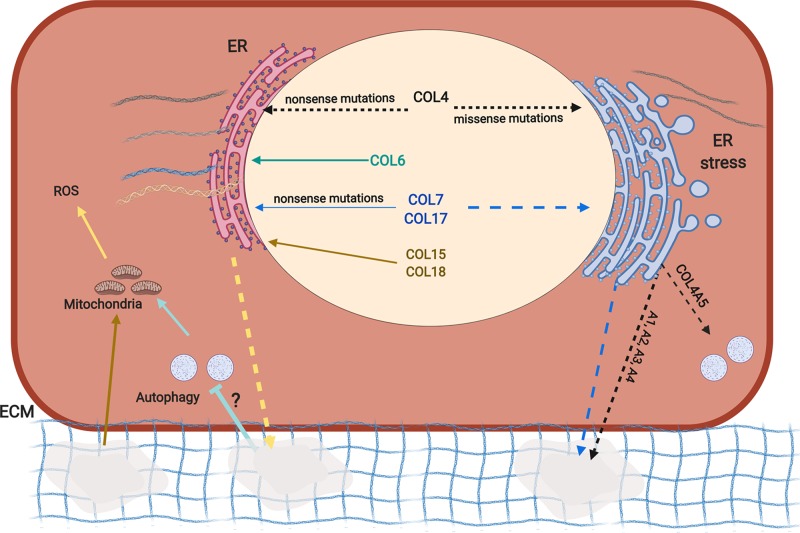
Figure 1
Figure 1. Overview of disease mechanisms caused by mutations in BM collagens
Collagen IV (COL4, black arrows) proteins harbouring nonsense mutations are processed in the ER, resulting in reduced secretion of proteins that are incorporated in the ECM, causing matrix defects (indicated by holes). Missense mutations in collagen IV and VII (COL7) can result in their ER retention and ER stress, and subsequent reduction in secretion (dashed arrows). COL4A5 mutations can also induce autophagy. Mutant collagen IV may also be incorporated in the ECM, resulting in BM defects. Nonsense mutations in collagen VI (COL6), VII (COL7), XVII (COL17), XV (COL15) and XVIII (COL18) (solid arrows) do not result in ER retention but rather in reduced incorporation in the ECM (yellow dashed arrow). Matrix defects resulting from COL6 mutations (light green) lead to failure to induce autophagy (via an as yet unknown mechanism) and result in mitochondrial defects and production of reactive oxygen species (ROS). Matrix defects, resulting from COL15 deficiency (brown arrow) also cause mitochondrial defects and ROS production.
Figure 2
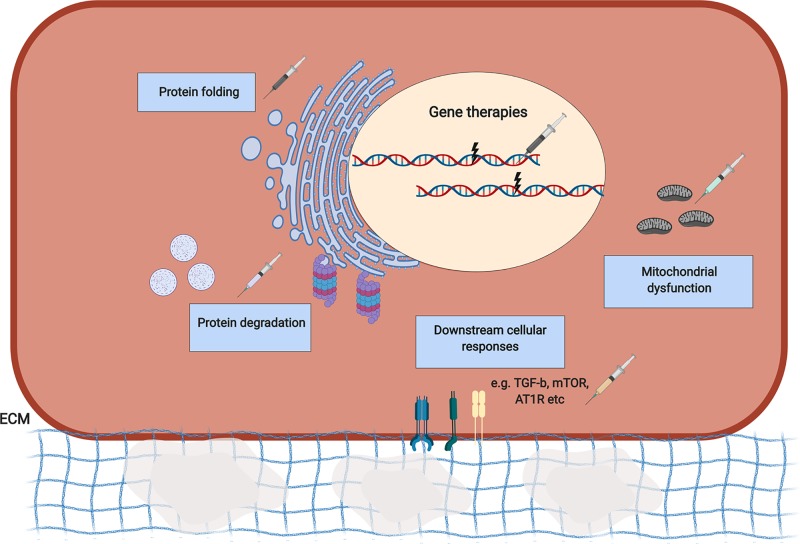
Figure 2. Overview of therapeutic strategies for BM collagen disorders
Gene therapy approaches have been implemented to silence disease alleles of COL6A1 and COL7A1 mutations using AONs and siRNAs. RNA trans-splicing strategies have also been implemented. Targeted pathomolecular effects of mutations include intracellular retained misfolded proteins and ER stress, which has been used for collagen IV mutations via chemical chaperones to increase protein folding and increase secretion of proteins. Additionally, promoting autophagy and the proteasome may promote degradation of misfolded proteins. Autophagy and mitochondrial defects due to COL6A1/COL15A1 mutations have also been targeted pharmacologically and through diet. As an example of targeting downstream cellular responses or signalling to modulate disease, TGF-β signalling has been targeted in epidermolysis bullosa due to COL7A1 mutations. For a more detailed overview of therapeutic strategies, we refer the reader to Table 2. Abbreviation: AON, antisense oligonucleotide.

References

    1. Randles M.J., Humphries M.J. and Lennon R. (2017) Proteomic definitions of basement membrane composition in health and disease. Matrix Biol. 57-58, 12–28 10.1016/j.matbio.2016.08.006 - DOI - PubMed
    1. Ishikawa Y., Ito S., Nagata K., Sakai L.Y. and Bächinger H.P. (2016) Intracellular mechanisms of molecular recognition and sorting for transport of large extracellular matrix molecules. Proc. Natl. Acad. Sci. U.S.A. 113, E6036–E6044 10.1073/pnas.1609571113 - DOI - PMC - PubMed
    1. Chew C. and Lennon R. (2018) Basement membrane defects in genetic kidney diseases. Front. Pediatrics 6, 1–16, 10.3389/fped.2018.00011 - DOI - PMC - PubMed
    1. Jeanne M. and Gould D.B. (2017) Genotype-phenotype correlations in pathology caused by collagen type IV alpha 1 and 2 mutations. Matrix Biol. 57–58, 29–44 10.1016/j.matbio.2016.10.003 - DOI - PMC - PubMed
    1. Mao M., Alavi M.V., Labelle-Dumais C. and Gould D.B. (2015) Type IV collagens and basement membrane diseases: cell biology and pathogenic mechanisms. Curr. Top. Membr. 76, 61–116 - PubMed

Publication types

Substances