Exposure to Polybrominated Diphenyl Ethers and a Polybrominated Biphenyl and Risk of Thyroid Cancer in Women: Single and Multi-Pollutant Approaches
- PMID: 31387967
- PMCID: PMC6774868
- DOI: 10.1158/1055-9965.EPI-19-0526
Exposure to Polybrominated Diphenyl Ethers and a Polybrominated Biphenyl and Risk of Thyroid Cancer in Women: Single and Multi-Pollutant Approaches
Abstract
Background: Thyroid cancer incidence is the most rapidly increasing malignancy; rates are three times higher in women than men. Thyroid hormone-disrupting flame-retardant chemicals, including polybrominated diphenyl ethers (PBDE) and polybrominated biphenyls (PBB), may contribute to this trend.
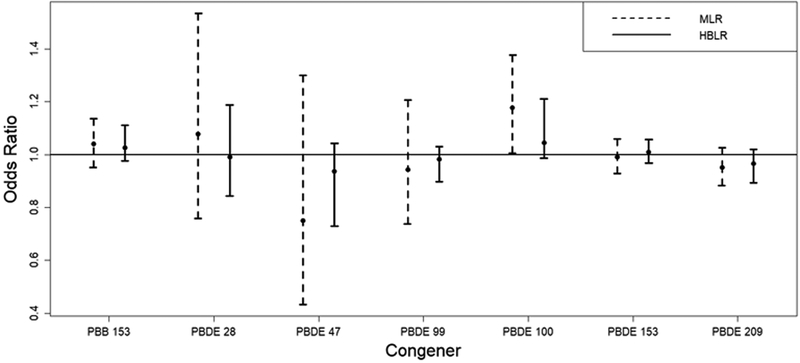
Methods: We investigated the relationship between PBDE/PBB exposure and papillary thyroid cancer (PTC) in 250 incident female papillary thyroid cancer cases and 250 female controls frequency-matched on age. Interviews and postdiagnostic serum samples were collected from 2010 to 2013. Serum samples were analyzed for 11 congeners. We calculated ORs and 95% confidence intervals (95% CI) using single-pollutant logistic regression models for continuous and categorical lipid-adjusted serum concentrations of PBDE/PBB, adjusted for age, alcohol consumption, and education. We applied three multi-pollutant approaches [standard multipollutant regression models, hierarchical Bayesian logistic regression modeling (HBLR), principal components analysis (PCA)] to investigate associations with PBDE/PBB mixtures.
Results: In single-pollutant models, a decreased risk was observed at the highest (>90th percentile) versus lowest (<median) category of BDE-209 concentrations (OR, 0.47; 95% CI, 0.23-0.98); an elevated PTC risk was observed at the highest versus lowest category of BB-153 concentrations (OR, 1.81; 95% CI, 0.96-3.39). In standard multi-pollutant models, an interquartile range increase in BDE-100 concentrations was associated with increased PTC risk (OR, 1.18; 95% CI, 1.01-1.38). HBLR and PCA yielded no statistically significant results.
Conclusions: Our results using single- and multi-pollutant modeling do not generally support a positive association with PBDE/PBB and PTC risk.
Impact: Prospective studies with more advanced statistical approaches to analyze mixtures and populations with higher exposures could reveal new insights.
©2019 American Association for Cancer Research.
Conflict of interest statement
Conflict of interest:
The authors declare no conflicts of interest.
Figures
References
-
- Howlader NNA, Krapcho M, Miller D, Bishop K, Kosary CL, Yu M, Ruhl J, Tatalovich Z, Mariotto A, Lewis DR, Chen HS, Feuer EJ, Cronin KA (eds). SEER Cancer Statistics Review, 1975–2014. Bethesda, MD: National Cancer Institute; 2017.
-
- Noone AMHN, Krapcho M, Miller D, Brest A, Yu M, Ruhl J, Tatalovich Z, Mariotto A, Lewis DR, Chen HS, Feuer EJ, Cronin KA (eds). SEER Cancer Statistics Review, 1975–2015. Bethesda, MD: National Cancer Institute; April 2018.
-
- Howlader NNA, Krapcho M, Garshell J, Miller D, Altekruse SF, Kosary CL, Yu M, Ruhl J, Tatalovich Z, Mariotto A, Lewis DR, Chen HS, Feuer EJ, Cronin KA(eds). SEER Cancer Statistics Review, 1975–2011, Bethesda, MD: 2014.
-
- Siegel RL, Miller KD, Jemal A. Cancer statistics, 2019. CA: a cancer journal for clinicians 2019, 69, (1), 7–34. - PubMed
Publication types
MeSH terms
Substances
Grants and funding
LinkOut - more resources
Full Text Sources
Medical