. 2019 Aug 6;9(1):11406.
doi: 10.1038/s41598-019-47850-w.

Transcriptomic analysis of insecticide resistance in the lymphatic filariasis vector Culex quinquefasciatus

Affiliations

Transcriptomic analysis of insecticide resistance in the lymphatic filariasis vector Culex quinquefasciatus

Walter Fabricio Silva Martins et al. Sci Rep. .

Abstract

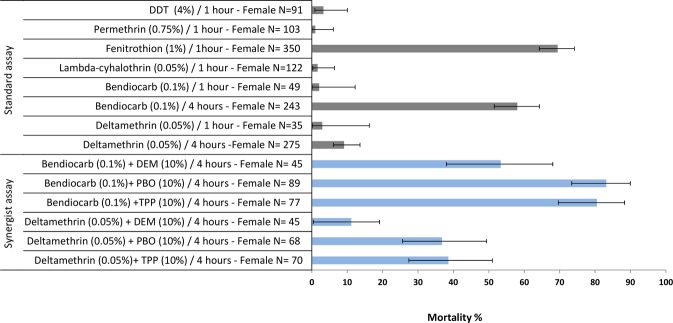
Culex quinquefasciatus plays an important role in transmission of vector-borne diseases of public health importance, including lymphatic filariasis (LF), as well as many arboviral diseases. Currently, efforts to tackle C. quinquefasciatus vectored diseases are based on either mass drug administration (MDA) for LF, or insecticide-based interventions. Widespread and intensive insecticide usage has resulted in increased resistance in mosquito vectors, including C. quinquefasciatus. Herein, the transcriptome profile of Ugandan bendiocarb-resistant C. quinquefasciatus was explored to identify candidate genes associated with insecticide resistance. High levels of insecticide resistance were observed for five out of six insecticides tested, with the lowest mortality (0.97%) reported to permethrin, while for DDT, lambdacyhalothrin, bendiocarb and deltamethrin the mortality rate ranged from 1.63-3.29%. Resistance to bendiocarb in exposed mosquitoes was marked, with 2.04% mortality following 1 h exposure and 58.02% after 4 h. Genotyping of the G119S Ace-1 target site mutation detected a highly significant association (p < 0.0001; OR = 25) between resistance and Ace1-119S. However, synergist assays using the P450 inhibitor PBO, or the esterase inhibitor TPP resulted in markedly increased mortality (to ≈80%), suggesting a role of metabolic resistance in the resistance phenotype. Using a novel, custom 60 K whole-transcriptome microarray 16 genes significantly overexpressed in resistant mosquitoes were detected, with the P450 Cyp6z18 showing the highest differential gene expression (>8-fold increase vs unexposed controls). These results provide evidence that bendiocarb resistance in Ugandan C. quinquefasciatus is mediated by both target-site mechanisms and over-expression of detoxification enzymes.


Conflict of interest statement

The authors declare no competing interests.

Figures

Figure 1
Figure 1
Overview of Culex quinquefasciatus whole-transcriptome analysis. (a) Design of the 8 × 60 K Agilent microarray. CpipJ1: consensus gene set of the automated gene prediction from the C. quinquefasciatus Johannesburg strain genome sequence. EST: expressed sequence tags. GSTD1: Glutathione S transferase D1. CV probe: coefficient of variation. (b) Interwoven hybridization loop design for comparison between bendiocarb exposed and non-exposed Ugandan field-collected mosquitoes and the TPRI susceptible strain. Circles represent pools of 10 females. C: Uganda non-exposed mosquitoes (sympatric control), R: Uganda Resistant mosquitoes, TPRI (Tropical Pesticides Research Institute): C. quinquefasciatus susceptible strain from Tanzania.
Figure 2
Figure 2
Insecticide susceptibility status of C. quinquefasciatus from Tororo (Uganda). Bioassay results following exposure to WHO insecticide treated papers at standard conditions and effect of insecticide synergists on the susceptibility status. Grey and blue bars represent WHO standard and synergists bioassay, respectively. Error bars represent 95% CI. PBO: piperonyl butoxide, DEM: diethyl maleate, TPP: triphenyl phosphate.
Figure 3
Figure 3
Ace1-119S allele and bendiocarb association test in C. quinquefasciatus. (a) Ace-1 allelic (b) genotypic frequencies (c) association of the Ace-1 genotype and bendiocarb (0.1%)/4 hours resistant phenotype.
Figure 4
Figure 4
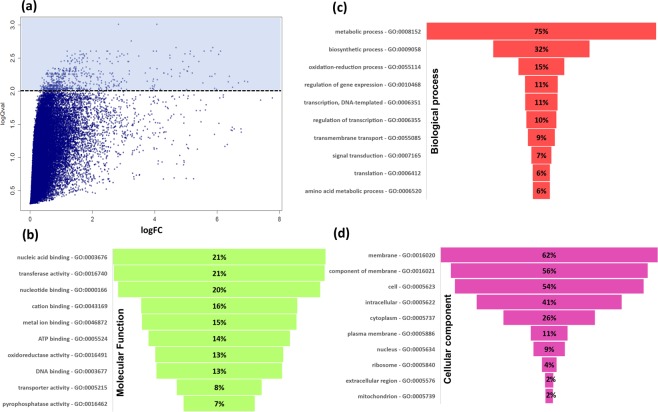
Candidate genes differentially transcribed in C. quinquefasciatus bendiocarb selected mosquitoes. (a) Changes of gene expression between the three groups (Uganda exposed and un-exposed and TPRI) presented as a volcano plot. (bd) Are sunburst plots showing representative top 10 GO term clusters (molecular function, biological process and cellular component, respectively) of differentially expressed transcripts with FDR > 2.0.
Figure 5
Figure 5
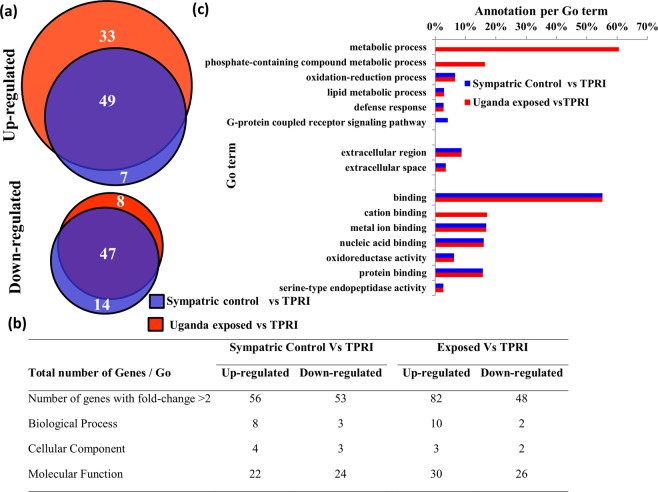
Transcriptomic profile of differentially expressed genes with fold-change >2 in Uganda exposed and sympatric mosquitoes compared to TPRI. (a) Venn diagram showing the overlap of up- and down-regulated transcripts between the three groups. (b) Comparison of the number of GO terms identified by each pair-wise comparison. (c) GO term enrichment of up-regulated transcripts between the groups with frequency higher than 2%.
Figure 6
Figure 6
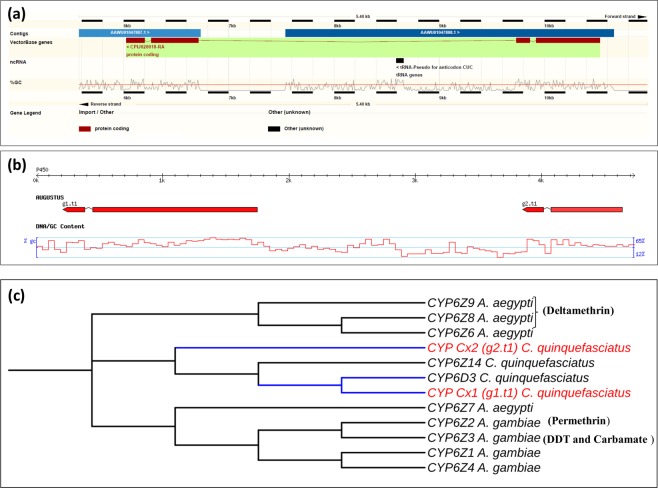
Cyp6z16 and cyp6z18 predicted gene structure and annotation. (a) output of the VectorBase genome Browser suggesting a gene architecture with four exons and three introns. Figure adapted from VectorBase (b) Schematic representation of CPIJ020018 after re-annotation using Augustus software, indicating two distinct genes here named cyp6z18 (g1.t1) and cyp6z16 (g2.t1). (c) Unrooted distance neighbour joining tree showing phylogenetic relationship of the predicted gene cyp6z18 from C. quinquefasciatus to Aedes aegypti and An. gambiae cytochrome P450s from the CYP6 gene family. Blue branches and genes highlighted in red represents the relationship of the re-annotated gene structure.

References

    1. Bockarie MJ, Pedersen EM, White GB, Michael E. Role of vector control in the global program to eliminate lymphatic filariasis. Annu. Rev. Entomol. 2009;54:469–487. doi: 10.1146/annurev.ento.54.110807.090626. - DOI - PubMed
    1. de Souza DK, et al. Diversity and transmission competence in lymphatic filariasis vectors in West Africa, and the implications for accelerated elimination of Anopheles-transmitted filariasis. Parasit. Vectors. 2012;5:259. doi: 10.1186/1756-3305-5-259. - DOI - PMC - PubMed
    1. Katiyar D, Singh KL. Filariasis: current status, treatment and recent advances in drug development. Curr. Med. Chem. 2011;18:2174–2185. doi: 10.2174/092986711795656234. - DOI - PubMed
    1. Rebollo MP, Bockarie MJ. Toward the elimination of lymphatic filariasis by 2020: treatment update and impact assessment for the endgame. Expert Rev. Anti. Infect. Ther. 2013;11:723–731. doi: 10.1586/14787210.2013.811841. - DOI - PubMed
    1. van den Berg H, Kelly-Hope LA, Lindsay SW. Malaria and lymphatic filariasis: the case for integrated vector management. The Lancet Infect. Diseases. 2013;13:89–94. doi: 10.1016/S1473-3099(12)70148-2. - DOI - PubMed

Publication types

MeSH terms