


The reliability of the ankle brachial index: a systematic review
- PMID: 31388357
- PMCID: PMC6679535
- DOI: 10.1186/s13047-019-0350-1
The reliability of the ankle brachial index: a systematic review
Abstract
Background: The ankle brachial index (ABI) is widely used in clinical practice as a non-invasive method to detect the presence and severity of peripheral arterial disease (PAD). Current guidelines suggest that it should be used to monitor potential progression of PAD in affected individuals. As such, it is important that the test is reliable when used for repeated measurements, by the same or different health practitioners. This systematic review aims to examine the literature to evaluate the inter- and intra-rater reliability of the ABI.
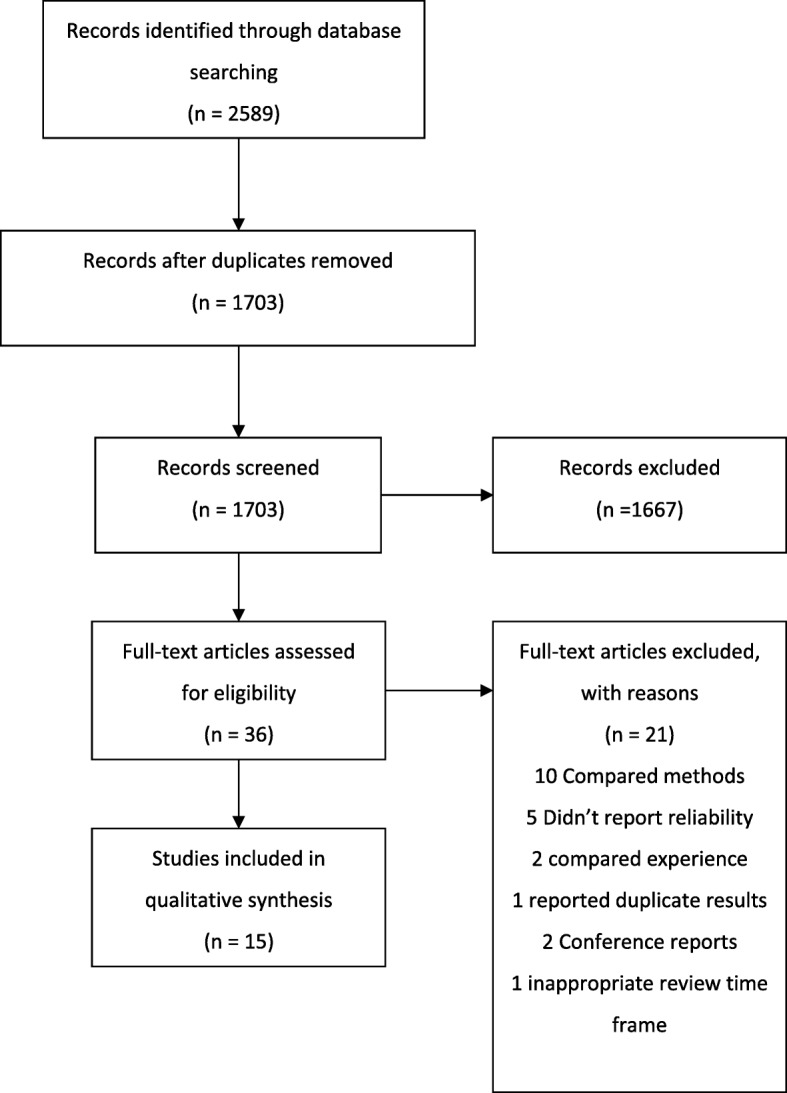
Methods: A systematic search of MEDLINE, EMBASE and CINAHL Complete was conducted to 20 January 2019. Two authors independently reviewed and selected relevant studies and extracted the data. Methodological quality was determined using the Quality Appraisal of Reliability (QAREL) Checklist.
Results: Fifteen studies of ABI reliability in a range of patient populations were identified as suitable for inclusion in the review: seven considered inter-rater reliability, four intra-rater reliability, and four studies evaluated both inter- and intra-rater reliability. Inter-rater reliability was found to be highly variable, with intraclass correlation coefficients (ICC's) ranging from poor to excellent (ICC 0.42-1.00), while intra-rater also demonstrated considerable variation, with ICCs from 0.42-0.98. Meta-analysis was not possible due to the lack of statistical information reported.
Conclusions: Results of included studies suggest the inter- and intra-tester reliability of the ABI is acceptable. However, inconsistencies in obtaining systolic pressure measurements, calculating ABI values, and incomplete reporting of methodologies and statistical analysis make it difficult to determine the validity of the results of included studies. Further research, with more consistent reliability methodology, statistical analysis and reporting conducted in populations at risk of PAD is needed to conclusively determine the ABI reliability.
Keywords: Ankle brachial index; Lower extremity artery disease; Peripheral arterial disease; Reliability; Repeatability; Reproducibility.
Conflict of interest statement
Competing interestsThe authors declare that they have no competing interests.
References
-
- Meijer WT, Hoes AW, Rutgers D, Bots ML, Hofman A, Grobbee DE. Peripheral arterial disease in the elderly. Rotterdam Stud. 1998;18(2):185–192. - PubMed
-
- Norman PE, Eikelboom JW, Hankey GJ. Peripheral arterial disease: prognostic significance and prevention of atherothrombotic complications. Med J Aust. 2004;181(3):150–154. - PubMed
-
- Bonham PA. Get the LEAD out: noninvasive assessment for lower extremity arterial disease using ankle brachial index and toe brachial index measurements. J Wound Ostomy and Continence Nurs. 2006;33(1):30–41. - PubMed
-
- American Diabetes Association Peripheral arterial disease in people with diabetes. Diabetes Care. 2003;26(12):3333–3341. - PubMed
-
- Jude EB, Oyibo SO, Chalmers N, Boulton AJM. Peripheral arterial disease in diabetic and nondiabetic patients: a comparison of severity and outcome. Diabetes Care. 2001;24(8):1433–1437. - PubMed
Publication types
MeSH terms
LinkOut - more resources
Full Text Sources
Medical
