


Added value of amyloid PET in individualized risk predictions for MCI patients
- PMID: 31388557
- PMCID: PMC6667768
- DOI: 10.1016/j.dadm.2019.04.011
Added value of amyloid PET in individualized risk predictions for MCI patients
Abstract
Introduction: To construct a prognostic model based on amyloid positron emission tomography (PET) to predict clinical progression in individual patients with mild cognitive impairment (MCI).
Methods: We included 411 MCI patients from the Alzheimer's Disease Neuroimaging Initiative. Prognostic models were constructed with Cox regression with demographics, magnetic resonance imaging, and/or amyloid PET to predict progression to Alzheimer's disease dementia. The models were validated in the Amsterdam Dementia Cohort.
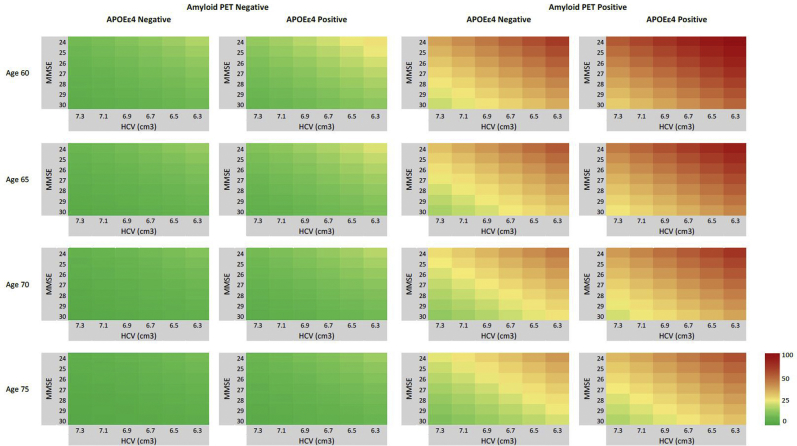
Results: The combined model (Harrell's C = 0.82 [0.78-0.86]) was significantly superior to demographics (β = 0.100, P < .001), magnetic resonance imaging (β = 0.037, P = .011), and PET only models (β = 0.053, P = .003).The models can be used to calculate individualized risk, for example, a female MCI patient (age = 60, APOE ε4 positive, Mini-Mental State Examination = 25, hippocampal volume = 5.8 cm3, amyloid PET positive) has 35% (19-57) risk in one year and 85% (64-97) risk in three years. Model performances in the Amsterdam Dementia Cohort were reasonable.
Discussion: The present study facilitates the interpretation of an amyloid PET result in the context of a patient's own characteristics and clinical assessment.
Keywords: Alzheimer's disease; Amyloid positron emission tomography; Biomarkers; MCI; Progression.
Figures
References
-
- Klunk W.E., Engler H., Nordberg A., Wang Y., Blomqvist G., Holt D.P. Imaging brain amyloid in Alzheimer's disease with Pittsburgh Compound-B. Ann Neurol. 2004;55:306–319. - PubMed
-
- Johnson K.A., Minoshima S., Bohnen N.I., Donohoe K.J., Foster N.L., Herscovitch P., Alzheimer's Association. Society of Nuclear Medicine and Molecular Imaging. Amyloid Imaging Taskforce Appropriate use criteria for amyloid PET: a report of the Amyloid Imaging Task Force, the Society of Nuclear Medicine and Molecular Imaging, and the Alzheimer's Association. Alzheimers Dement. 2013;9 e-1-e-16. - PMC - PubMed
LinkOut - more resources
Full Text Sources
Miscellaneous