


Care Settings and Clinical Characteristics of Older Adults with Moderately Severe Dementia
- PMID: 31389002
- PMCID: PMC6732035
- DOI: 10.1111/jgs.16054
Care Settings and Clinical Characteristics of Older Adults with Moderately Severe Dementia
Abstract
Objectives: Little population-level evidence exists to guide the development of interventions for people with dementia in non-nursing home settings. We hypothesized people living at home with moderately severe dementia would differ in social, functional, and medical characteristics from those in either residential care or nursing home settings.
Design: Retrospective cohort study using pooled data from the National Health and Aging Trends Study, an annual survey of a nationally representative sample of Medicare beneficiaries.
Setting: US national sample.
Participants: Respondents newly meeting criteria for incident moderately severe dementia, defined as probable dementia with functional impairment: 728 older adults met our definition between 2012 and 2016.
Measurements: Social characteristics examined included age, sex, race/ethnicity, country of origin, income, educational attainment, partnership status, and household size. Functional characteristics included help with daily activities, falls, mobility device use, and limitation to home or bed. Medical characteristics included comorbid conditions, self-rated health, hospital stay, symptoms, and dementia behaviors.
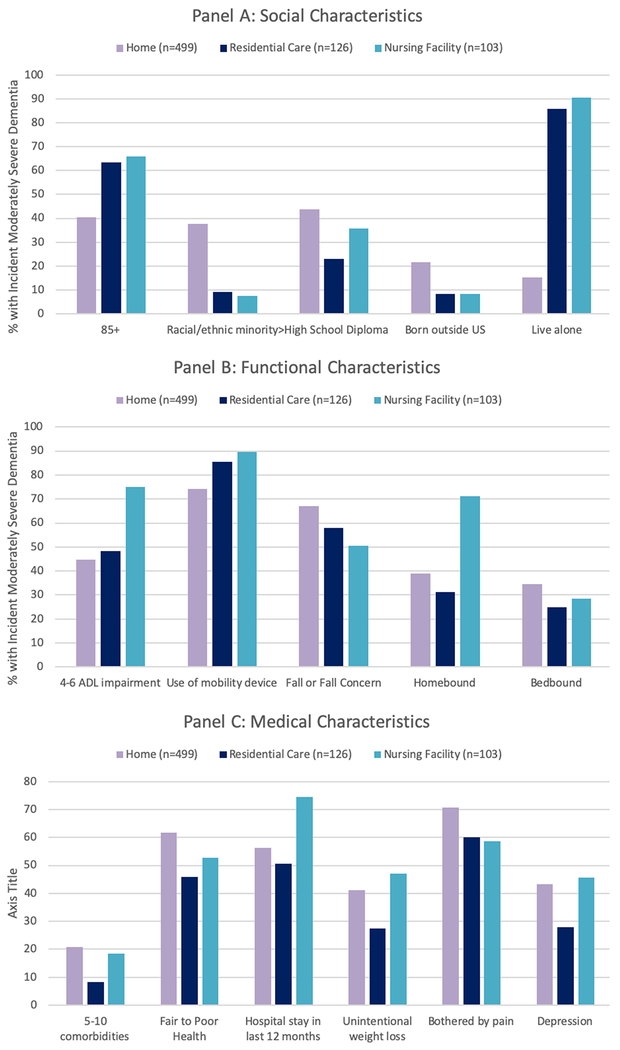
Results: Extrapolated to the population, an estimated 3.3 million older adults developed incident moderately severe dementia between 2012 and 2016. Within this cohort, 64% received care at home, 19% in residential care, and 17% in a nursing facility. social, functional, and medical characteristics differed across care settings. Older adults living at home were 2 to 5 times more likely to be members of disadvantaged populations and had more medical needs: 71% reported bothersome pain compared with 60% in residential care or 59% in nursing homes.
Conclusion: Over a 5-year period, 2.1 million people lived at home with incident moderately severe dementia. People living at home had a higher prevalence of demographic characteristics associated with systematic patterns of disadvantage, more social support, less functional impairment, worse health, and more symptoms compared with people living in residential care or nursing facilities. This novel study provides insight into setting-specific differences among people with dementia. J Am Geriatr Soc 67:1907-1912, 2019.
Keywords: care setting; dementia; disparities; home.
© 2019 The American Geriatrics Society.
Conflict of interest statement
Conflict of Interest:
The authors have no conflicts of interest.
Figures
Comment in
-
Through a Glass, Darkly: Data on Incident Moderately Severe Dementia.J Am Geriatr Soc. 2019 Sep;67(9):1777-1778. doi: 10.1111/jgs.16058. Epub 2019 Aug 7. J Am Geriatr Soc. 2019. PMID: 31389611 No abstract available.
References
-
- Alzheimer’s Association. 2018 Alzheimer’s disease facts and figures. Alzheimer’s & Dementia. 2018;14(3):367–429. https://www.alz.org/media/HomeOffice/Facts%20and%20Figures/facts-and-fig...
Publication types
MeSH terms
Grants and funding
- KL2 TR001870/TR/NCATS NIH HHS/United States
- K01 AG059831/AG/NIA NIH HHS/United States
- UCSF Hellman Fellows Award/International
- P01 AG066605/AG/NIA NIH HHS/United States
- K24 AG031155/AG/NIA NIH HHS/United States
- P30AG044281/Claude D. Pepper Older Americans Independence Center, University of California San Francisco/International
- L30 AG060590/AG/NIA NIH HHS/United States
- KL2TR001870/TR/NCATS NIH HHS/United States
- N/A/Tideswell Innovation and Implementation Center for Aging & Palliative Care Research (I-CAP)/International
- AF-3Q-09-2019-C/VA Quality Scholars Program funded through the VA Office of Academic Affiliations Department of Veterans Affairs, Veterans Health Administration/International
- National Palliative Care Research Center Junior Faculty Award/International
- P30 AG044281/AG/NIA NIH HHS/United States
- Atlantic Fellowship, Global Brain Health Institute/International
