


Review
doi: 10.1152/physiol.00012.2019.
CRISPR for Neuromuscular Disorders: Gene Editing and Beyond
Affiliations
- PMID: 31389773
- PMCID: PMC6863376
- DOI: 10.1152/physiol.00012.2019
Item in Clipboard
Review
CRISPR for Neuromuscular Disorders: Gene Editing and Beyond
Physiology (Bethesda).
.
Abstract
This is a review describing advances in CRISPR/Cas-mediated therapies for neuromuscular disorders (NMDs). We explore both CRISPR-mediated editing and dead Cas approaches as potential therapeutic strategies for multiple NMDs. Last, therapeutic considerations, including delivery and off-target effects, are also discussed.
Keywords: CRISPR/Cas; gene editing; gene therapy; muscular dystrophy; neuromuscular disorders.
Figures
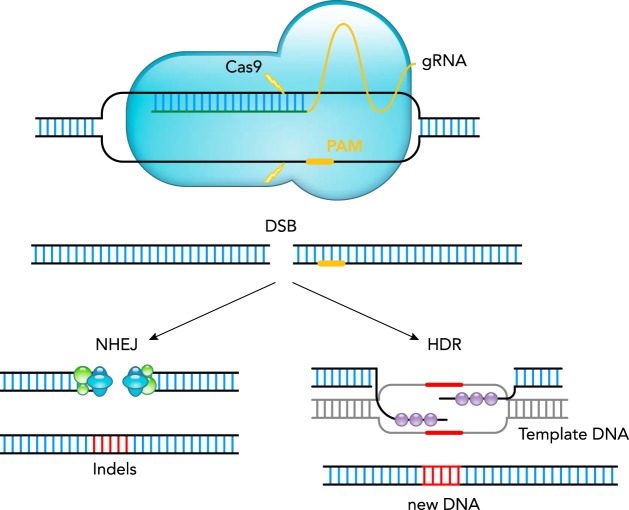
The CRISPR/Cas system for gene editing The CRISPR/Cas9 gene editing system consists of two components: the Cas9 endonuclease (shown in blue) and a guide RNA (gRNA), which is composed of a target spacer region for DNA binding (shown in green) and a scaffold region for binding to Cas9 (in yellow). The gRNA spacer sequence is designed to be homologous to a target site in the genome, which must have a 3′ protospacer adjacent motif (PAM) sequence. gRNA targeting results in Cas9 creating a double-stranded break (DSB) in the DNA 3 bp upstream of the PAM. The DSB can be repaired either through the cells endogenous repair, non-homologous end joining (NHEJ), which can sometimes result in small insertions or deletions (indels), or through homology-directed repair (HDR) to incorporate new DNA by addition of template DNA containing homology arms.
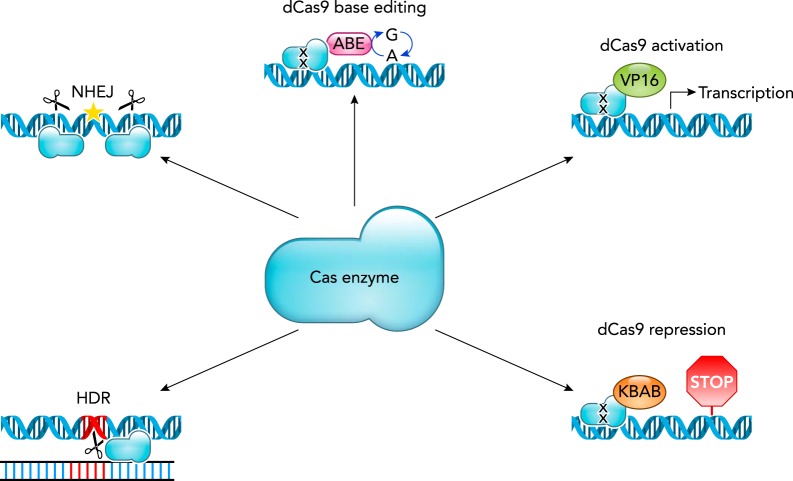
Therapeutic strategies that exploit the CRISPR/Cas system The CRISPR system has many applications. Some examples where it can be used to edit DNA, through NHEJ or HDR, or as an inactive targeting agent for base editing by fusion with an adenine base editor (ABE), with VP16 for gene activation, or with KRAB for gene repression are depicted. Inactivated Cas9 is represented by the black X on the protein.

Schematics of normal, DMD, and BMD genes and protein Representations of parts of the DMD gene, with blue boxes denoting exons (left) and corresponding dystrophin protein schematics (right). DMD mutations, often deletions of exons, disrupt the reading frame, preventing expression of dystrophin protein. BMD mutations are often in-frame, allowing for expression of an internally deleted but at least somewhat functional dystrophin.
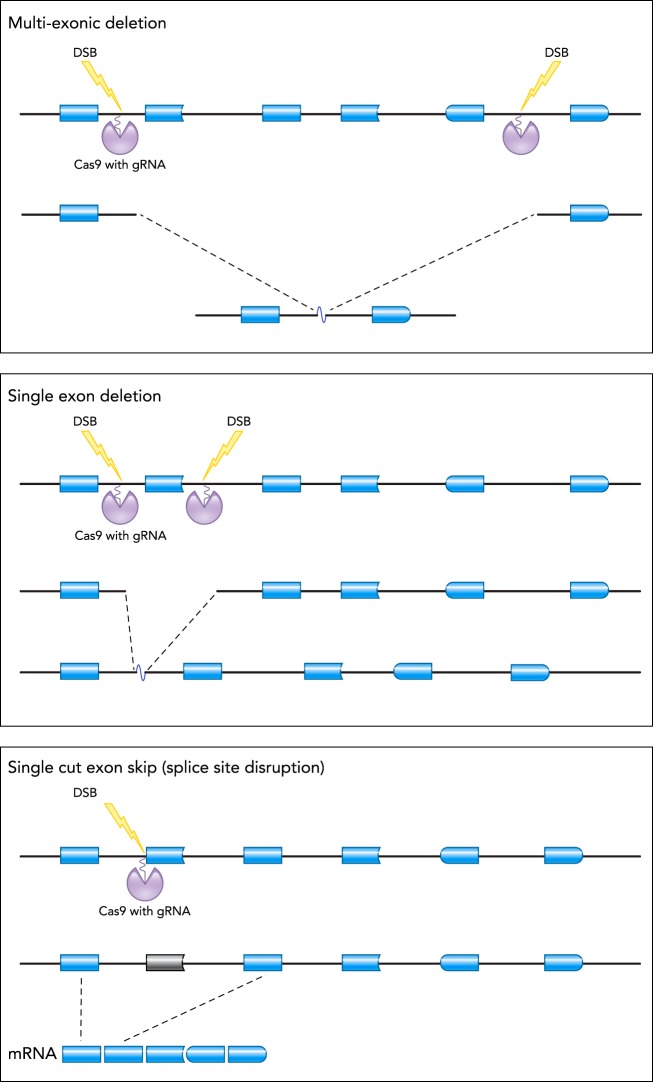
NHEJ-based CRISPR approaches for reframing DMD Different CRISPR/Cas9-mediated strategies that could use NHEJ to reframe the DMD gene are depicted. Top: a multi-exon deletion. Middle: a single exon deletion. Bottom: a single cut permanent exon skipping approach. A region of the DMD gene is shown by blue boxes (representing exons); Cas9 and its associated gRNA are shown in purple; and the corresponding double-stranded break (DSB) is represented by the yellow lightning bolt.
References
-
- Aartsma-Rus A, Singh KHK, Fokkema IFAC, Ginjaar IB, van Ommen G-J, den Dunnen JT, van der Maarel SM. Therapeutic exon skipping for dysferlinopathies? Eur J Hum Genet 18: 889–894, 2010. doi: 10.1038/ejhg.2010.4 . A corrigendum for this article is available at http://dx.doi.org/10.1038/ejhg.2010.43. - DOI - PMC - PubMed
-
- van Agtmaal EL, André LM, Willemse M, Cumming SA, van Kessel IDG, van den Broek WJAA, Gourdon G, Furling D, Mouly V, Monckton DG, Wansink DG, Wieringa B. CRISPR/Cas9-induced (CTG⋅CAG)n repeat instability in the myotonic dystrophy type 1 locus: implications for therapeutic genome editing. Mol Ther 25: 24–43, 2017. doi: 10.1016/j.ymthe.2016.10.014. - DOI - PMC - PubMed
-
- Akcakaya P, Bobbin ML, Guo JA, Malagon-Lopez J, Clement K, Garcia SP, Fellows MD, Porritt MJ, Firth MA, Carreras A, Baccega T, Seeliger F, Bjursell M, Tsai SQ, Nguyen NT, Nitsch R, Mayr LM, Pinello L, Bohlooly-Y M, Aryee MJ, Maresca M, Joung JK. In vivo CRISPR editing with no detectable genome-wide off-target mutations. Nature 561: 416–419, 2018. doi: 10.1038/s41586-018-0500-9. - DOI - PMC - PubMed
-
- Amoasii L, Hildyard JCW, Li H, Sanchez-Ortiz E, Mireault A, Caballero D, Harron R, Stathopoulou T-R, Massey C, Shelton JM, Bassel-Duby R, Piercy RJ, Olson EN. Gene editing restores dystrophin expression in a canine model of Duchenne muscular dystrophy. Science 362: 86–91, 2018. doi: 10.1126/science.aau1549. - DOI - PMC - PubMed
